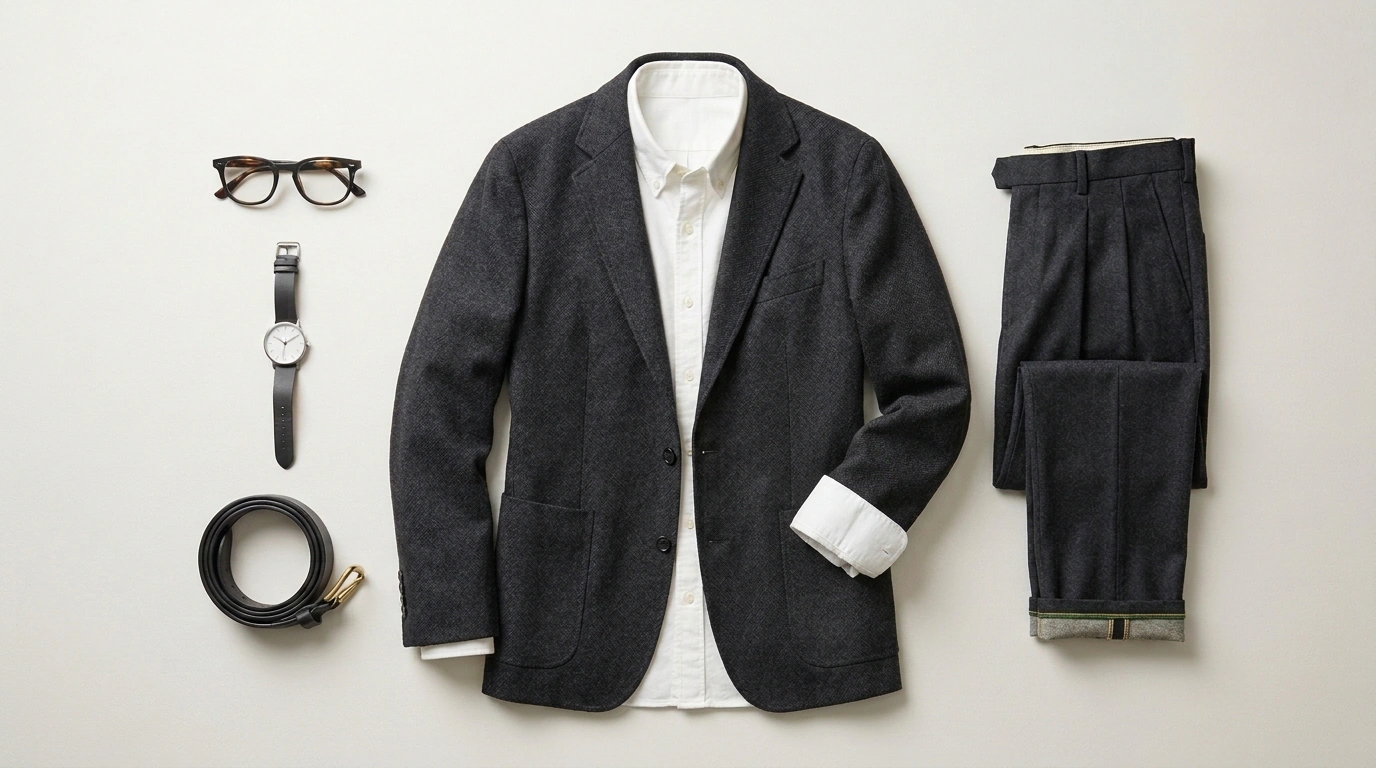
A plain shirt and basic chinos can upgrade your first impression in five seconds if five layers line up: haircut, glasses fit, top tailoring, trouser length, and a simple color scheme. No designer logos on your chest are needed. In a University of Hertfordshire study, 274 participants viewed photos of the same man—cropped below the face—for no more than five seconds. One photo showed an off-the-rack suit; the other showed a tailored fit. Even without seeing his face, sharp shoulder and waist fit immediately boosted ratings for confidence, success, flexibility, and perceived income. Tailoring didn't change perceived honesty, but it transformed first impressions.
Next comes the halo effect from the classic Dion, Berscheid, and Walster experiment: when someone looks neat and put-together, other people's brains automatically fill in a pleasant personality and career competence. A woman at a bar isn't walking around with a tape measure checking labels. She reads geometry in two seconds: if your sleeves billow, your pant cuffs bunch up like an accordion, and your glasses slide down past your eyebrows, the picture falls apart. Let's go through all five layers from top to bottom.
Layers One and Two: Haircut by Strand Length and Three Fit Points for Glasses
Walking into a barbershop often feels like a gamble: 'shorter on the sides, a bit off the top' ends in random results. Trying to guess your face shape from internet charts wastes time too. It is far more reliable to start from your actual hair length.
Stand in front of a mirror, grab a front strand of hair, and pull it straight down over your face. If the tip reaches your eyebrows or above, you have short hair. Low-effort cuts that work well here are a buzz cut (8 guard), a textured crop or French crop (short sides and back with textured top pushed forward into a short fringe), or a mod cut. If the strand lands between your eyebrow and lip, you are in medium-length territory: go for a messy fringe, curtains, blowout taper, mullet, shag cut, or taper / low fade. If the hair drops past your lip, it is long—long curtains or a long flow will sit best.
Glasses follow the same practical logic. Forget confusing face-shape rules: put on a frame and check three points.
First, your eyebrows. They should run smoothly along the top rim of the frame. A big gap breaks your proportions, while a frame that covers and 'cuts' across the brow is too large. Second, eye alignment near the bridge. When the inner rims sit too close to your nose bridge, your eyes look pulled toward the center. The bridge and lenses should frame your gaze evenly. Third, the cheekbone test: the outer edges of the frame should line up roughly with the widest part of your face at the cheekbones. Narrower than your cheekbones means too small; wider means too big. Hit three out of three and the frame fits great. Two out of three is passable, nothing special. One out of three—put it back on the shelf.
Layer Three: Top Fit, Sleeve Roll, and the V-Silhouette
In clothing fit, three anchor points build your silhouette: arms, waist, and leg length. Let's start with the upper body.
Fitted men's button-down shirt with clean shoulder and collar alignment (Source: Wikimedia Commons)
In a survey of over 1,700 people, women consistently rated well-developed arms and triceps as a major visual plus. You cannot build bigger arms the night before a date, yet a clean sleeve roll instantly shows your forearms and makes your arms look fuller.
The usual habit of rolling a cuff up three times slips down fast and looks messy. Use the Italian roll (master roll) instead. Unbutton both the cuff and the sleeve placket, fold the cuff up in one wide turn straight to your elbow crease, then fold the lower sleeve up once more over that first fold. The edge stays neat, symmetrical, and locked in place all night.
The biggest trap here is an off-the-rack shirt with baggy sleeves. Roll up a loose sleeve, and fabric puffs out like a balloon around your bicep. The same thing happens at the waist. Research points to a waist-to-shoulder ratio around 0.6 as a classic V-taper benchmark. Extra fabric around your midsection turns your torso into a square box even if you are in shape. When trying on shirts, make sure the shoulder seam sits right on the edge of your shoulder and the waist doesn't billow. If a shirt fits your shoulders well but feels loose around the waist, take it to a local tailor: taking in the side seams and slimming the sleeves costs very little and makes a basic shirt look custom-made.
Layer Four: Trouser Line, Five Core Shoes, and the Accessory Limit
The third anchor point is leg length. What matters is the visual proportion of your legs to your torso, not the height on your ID—longer-looking legs make your whole frame look leaner and sharper.
Trouser length over shoes comes in three styles: stacked (fabric bunches at the ankle), full break (one heavy horizontal crease), and no-break (the hem lightly kisses the top of the shoe with zero fold). No-break lengthens your legs the most because any bunching cuts your vertical line. To stop guessing in fitting rooms, measure your trouser outseam: run a tape measure down the outside of your leg from your hip bone to the bottom of your ankle bone. With that number, buying pants or asking a tailor for a hem becomes effortless.
Clean trouser lines need solid shoes underneath. Five pairs cover an entire core wardrobe: loafers, low-profile gum-sole sneakers (think GATs / German Army Trainers), athletic trainers, Chelsea boots, and a character boot (cowboy boots or classic work boots).
Classic leather penny loafers, one of five core pairs in a men's wardrobe (Source: Wikimedia Commons)
Most mistakes happen where shoe bulk meets pant leg width—like pairing chunky trainers with skinny trousers. Keep this quick cheat sheet handy.
| Shoe Style | Best Trouser Cut |
|---|---|
| Slim low-profile sneakers | Straight-leg trousers or shorts |
| Work boots | Bootcut or wide-leg trousers |
| Chunky athletic sneakers | Baggy jeans or wide-leg trousers |
| Chelsea boots | Straight-leg jeans or straight dress trousers |
The final detail of this layer is accessories. A solid men's lineup has ten options: chain, bracelet, rings, watch, bag, backpack, glasses, hat, cardholder, and cologne. Owning six or more gives you variety, but wearing them all at once ruins the look. Stick to one strict rule: no more than three visible accessories at a time. Glasses, bag, and chain look sharp. Cap, bracelet, and backpack look clean too. Adding a fourth and fifth piece starts cluttering the outfit.
Layer Five: Five Color Formulas Instead of Endless All-Black
It is easy to live in all-black outfits because black-on-black is hard to mess up. The downside is obvious: you look the same every single day. To build sharp outfits in a minute without an artist's eye, rely on five simple formulas.
First, the sandwich method: your top layer (or base shirt) and shoes match in color, framing a contrasting middle. Two easy combos: white tee, blue jeans, navy jacket, and white sneakers; or white tee, black trousers, black jacket, and black loafers.
Second, color blocking: three calm colors used in clean, solid blocks with no busy prints. For example: navy polo, beige chinos, and brown leather loafers.
Third, warm tonal layering in a soft earthy palette. A cream long-sleeve, dark jeans, tan jacket, and brown boots flow together smoothly without harsh contrast.
Fourth, an achromatic outfit when you want a dark look without flat 'all-black.' Mix shades of black and gray: gray sweater, black trousers, charcoal coat, and black Chelsea boots. Mixing tones and textures adds instant depth.
Fifth, a monochrome outfit built from light shades of one color: light linen shirt, beige trousers, cream jacket, and light suede loafers. Against a sea of dark city coats, a light monochrome look stands out immediately and looks far more expensive than it cost.