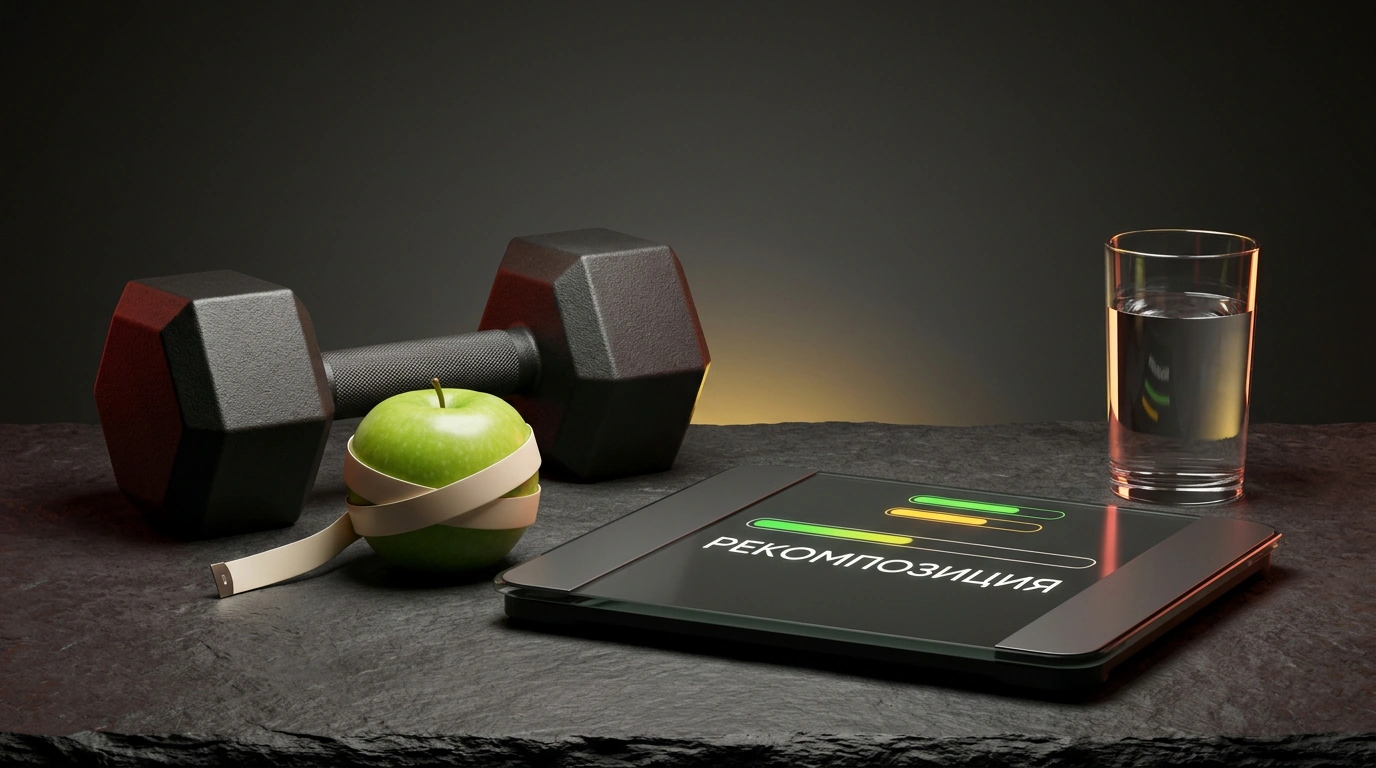
In the first quarter of 2026, Russian pharmacies sold 17 billion RUB worth of semaglutide and tirzepatide weight-loss medications—more than double the previous year's revenue. Among American men considering these injections, heart health is cited twice as often as wanting a better number on the scale. Yet the SURMOUNT-1 clinical trial revealed a sobering catch: when weight drops from suppressed appetite without strength training, your body burns a sizable chunk of muscle right alongside fat.
That is where judging your shape by the scale alone breaks down. Guys spend years chasing a lower weight or riding the 'bulk all winter, crash-diet every spring' rollercoaster, only to still look soft in the mirror. How a plain T-shirt drapes on you depends on your ratio of muscle to fat. Shifting that ratio is called body recomposition. Let's cut through the myths to see who gets the best results, where clear medical lines sit for weight-loss drugs, and what three habits stick with you for life.
Why 85 Kilograms on the Scale Tells You Nothing About Your Shape
Picture two guys standing side by side: both are 180 cm tall and both weigh exactly 85 kg. The first walks into a coffee shop in a plain black tee, and within three seconds you notice broad shoulders, a straight back, and a solid frame. The second guy, at the exact same scale weight, looks like he has spent the past five years fighting office spreadsheets: soft love handles, narrow shoulders, and a belly hanging over his belt. The scale gives them the same number, even though they live in two different bodies.
Stripped of technical jargon like lipolysis and myofibrillar hypertrophy, body recomposition is simple: you lose fat while keeping or adding muscle. Bodybuilder and coach Sergey Yugay sums up the goal plainly: a little less fat and a little more muscle. The scale might sit still for months or move by just a couple of kilos. Meanwhile, your belt tightens by two notches and your shirts fit snugly across the shoulders instead of the stomach.
Classic strict diets break regular guys for a simple reason: weighing every spoonful of rice and living in the gym for two or three hours a day only fits someone prepping for a stage. When you have classes, a job, and dates, you need a steady routine you can actually live with for years.
Dumbbell pressing in the gym, a core foundation of body recomposition (Source: Wikimedia Commons)
Who Gets Easy Recomposition and Who Has to Work Harder
Building muscle while losing fat sparks endless arguments: some claim it is magic for everyone, others insist physiology makes it impossible. In truth, everything depends on your training age.
Body composition changes fastest for three groups: gym beginners, lifters returning after a long layoff, and the skinny fat build. 'Skinny fat' describes a familiar shape: normal scale weight, thin arms and shoulders, yet soft fat sitting around the waist and lower back. Going on a starvation cut from there backfires—stubborn belly fat clings on, and you just end up with even skinnier arms.
Sports physiologist Mike Israetel advises skinny-fat guys to skip the bulk-and-cut cycle altogether and settle into steady recomposition for one to two years. The plan is grounded: hold your current weight without big swings, hit your daily protein from real food, and lift heavy with progressive overload. In that mode, a beginner can build muscle and melt fat simultaneously for up to two full years. Once a real muscle frame sits under your skin, dropping roughly 4.5 kg (10 lbs) reveals clean athletic definition.
What if you already have several years under the barbell? A major review by Barakat et al. (2020) in the Strength and Conditioning Journal confirmed that trained lifters can recompose too. Still, there is a clear catch: for an experienced lifter, the process moves much slower and demands near-perfect sleep, protein, and training discipline. If you already have solid years in the gym and want faster size or crisp leanness, separate bulk and cut phases remain more predictable.
Weight-Loss Injections Without Illusions: What They Do and Where the Red Line Sits
The hardest part of changing your body is sticking to a calorie deficit without caving to late-night pizza. That struggle fueled a boom in next-generation prescription drugs. In 2025, Eli Lilly crossed a trillion-dollar market cap largely on tirzepatide-based treatments. Original Mounjaro was not imported into Russia, yet in 2025 St. Petersburg-based Geropharm launched the domestic prescription drug Sejaro, and pharmacy sales in this class doubled in a year.
Tirzepatide was developed to treat type 2 diabetes and obesity, not to get lean for a beach trip. It acts as a dual GIP and GLP-1 receptor agonist—in plain English, it mimics natural gut hormones that signal fullness. Your brain gets the 'I'm full' message faster, cravings for calorie-dense food quiet down, and you eat less without constantly fighting hunger.
Sounds like a cheat code? That is where clinical reality hits. In a DXA sub-study of SURMOUNT-1 (Look et al., 2025) tracking 160 adults over 72 weeks, researchers used X-ray scans to measure what kind of tissue patients actually lost on tirzepatide.
Composition of Weight Lost in the SURMOUNT-1 Study (72 Weeks)
Lean mass means everything in your body that isn't fat: skeletal muscle, water, bones, and organs. Participants did lose large amounts of total fat and deep visceral fat around organs—33.9% and 40.1% from baseline. Yet lean mass dropped alongside it by an average of 10.9%, roughly the same ratio seen in standard dieting. The drug turns down appetite, not muscle loss. Lose weight on injections without lifting, and your body strips away fat and muscle tone together, leaving a softer, flat frame.
Another popular rumor claims these drugs directly boost testosterone. In a retrospective study of 234 men, average total testosterone did rise from 312 to 368 ng/dL. However, the study could not prove direct causation, and hormone levels were not tracked after stopping the drug. Endocrinologist Irina Troitskaya explains the shift simply: losing excess fat improves metabolic health, allowing your own hormone system to recover naturally. No doctor will prescribe these drugs to a healthy guy just for a testosterone 'boost.'
Tirzepatide medications are strictly prescription drugs. Official indications are clear: obesity with a body mass index (BMI—weight in kilograms divided by height in meters squared) of 30 kg/m² or higher, or a BMI of 27 kg/m² or higher alongside a weight-related condition (hypertension, cholesterol issues, sleep apnea, heart disease, prediabetes, or type 2 diabetes; for type 2 diabetes, they may be prescribed regardless of BMI).
Before writing a prescription, a doctor orders lab work: fasting glucose, HbA1c, liver enzymes, creatinine, lipids, uric acid, TSH, complete blood count, urinalysis, and an abdominal ultrasound. Strict contraindications include a personal or family history of medullary thyroid cancer, multiple endocrine neoplasia syndrome type 2 (MEN-2), and known hypersensitivity. Gastrointestinal side effects hit hardest in people who eat large portions or heavy fried, fatty meals.
Three Pillars That Stay With You for Life
Doctors view obesity as a chronic condition with a real risk of weight regain. Any medication course eventually ends or shifts to supervised maintenance, with no single exit protocol. When treatment stops, you keep only the habits you built yourself. And for a healthy guy carrying a small belly, drugs aren't needed at all—three core pillars handle the entire transformation.
Compound barbell training in the gym, the primary driver for keeping and building muscle (Source: Wikimedia Commons)
Pillar one is consistent strength training. According to Barakat et al. (2020), recomposition requires progressive resistance training at least three times a week. Compound free-weight lifts (presses, rows, squats) send your body a clear signal: muscles are needed, leave them alone and pull energy from fat instead. During a mild deficit, skip risky one-rep max attempts. Sergey Yugay recommends training by feel: lower peak loads slightly, trim rest times, and work in ranges like 12 to 15 reps on compounds and up to 20 to 25 on isolation moves. Steady weekly tension is what counts.
Pillar two is high protein and a sensible deficit—no starvation. If fat loss is needed, start with a deficit no larger than 500 kcal per day below your normal burn (resting metabolism plus daily movement). Cut back on simple sugars and excess saturated fats, keep complex carbs to fuel your workouts, and anchor meals with whole proteins like chicken breast, turkey, beef, fish, and egg whites. Sports nutrition guidelines target 1.6 to 2.2 g of protein per kilogram of total body weight daily, while Barakat et al. (2020) highlight 2.6 to 3.5 g per kilogram of lean mass for reliable recomposition.
Pillar three is daily movement and sleep. Three hours a week in the gym won't undo sixteen hours sitting at a laptop. Plain daily walks, step counts, water, fiber, and solid sleep quietly do half the work: they blunt junk-food cravings and let your muscles rebuild after lifting. A barbell, protein, and daily steps sound less flashy than a trendy shot, yet they are what turn 85 kg on the scale into a strong, athletic build that lasts.