In 1820, London haberdasher Albert Thurston opened a shop on Panton Street and began making sturdy wool suspenders with leather button loops. Within a few years came X- and Y-shaped backs, followed by elastic panels. The design caught on everywhere, worn by dockworkers and members of Parliament alike. Yet nobody saw them in public. In the nineteenth century, suspenders counted as underwear, so taking off your jacket or waistcoat around ladies felt almost like standing in your shorts.
Where was the everyday belt back then? For thousands of years, belts didn't hold up pants at all. A leather belt acted as utility gear for carrying swords, canteens, pouches, and riding equipment. Meanwhile, trousers before the twentieth century sat at your natural high waist, right around the navel. Tighten a belt there, and it slides down toward your hips on your first step.
How War and Hollywood Replaced Suspenders
World War I changed everything. Between 1914 and 1918, textile mills ran short on wool and cotton, so tailors found a simple way to save about 10% of the fabric on every pair of trousers: lower the waistline. Dress shirts were cut long anyway, so nobody minded. At the same time, millions of soldiers got used to military belts and looser uniform cuts.
Back home, young men didn't want to squeeze back into stiff pre-war suits. By the 1920s, civilian trousers with lower waists began shipping with belt loops—those fabric tabs you thread your belt through every morning without thinking.
Waistcoats and cinema finished the job. In the 1930s, suits grew lighter, vests faded out, and showing 'underwear' straps in public was still frowned upon. Then Clark Gable and Humphrey Bogart hit the screen wearing belted trousers, and young men copied the silhouette overnight. By the late 1930s, belt sales matched suspenders. After World War II, Cary Grant and James Dean locked in the trend, and by the 1960s and 1970s, bands like The Beatles turned belts into statement accessories. Suspenders briefly popped back up in the 1980s thanks to Wall Street and Gordon Gekko, before slipping back into niche menswear in the 1990s.
Today you wear a belt for one simple reason: almost all off-the-rack jeans and chinos are cut for low or mid-rise waists and come with belt loops sewn in. Finding classic high-rise trousers built for suspenders in regular stores takes real effort.
Fit Physics: Suspension vs. Compression
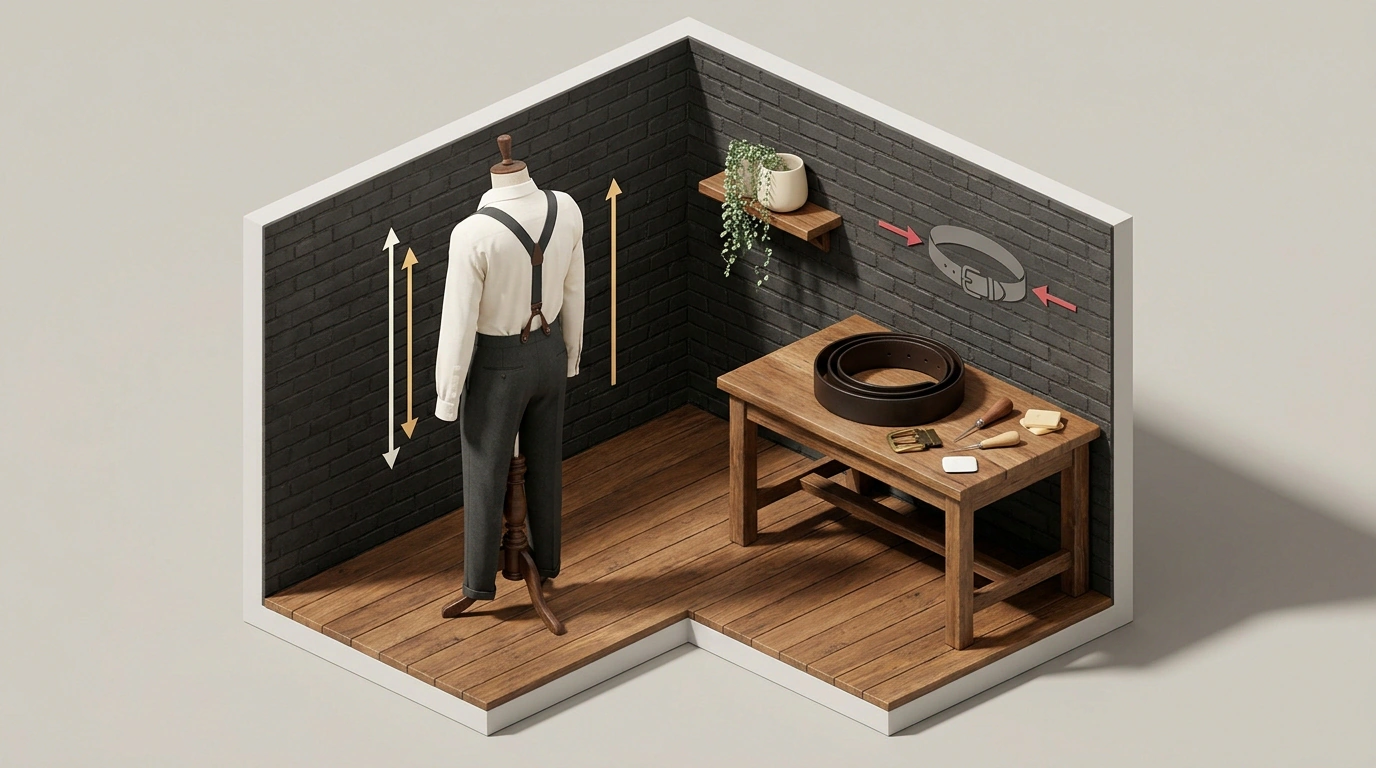
Set fashion aside and look at mechanics: both tools solve the same problem in opposite ways. A belt holds pants up through horizontal squeezing—you cinch a strap tight around your midsection so fabric doesn't slip. Suspenders work vertically, hanging trousers cleanly from your shoulders.
| Feature | Suspenders | Belt |
|---|---|---|
| How trousers stay up | Vertical suspension from shoulders | Horizontal squeeze around the waist |
| Comfort when sitting | Waistband stays put, zero stomach pressure | Buckle digs into your stomach, waistband slides down |
| Fabric drape | Trouser legs hang in a clean, straight line | High-waisted fabric bunches and gathers at the belt |
| Best paired with | Mid-to-high and high-rise dress trousers | Low-rise jeans, chinos, and casual pants |
Tailors use the word 'drape' for how smoothly trouser fabric hangs under its own weight. On a high-rise suit, suspenders give you a clean vertical line: your legs look longer, the waistband never digs in after a big dinner on a date, and when you stand up from a table, you never have to tug your pants back up.
With regular jeans and chinos, it is the opposite story. They have a low rise (short distance from crotch seam to top of waistband) and are designed to rest on your hip bones. A belt belongs there, while suspenders on low-rise jeans look like you raided a costume closet.
Three Rules Before Wearing Suspenders
If you are putting together a dress-trouser or suit outfit and want to try suspenders, keep three simple rules in mind.
First, skip metal clips. Proper suspenders attach with leather tabs to six inner buttons sewn inside the trouser waistband. Metal clips chew up fabric over time, pop off at the worst moment, and instantly cheapen your look. Having a tailor sew in six buttons costs pocket change and takes ten minutes.
Second, watch the trouser rise. Suspenders only belong on mid-to-high or high-rise dress trousers, ideally without belt loops (using side tabs or custom tailoring). Clipping them onto tight, low-rise jeans is a guaranteed way to get odd looks.
Third, never wear a belt and suspenders at the same time. They do the exact same job, and doubling up is a classic style blunder. In menswear, there is an old joke about a guy wearing both: he's so insecure he doesn't even trust his own pants.