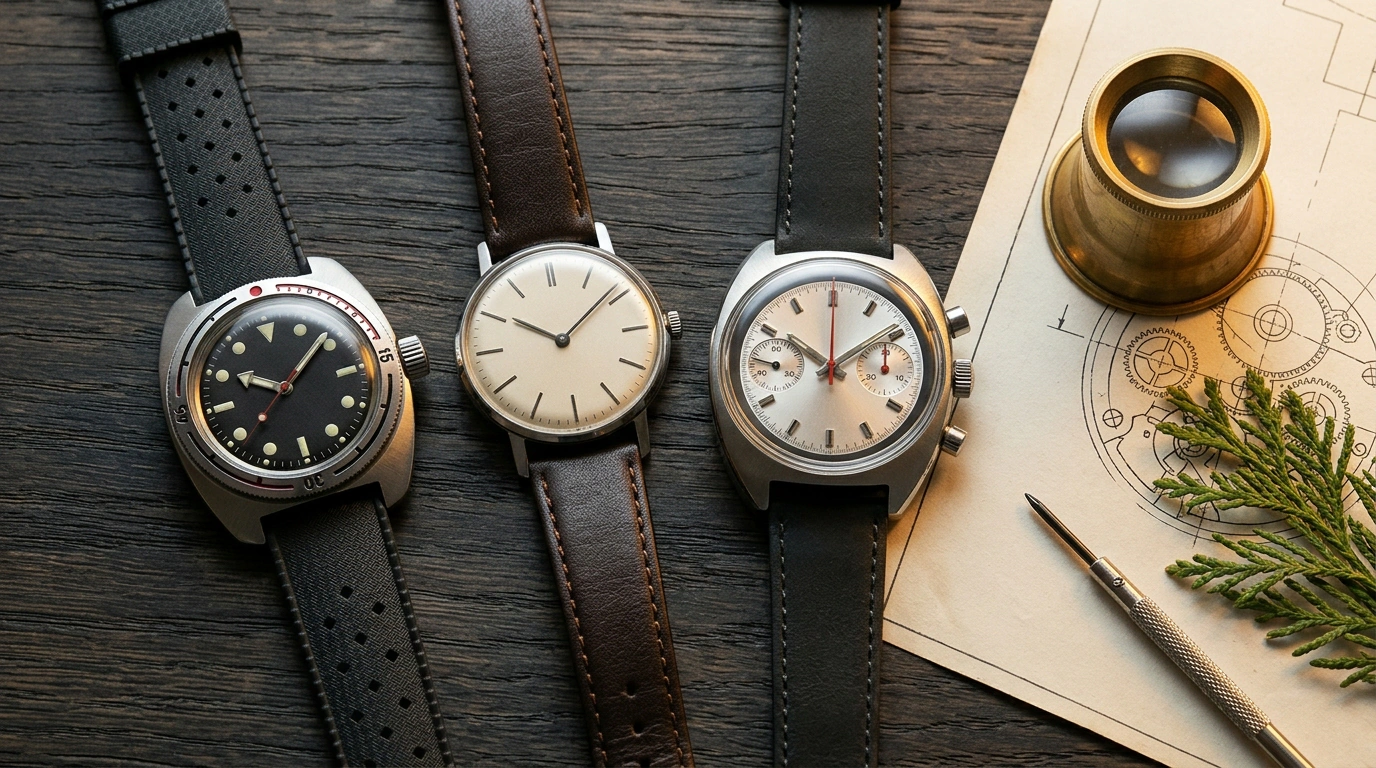
Look at any mall display under 20,000 rubles. Nine out of ten men's watches there are generic quartz pieces from clothing brands, packing a dirt-cheap movement and a markup for the logo. Within a month the novelty wears off, and within a year it gathers dust on a shelf. That is why more guys and collectors are turning toward Soviet watchmaking.
Why Look at Soviet Watches in the First Place?
This comes down to pure practicality, not nostalgia. For 7,000 to 15,000 rubles, you get a real mechanical piece or an iconic digital watch with genuine engineering history and character that catches eyes on a date or with friends. When you wear something with a rotating bezel or a constructivist dial, it brings its own conversation starter.
Let's see which seven models are actually worth your attention, how they work inside, and how to wear them so you look sharp today rather than like someone who borrowed his grandfather's watch.
Sport and Military Mechanics: Sturmanskie, Poljot 3133, and Vostok Amphibia
In Soviet watchmaking, a movement (caliber) number is easy to read: the first two digits show the movement's diameter in millimeters. That tells you right away whether you are looking at a chunky workhorse or a slim dress watch.
First on the list is the Sturmanskie. Hunting down an original 1950s three-hander in clean condition is nearly hopeless today: survivors are rare, and the market is full of pieced-together frankenwatches. On the secondary market, buyers usually go for later Sturmanskie chronographs—watches with a built-in mechanical stopwatch, extra subdials, and pushers on the case.
Inside those later versions beat the star of the First Moscow Watch Factory: the Poljot Chronograph 3133. Despite old rumors, it is not a blind Swiss knockoff. In the early 1970s, the factory officially bought Valjoux equipment and blueprints for caliber 7734, then heavily upgraded the internals. Engineers shrank the balance wheel, raised the beat rate from 18,000 to 21,600 vibrations per hour (3 Hz instead of 2.5 Hz), added six ruby jewels to the chronograph mechanism (23 instead of 17), and installed their own shock protection.
Starting in 1976, this cam-actuated chronograph—31 mm across and 7.38 mm thick—went to military pilots and cosmonauts. Power reserve runs about 42 hours, or roughly 37 hours with the stopwatch running. In your wardrobe, a Poljot 3133 pairs effortlessly with a leather jacket, bomber, heavy denim, flannel shirt, and plain tee. A brown perforated racing strap plays up its vintage vibe, while smooth black leather dresses it up.
If your budget is tighter and you want bold engineering, pick the Vostok Amphibia. In 1967, Chistopol Watch Factory engineers Mikhail Novikov and Vera Belova were tasked with building a 200-meter military diver without access to Western patents. They flipped standard sealing logic upside down: they used a domed acrylic crystal roughly 3 mm thick, a thin caseback held by a wide threaded ring, and a "space-grade" sintered rubber gasket. Under water pressure, the crystal flexes inward by about 0.5 mm and presses tighter against the case, while the caseback squeezes harder onto the gasket. The deeper you dive, the tighter the seal becomes. Civilian models rated 200 meters, and the military NVCh-30 hit 300.
Mechanical watch from the Chistopol Watch Factory 'Vostok' with its signature steel case (Source: Vostok official website)
The Amphibia comes in iconic cases ("Barrel," "Eared," and the 710 cushion case) with a rotating bezel for timing intervals. Clothing-wise, it belongs naturally with workwear, military, and gorpcore outfits: cargo pants, heavy denim, fleeces, windbreakers, and chunky boots. Steel bracelets, rubber straps, or olive and sand nylon straps suit it best.
One key catch applies to older examples. If you buy a vintage Soviet Amphibia secondhand, ignore the "200 m" print on the dial: after forty years, rubber gaskets dry out and crack. Never swim or dive in one without replacing the seals and pressure-testing it first.
Dress Classics, Avant-Garde, and Retro-Futurism: From Poljot de Luxe to Elektronika 5
Now let's look at pieces built around silhouette, graphics, and taste.
For a suit, a blazer over a black turtleneck, or a crisp white dress shirt, the First Moscow Watch Factory created the ultra-thin caliber 2209 in 1961—just 2.9 mm thick with 23 jewels. It launched as the "Vympel," became Poljot de Luxe in 1963, and won a gold medal at the Leipzig Trade Fair (blueprints later moved to the Luch factory in Minsk). Total case thickness with crystal stays around 7.5–8 mm, slipping effortlessly under a shirt cuff. An "Au 20" stamp marks a 20-micron gold plating layer, compared to today's typical 5–10 microns. Warm gold demands discipline, though: match it with your belt buckle, glasses frame, or cufflinks, and keep silver bracelets off that wrist.
A totally different mood comes from two 1980s icons made at the Petrodvorets Watch Factory. The Raketa Big Zero—famously worn by Mikhail Gorbachev, according to legend—puts a bold zero where the 12 belongs and sets the rest of the numerals in heavy constructivist geometry. The Raketa Copernic goes even further: instead of traditional hands, two disks glide across the dial—a black circle for Earth and a gold or white ring for the Sun. Once an hour, they overlap to stage a solar eclipse.
Both Raketas hate busy patterns and extra bracelets nearby. The Big Zero shines in clean casual wear with solid tees, relaxed shirts, and straight jeans (a white dial on smooth black leather never misses). The Copernic asks for even more breathing room: a solid turtleneck, relaxed blazer, straight trousers, and minimalist sneakers.
Closing out the seven is 1970s–1980s retro-futurism: the Elektronika 5 from Minsk's Integral factory (models B6-202 and 29367). Responding to Casio's quartz boom, Soviet engineers added a rare CNH (digital rate adjustment) feature to certain versions. Owners could use the buttons to manually calibrate daily quartz drift down to fractions of a second per day.
Digital watch from the 'Elektronika' line made by Minsk's 'Tekhnochas' in a classic angular case (Source: Tekhnochas official website)
That angular LCD case fits right into today's 1980s revival and streetwear: track jackets, denim, hoodies, oversized trench coats, and retro sneakers. Skip them with a formal suit; for city walks, they hit the mark.
What They Cost, Where to Buy, and How to Avoid Repair Headaches
The Soviet watch market splits into two camps. Chistopol's Vostok still builds the Amphibia in-house from scratch, Minsk's Tekhnochas assembles modern Elektronika models using the old designs, and Petrodvorets's Raketa (operating since 1721) moved upmarket into luxury pieces with in-house automatic calibers.
That explains the sharp price gap: a brand-new automatic Raketa costs several times more than a hand-wound Soviet original. Meanwhile, the Poljot 3133—discontinued in the early 2010s—climbed steeply over recent years. Clean examples used to sell around 25,000 rubles, whereas specialty shops now ask much more. All seven models, current price ranges, and outfit pairings are laid out below.
| Model | Engineering or design highlight | Status and price range | How to wear it | | --- | --- | --- | --- | --- | | Sturmanskie | 1950s pilot classic and later 3133 chronographs | Secondary market only (1950s originals rare; 3133 versions track Poljot prices) | Leather jacket, bomber, denim, flannel | | Poljot Chronograph 3133 | Upgraded Valjoux 7734 base, 23 jewels, 21,600 vph | Secondary market only: 55,000–90,000 RUB in specialty shops | Bombers, heavy denim, perforated leather | | Vostok Amphibia | Self-sealing 200 m system, rotating bezel | New: 7,000–8,000 (710 case), 11,000–25,000 (automatic), 40,000–45,000 (sapphire); vintage similar | Workwear, military, gorpcore, rubber or nylon | | Poljot de Luxe | Ultra-thin caliber 2209 (2.9 mm), Au 20 gold plating | Secondary market only: 20,000–25,000 RUB (rare exports up to 50,000–55,000 RUB) | Dark suit, blazer with turtleneck, white shirt | | Raketa Big Zero | Constructivist dial with a zero instead of 12 | New (auto 2615): 140,000–160,000 RUB; vintage: 7,000–15,000 (boxed 20,000–25,000) | Clean casual, white dial + black leather | | Raketa Copernic | Two disks (Earth and Sun) instead of hands | New limited editions (auto): 150,000–180,000 RUB; vintage: 10,000–25,000 RUB | Turtleneck, relaxed blazer, straight pants, sneakers | | Elektronika 5 | LCD screen and manual CNH rate tuning | New (Tekhnochas): 4,000–10,000 RUB; vintage: 3,000–12,000 RUB | 1980s retro-futurism: track jackets, hoodies, trench |
If you want a zero-risk start, order a brand-new Amphibia or Elektronika straight from the factory—you get a warranty and fresh gaskets. If vintage pulls you in, choose between a specialty shop selling serviced watches (pricier, yet ready to wear) and private listings. Buying privately means budgeting right away for a full service—complete disassembly, cleaning, fresh oil, and regulation by a watchmaker.
What to check before buying vintage Soviet watches
- On a Vostok Amphibia, never trust the factory '200 m' rating—have a watchmaker replace dried-out gaskets and pressure-test it right away.
- On a Poljot de Luxe, inspect the strap lugs and case edges under bright light: Au 20 gold plating wears down to brass there first.
- On an Elektronika 5, tilt the LCD screen at different angles to check for dark edge bleeding or faded digit segments.
- On a Poljot 3133 or Raketa Copernic, verify original dials and disk hands, and have a watchmaker test the chronograph pushers before paying.