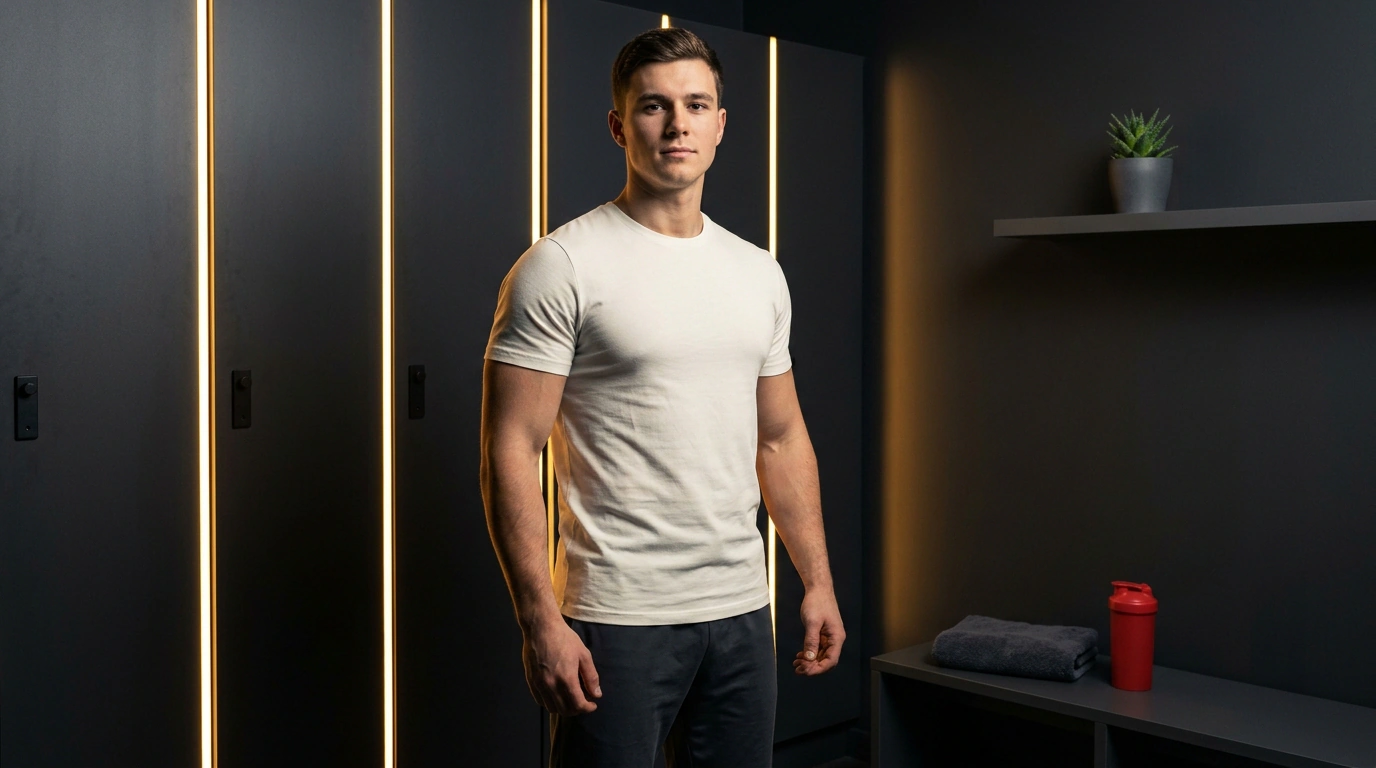
In 2017, researchers showed 160 women photos of real male torsos with blurred faces and asked them to rate attractiveness. The result broke the biggest gym stereotype: not a single woman out of 160 preferred the thinner, visually weaker build. More than 70% of the difference in ratings came down to one factor—how strong the upper body looked. Add height and overall leanness, and you account for roughly 80% of the whole picture.
Chiseled abs—the thing guys starve themselves for months on plain chicken breast to uncover—lost badly in that equation.
Why six-pack abs don't do much through a T-shirt
Picture a normal scene: you walk into a bar or coffee shop wearing a plain T-shirt. From across the room, no woman can tell whether you have six abs or eight, let alone guess your body fat percentage. Your midsection stays hidden as long as your shirt stays on.
What reads in two seconds flat is shoulder width, chest fullness, and how your torso tapers down to your waist. That is the V-taper, or upper-body frame. In Sell, Lukazsweski, and Townsley (2017), visual cues of upper-body strength drove nearly the entire gap between high and low ratings.
That creates a classic trap. A guy decides to "get shredded for summer," slashes calories to the floor, and drops to 10% body fat. The scale reads fifteen pounds lighter, and lines show up on his stomach in the mirror. Looks great? Maybe in the locker room. In normal clothes, his shoulders shrank, his chest flattened, and his T-shirt sleeves hang loose. Along with fat, upper-body volume disappeared, leaving him looking smaller and weaker.
Before you jump on a harsh cut, it makes far more sense to build the frame first: load up your delts, upper chest, and lats. Once you add width up top, the exact same waist automatically looks narrower beneath it.
A six-second tape test instead of the morning scale battle
A standard bathroom scale is the most useless tool if you care about how you look. Two guys of the same height can both weigh exactly 80 kilograms: one carries soft love handles and sloped shoulders, while the other has a dense back and a crisp silhouette. Same number on the screen, worlds apart in person.
Back in 1999, The Lancet published a landmark study by Maisey's team. Scientists tested which geometric measurement of a man's body best predicted women's ratings. The winner was the waist-to-chest ratio (WCR)—simply dividing waist circumference by chest circumference.
What explains variance in male body ratings (Maisey et al., The Lancet)
The chart makes it obvious why obsessing over BMI goes nowhere. BMI adds only a modest piece to the picture, and waist-to-hip ratio—a big deal for female figures—barely mattered at all for men. What drives the look is the drop from a broad upper torso to a tight midsection.
You can check your ratio at home in six seconds with a basic cloth tape measure.
How to measure waist-to-chest ratio accurately
- Wrap the tape around your chest right across nipple level, relax your arms at your sides, and exhale normally. Write down the number.
- Move the tape to your waist at navel level. Don't suck your stomach in; stand naturally and take the second reading.
- Divide your waist by your chest. For example, 79 cm divided by 107 cm equals 0.73.
There isn't one rigid textbook number, though top scores in studies tend to cluster around 0.70–0.75. The real value is tracking direction. If your ratio drifts down over a couple of months—say from 0.86 to 0.79—you're moving in the right direction even if the scale stays flat or ticks up slightly.
This check also saves you from watching only your waist. When you diet too aggressively, your waist drops three centimeters, but your chest shrinks three centimeters too. Your ratio stays stuck while you simply get smaller.
The 10% trap and the pro-bodybuilder ceiling
Say you can already see a faint outline of abs and face a choice: push the cut down to paper-thin skin or shift into building muscle? A solid benchmark comes from Brierley et al. (2016) in PLOS ONE. Participants were given 3D male body models and allowed to adjust sliders for body fat and muscle mass until the figure looked most attractive.
The sweet spot landed right around 16% body fat paired with well-developed muscle mass. That sits comfortably inside the clinically healthy range for young men (8–21%). One interesting detail: people sometimes retell this study as if "healthiest" and "most attractive" body fat are far apart. In the paper itself, there was no statistically significant gap between the two. Both landed side by side in the 15–16% zone. You don't have to wreck how you feel for extreme definition just to look your best.
Even better, when similar studies compared men's picks with women's picks, a funny gap appeared. Men consistently aimed for a leaner, lighter build, while women leaned toward a slightly fuller, muscular frame with a normal layer of body fat. Shredded 10% and lower-ab veins earn plenty of respect from guys in the gym locker room. On a date, though, a completely different audience is looking.
Here's a practical marker: once you can see the outline of your abs, pull the brake on cutting. Dropping below 8–10% without medical oversight brings real downsides—testosterone often dips, sleep suffers, energy drops, and muscle tissue itself starts burning away.
Does that mean blowing up to pro-bodybuilder size? Not at all. In Frederick and Haselton (2007), attractiveness followed an inverted U-curve as muscularity increased. Moderately muscular, athletic men scored highest. Hyper-muscular giants lost points and were more often judged as aggressive or less reliable for long-term relationships.
| Physique strategy | How it looks in clothes | Research response | Main catch |
|---|---|---|---|
| Hard cut down to 10% | Narrow shoulders, flat chest, smaller frame | Loses to a fuller, stronger upper body | Strength, energy, sleep, and testosterone dip |
| Athletic sweet spot (~15–16%) | Clear V-taper, solid shoulders and back | Top scores for both health and attraction | Takes patience and heavy lifting, not a crash diet |
| Extreme hypertrophy | Massive frame, clothes fit poorly | Drops on the U-curve, lower trust long-term | Mostly impresses other guys at the gym |
Of course, lab studies with photos and 3D avatars only measure initial visual impressions. A great frame opens the door at the start, yet it won't carry conversation, humor, or real confidence for you.
Recomposition without yo-yo dieting: heavy compounds, mild deficit, and protein
Since staying shredded year-round hurts and dirty bulking until you're out of breath makes no sense, the smartest route is body recomposition. In plain terms, you gradually trim excess fat while holding onto or adding muscle. Scale weight may barely budge, yet your waist tightens, your chest and shoulders grow, and your WCR drops.
The whole setup rests on three simple pillars.
First: heavy compound lifts focused on the upper body. The most common mistake on a cut is eating less and immediately pulling plates off the bar because "I feel weaker." To your body, that's a direct signal it no longer needs big muscle. Do the opposite—fight for every pound on the bar and slowly add weight or an extra rep. Prioritize presses, pull-ups, bent-over rows, and lateral raises for side delts: chest, lats, and shoulders are what build the V-taper.
Second: a mild calorie deficit. Instead of slashing a thousand calories and bingeing on weekends, trim intake modestly so you still have fuel for hard workouts and solid sleep. Fat comes off a bit slower, while your shoulders and back stay put.
Third: enough daily protein. A major meta-analysis by Morton et al. (2018) showed that muscle growth from lifting plateaus right around 1.62 g of protein per kilogram of body weight per day. If you're an experienced lifter in a deficit, the upper confidence bound in that review reaches 2.2 g/kg, though chasing extreme amounts isn't necessary.
The math is straightforward: at 82 kg, multiply by 1.6 to get roughly 130 grams of protein a day. Get most of it from real whole foods—meat, fish, eggs, cottage cheese, beans—rather than living on sweet protein bars and shakes. Your total daily intake matters far more than stressing over a 20-minute "anabolic window" after your shower. That 1.6 g/kg target applies to healthy adults; if you have kidney issues, check your protein target with a doctor first.