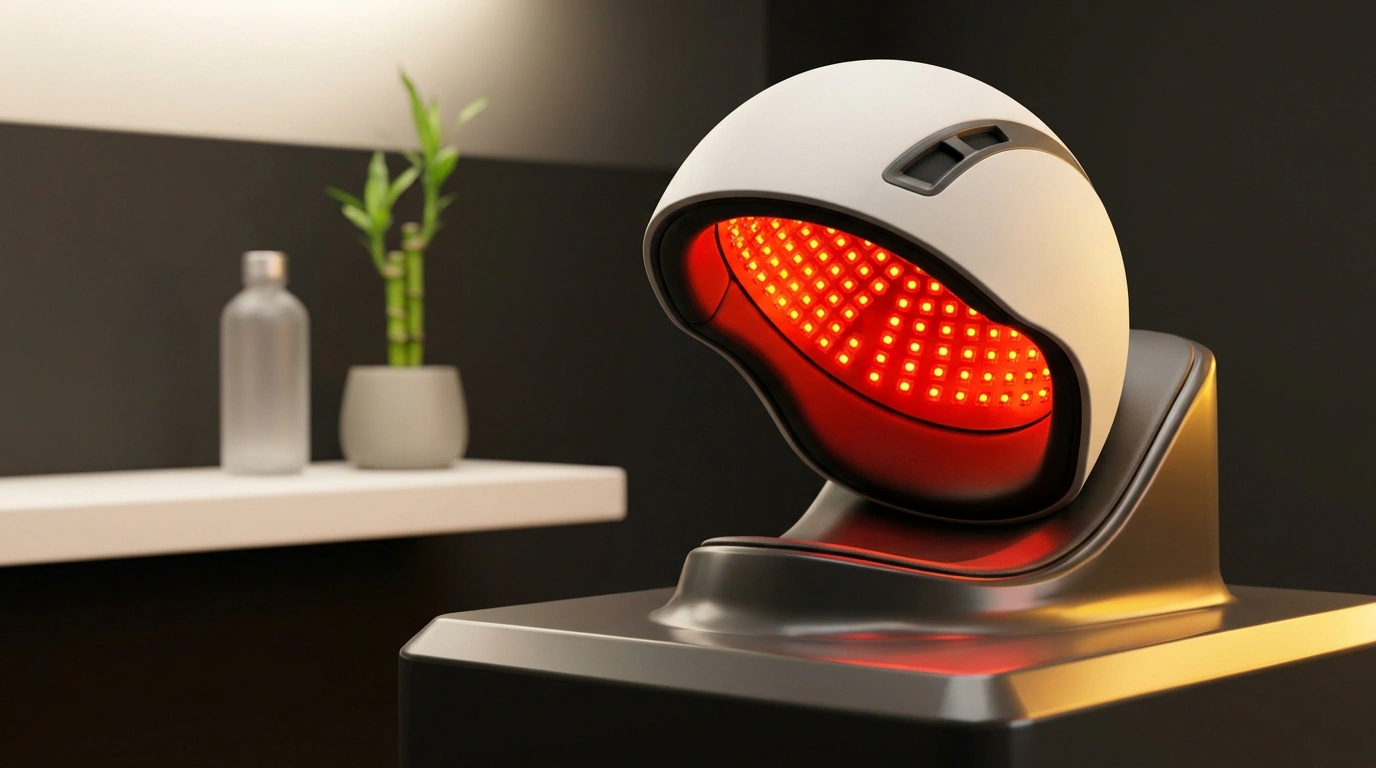
The first time you see a red-light helmet for hair growth, your thumb instinctively wants to scroll past. It looks like a prop from a B-grade sci-fi movie or an infomercial gadget—shining red bulbs on your head feels about as serious as rubbing onion juice into your temples.
In practice, the picture is different. Low-level light therapy (LLLT), also known as photobiomodulation, is the one at-home hair gadget backed by real clinical data. The technology moved into consumer helmets from hair transplant clinics, where doctors use it after surgery. That said, it won't bring back a completely smooth bald scalp. Let's look at how the light works, when it actually helps, and how to pick a legit device.
Three levers of photobiomodulation: what red light does to a follicle
Photobiomodulation works on a straightforward setup: soft red light (650–680 nm, most often 655 nm) and near-infrared light shine onto the scalp. That wavelength sits in an optical window where light reaches the follicle without heating or burning skin.
Three processes kick in below the surface. First, mitochondria inside dermal papilla cells absorb the light (via the enzyme cytochrome c oxidase), giving cells more energy and nudging resting follicles back into the active growth phase (anagen). Second, local micro-inflammation around the root calms down. Third, microcirculation improves, bringing more oxygen, nutrients, and growth factors to the bulb.
In randomized trials—including Jimenez and colleagues using 655 nm devices—participants saw higher hair density and thicker terminal hairs over 26 weeks compared to placebo helmets. Later, a 2017 meta-analysis by Adil and Godwin in the Journal of the American Academy of Dermatology confirmed statistically significant superiority of LLLT over sham devices for hereditary thinning (P < 0.00001). The physics checks out.
Who actually benefits and where waiting for a miracle fails
The biggest mistake guys make is waiting too long. Light only works while the follicle is still alive, even if miniaturized and weak.
Its main target is early-to-moderate androgenetic alopecia: hereditary thinning where temples recede or the crown starts showing through as androgens shrink follicles. Clinical protocols cover Norwood–Hamilton stages IIa–V in men (and Ludwig–Savin I-4, II-1, II-2 in women). Light also helps with telogen effluvium—temporary shedding after stress, illness, nutrient gaps, or childbirth when follicles enter rest mode at once. Since lasers don't alter hormones, they are even safe during breastfeeding. There is also supportive use in non-scarred areas of frontal fibrosing alopecia.
On a long-bald, shiny scalp or in scarring alopecias, shining light does nothing: once scar tissue replaces a follicle, no beam brings it back. Also note that most FDA-cleared devices were tested on Fitzpatrick skin types I–IV, as higher melanin in darker skin absorbs part of the light.
Another trap is buying a helmet and quitting pharmacy treatments. Hair growth works like a garden: you need water, fertilizer, and sunlight. Evidence-based basics remain minoxidil, finasteride, dutasteride, spironolactone, or PRP prescribed by a doctor. A helmet can fly solo at the very earliest stage, yet you get the strongest return when pairing it with core medical therapy.
Realistic routine: timelines, FDA clearance, and choosing a device
Helmets mostly disappoint for psychological reasons, just like a home treadmill: you stick with it for two weeks, then it gathers dust in a closet. Newer models run 12–15 minutes per session, while clinical studies typically ran 20–25 minutes every other day. Real changes take 4–6 months (16–26 weeks) to judge, and you need ongoing maintenance afterward or gains slowly fade.
When shopping, check for FDA-cleared status under the 510(k) pathway. Don't confuse that with FDA-approved (which applies to drugs): clearance confirms home safety and equivalence to a tested clinical device. Look for a working wavelength of 650–670 nm, solid laser diode density (often paired with LEDs), and comfortable fit. A built-in battery cuts the cord yet makes the shell heavier, while an external battery pack feels lighter on your head. Pick the setup you won't dread wearing every two days.
A laser helmet doesn't replace a dermatologist, trichologist, or core medical treatment. Hair thinning can stem from nutrient deficiencies, thyroid issues, or scarring conditions—in those cases, an expensive device only wastes time.