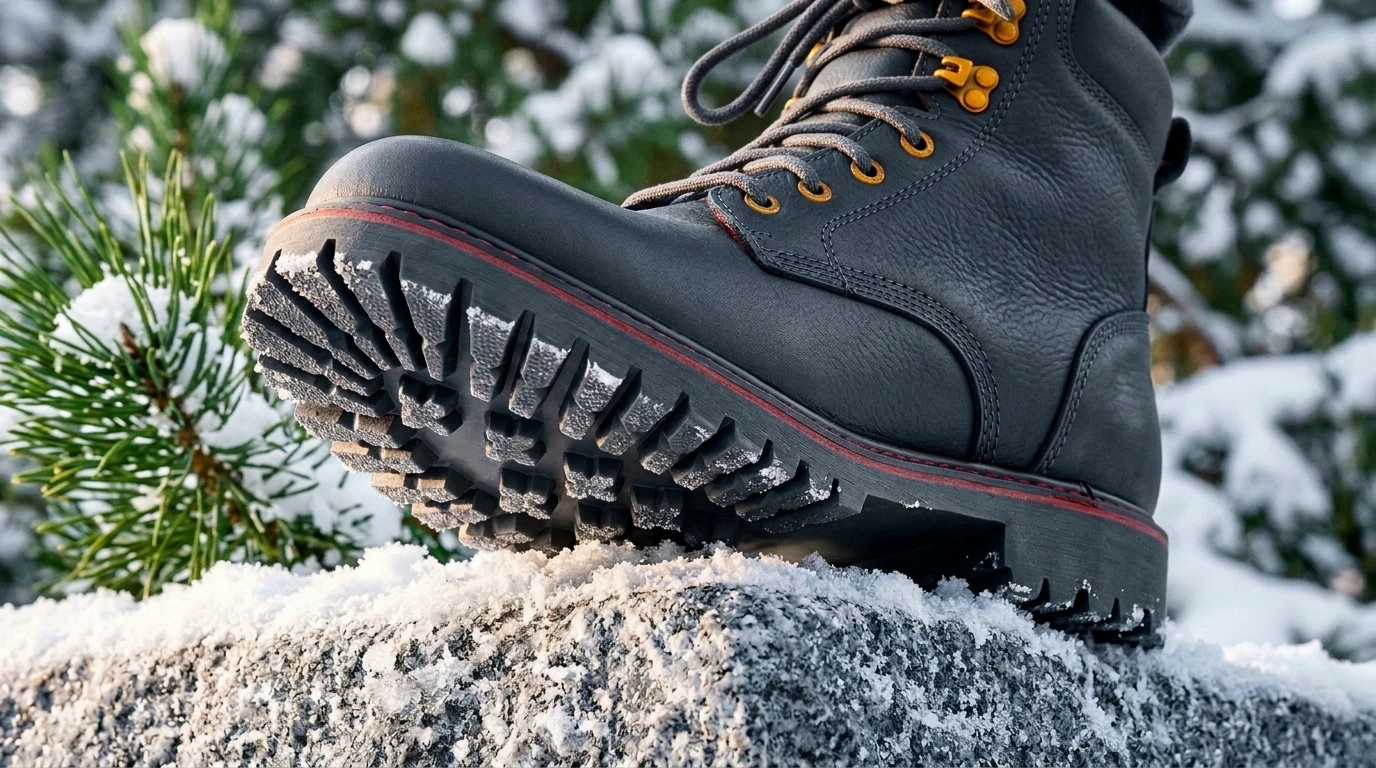
Walking across January pavement glazed with wet ice—confidently, without flailing your arms in front of a date or scratching subway tiles with metal spikes—is completely doable. You just need to check the winter rubber compound and tread depth, then match the pair honestly to your daily routes.
City winters bounce around freezing: crust in the morning, salted slush by noon, and a skating rink outside the coffee shop at night. Summer and mild-weather rubber quits right away here, while heavy Arctic boots turn a normal walk into a polar trek.
Winter compounds, tread lugs, and dry feet
Most winter slips trace back to the outsole material—its rubber or polymer compound. Standard rubber stiffens in the cold and skates across frozen sidewalks like plastic, whereas a winter compound stays flexible below zero.
Snow and ice call for different tools, though. Loose snow needs deep, multidirectional lugs; tall Keen boots use Keen.Polar Traction with lugs around 5 mm deep. On wet ice covered by a thin film of water, plain tread still slides. That's what Vibram Arctic Grip was built for: a polymer blend with special fillers—zero metal studs—that bites into wet ice without wrecking indoor tile. Genuine soles include a thermochromic lug that shifts from white to blue around 0 °C. Boots use three main versions: All Terrain (paired with durable XS Trek Evo rubber for city and mixed ground), Trac for trail hiking, and Nisqually for active city walking.
Wet feet freeze several times faster than dry ones, so the inside relies on a membrane plus synthetic insulation. A Gore-Tex membrane packs over 9 billion microscopic pores per square inch: each pore is 20,000 times smaller than a water droplet yet 700 times larger than a vapor molecule, blocking slush outside while letting sweat escape. PrimaLoft hydrophobic microfibers keep insulating even when damp, and a 200 g/m² weight hits the sweet spot for active walking without overheating.
Four winter scenarios: cost vs. payoff
Overpaying for backcountry specs just to walk to the train makes little sense, yet wearing smooth soles across icy courtyards is asking for a fall. Prices in the table are rough estimates and vary by size, color, and seller:
| Scenario | Model | Key tech | Price | Main drawback |
|---|---|---|---|---|
| Mild city and slush | Columbia Fairbanks Omni-Heat | Omni-Heat, Omni-Grip outsole | from 7,500 ₽ | Weaker on slick ice and in deep freeze |
| Deep snow and suburbs | Kamik Nation Plus / tall Keen | Rubber shell and removable liner / Keen.Dry, 5 mm Keen.Polar Traction | from 9,000 ₽ (Kamik) | Bulky look, warm in mild weather; Keen runs wide |
| All-around wet ice | Merrell Thermo Snow Grip Mid Waterproof | Vibram Arctic Grip All Terrain, waterproof | from 13,000 ₽ | Sporty look, needs warm socks in harsh cold |
| Long walks and premium | Lowa Renegade Evo Ice 2 GTX / Danner Arctic 600 Side-Zip | Gore-Tex Cirrus XT + Arctic Grip Trac / leather, PrimaLoft 200 g, Danner Dry + Nisqually Arctic Grip | from 27,000 ₽ / from 32,000 ₽ | Lowa needs break-in; Danner is pricey and heavier |
At the entry level sit lightweight Columbia Fairbanks Omni-Heat: they feel closer to sneakers, grip wet pavement and light snow well, yet lose footing on polished ice. Snow-ready Kamik Nation Plus shine with a removable liner you can dry overnight, though they look bulky and run hot during thaws; tall Keen boots share a wide fit.
The city sweet spot for slick sidewalks is the mid-cut Merrell Thermo Snow Grip Mid Waterproof with Arctic Grip All Terrain. The top tier fits specific needs: Lowa Renegade Evo Ice 2 GTX lock your ankle down on uneven trails yet take time to break in, while leather Danner Arctic 600 Side-Zip save morning time with a side zipper instead of full lacing—at the cost of a steep price tag and noticeable weight.
Where rubber hits its limit—and matching your outfit
No outsole beats physics: on smooth, mirror-flat ice, every studless boot—including Vibram Arctic Grip and Keen tread—falls behind metal spikes. Studless winter rubber remains a city compromise for subways and offices; during an ice storm, tossing slip-on ice cleats in your backpack is smarter.
Style-wise, volume balance decides everything. Hiking and snow boots look natural with straight-leg jeans, cargos, lined trousers, and parkas, yet clash immediately with sharp dress slacks. Before buying, check toe-box width, decide if a daily side zipper matters, and give stiff leather a week to break in before long walks.