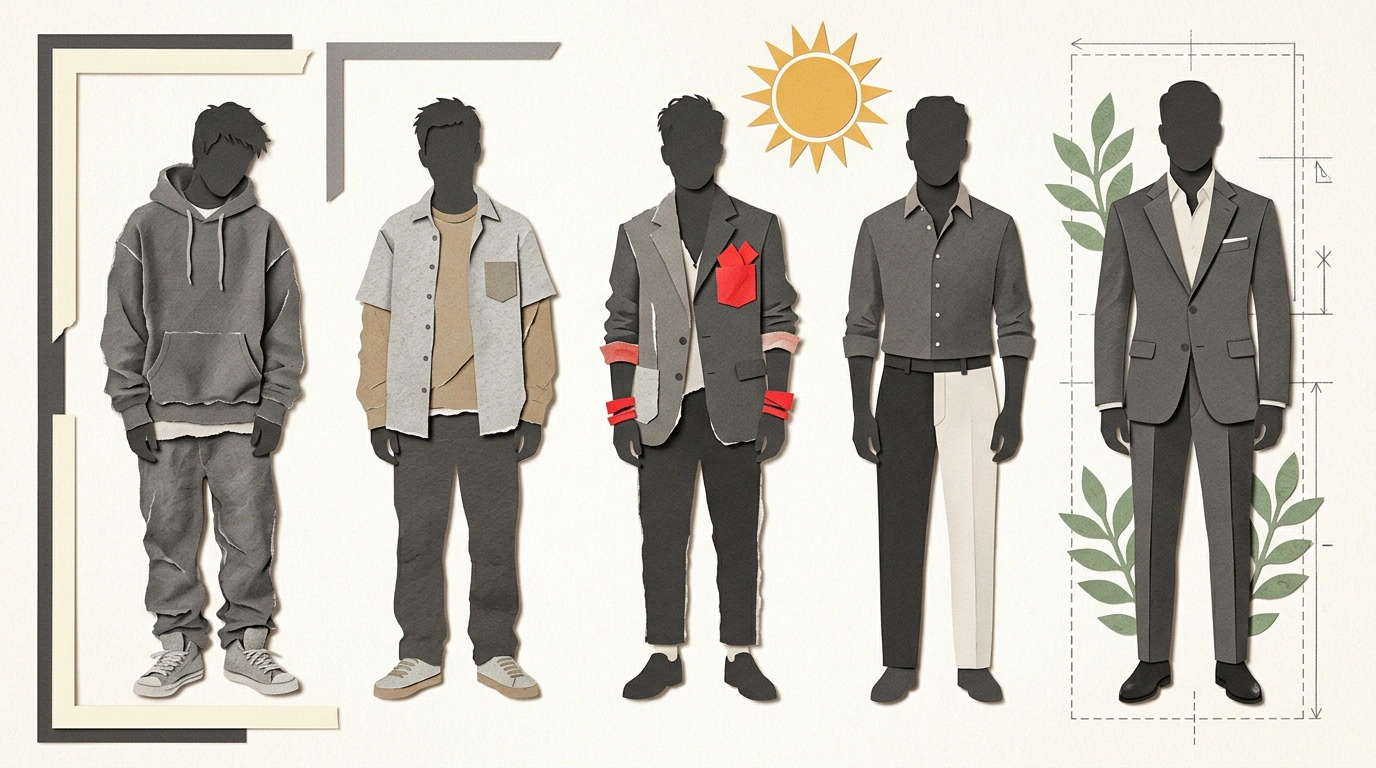
Opening your closet in the morning, pulling together an outfit in two minutes without agonizing in the mirror, and walking out to a date with your shoulders back is totally realistic. It only works on one condition: your wardrobe has no impulse buys, you understand your proportions, and you aren't trying to buy good taste in one trip to a luxury boutique.
The path to style looks straight from the outside: make money, buy a few status brands, done. In reality, a man's wardrobe grows through five predictable stages, and you can't skip them in a weekend with a credit card or a stylist. You can see this clearly in the 15-year journey of Brian Sacawa, a former Army musician who went from worn hoodies to a calm personal signature in menswear. Let's walk through those stages so you know where you stand and where not to burn cash too early.
Levels 1 and 2: when hoodies stop working and the mall drains your wallet
Level one starts with dissonance. Your life has moved forward—you have a job, ambition, and decent income—yet your closet still holds college skinny jeans, stretched t-shirts, and faded hoodies. For Brian, that click happened at 35 after ten years in the Army. Before that, he lived comfortably in a twenty-something "hipster" phase and never connected clothes with how people read him.
Often, though, the seeds sit there for years. As a kid he watched his dad wear suits and ties for New York state government work, watched early Sean Connery James Bond films (Dr. No, From Russia with Love, Goldfinger), wore a cream tuxedo to prom, and learned in music conservatory that stage appearance shows respect for the audience and craft. Still, bringing that into daily life only happened once he wanted his mirror reflection to match who he felt like inside.
Next comes level two: "Getting Started." The logic seems airtight—head to the mall for nicer clothes. Right there, most guys hit two classic traps that Brian ran into at J.Crew, Banana Republic, Nordstrom, Macy's, and Express.
Trap one is hunting single standout pieces. You spot patterned pants or a loud shirt, grab it, and realize the next morning nothing matches it: colors clash and your shoes belong to another planet. Trap two looks smarter: you buy the entire mannequin outfit. That feels like a win until you notice the jacket and trousers only work with each other and ignore the rest of your closet. Either way, money is gone, hangers are packed, and you have nothing to wear. That brings the first sober lesson: buying clothes and building a wardrobe are two different skills.
The turning point is often one great piece. For Brian, that launchpad was a black three-piece suit from United Colors of Benetton. Today he would tell beginners to skip black for a first suit because navy or gray gives way more pairings. Back then, though, he wore that three-piece everywhere—mixing the jacket, pants, and vest separately—and felt a physical boost he called "confidence on steroids." Good clothes shift your posture and mindset long before you memorize style rules.
Classic men's suit with sharp shoulder fit and clean silhouette — the foundation of a mature wardrobe (Source: Unsplash)
Level 3: imitation, Nick Wooster sunglasses, and Italian sprezzatura
Once a great suit gives you a taste for change, "what should I buy?" turns into "how does this work?" Level three begins: the imitation and obsession phase. First come Old Hollywood icons like Cary Grant, Humphrey Bogart, and Clark Gable. Their appeal lies in clean proportions and relaxed fit that translate smoothly to today without 1940s cosplay, forming a modern classic base. Next come bolder influences like Thom Browne's Black Fleece line for Brooks Brothers and street-style star Nick Wooster. When Brian saw cool sunglasses on Wooster, he went straight out and bought the exact same pair.
Don't feel embarrassed about copying at this stage. In style, imitation works just like the gym or music: repeating proven outfits trains your eye to tell sharp combinations from bad ones.
The danger of level three is detail overload. For Brian, that phase meant diving headfirst into Italian menswear and sprezzatura. In plain terms, sprezzatura means studied carelessness: looking like you threw everything on in two minutes when you spent half an hour dialing in every millimeter. Everything went on at once: wide spread collars, cufflinks, pocket squares, double monk-strap shoes, fedoras, and stacked bracelets.
The peak came when he and his wife Robin visited Milan boutique Al Bazar, opened in 1969 on Via Antonio Gramsci. Its owner, Lino Ieluzzi, is a symbol of Italian sprezzatura famous for double-breasted jackets with jeans, cropped cuffed trousers, and his signature number 7. Lino spoke little English and called over Giampaolo Alliata. What stuck with Brian was their warmth without snobbery and the scent of Black Afgano by Nasomatto. He asked what it was, got pointed to a nearby shop, and bought a bottle immediately—to this day, Robin smiles and thinks of Giampaolo whenever she smells it.
The downside hit a couple of years later: getting dressed turned into a second job. Which pocket square, which fold, one bracelet or three? When Brian finally started stripping items away, he didn't feel a loss—he felt relief.
Level 4: mastery, invisible details, and tightening the shot group
Level four starts when visual noise tires you out and you shift to editing. In the Army, they call this tightening the shot group. A beginner sprays shots across the whole target: leather biker jacket today, Italian blazer with three bracelets tomorrow, oversized hoodie the next day. At level four, every shot lands tightly in the center because you know exactly what works on your body.
Your eye circles back to the simplicity of Cary Grant and Sean Connery, only much sharper now. You start spotting the tiny details that make an outfit look expensive with zero logos: fit and silhouette proportions. Fit means how a garment sits on your frame—shoulder seam on the bone, sleeves clear of your hands, jacket neither pulling nor sagging. An affordable blazer with spot-on fit always beats poorly fitted luxury. Proportions balance top and bottom: trouser rise, leg opening width, jacket length, lapel shape, and how fabric drapes as you walk.
Mastery here relies on taste and the calm ability to walk past unnecessary buys. A simplification paradox kicks in: fewer pieces and calmer colors create more wearable outfits. Consumer envy fades too—you can admire another guy's bold look without itching to buy it yourself.
| Level | Main focus | Biggest trap | What moves you forward |
|---|---|---|---|
| 1. Awakening | Dissonance with old clothes | Living on autopilot | Wanting your look to match your life |
| 2. Getting Started | Mall shopping trips | Orphan pieces and closed outfits | Confidence from one great garment |
| 3. Imitation | Copying icons and accessories | Detail overload | Fatigue from visual noise |
| 4. Mastery | Fit, proportions, and editing | Treating rules like a race | Modular closet and clear taste |
| 5. Individuality | Personal expression | Trying to buy experience | Calm ongoing evolution |
Level 5: personal signature instead of wearing a costume
Moving from level four to level five, Brian barely changed what hung in his closet—nothing on the hangers has to change when the shift happens inside your head.
Understated everyday men's outfit without excess accessories — moving from imitation to personal signature (Source: Unsplash)
The difference is subtle but decisive. At level four you know how to dress well; at level five you stop curating a storefront of "who I want to seem like" and simply express who you already are. That brings real immunity to outside opinions. Brian still gets comments calling his outfits "boring" or "dressed like a grandpa." A jab might sting for a second, yet it has zero effect on what he puts on tomorrow morning.
That's why nobody can jump straight to level five. You can hire a stylist over a weekend and buy a flawless wardrobe, but experience isn't for sale—you earn it through trial and error, an imitation phase, and a few funny old photos.
At levels two and three your taste shifts every six months, so hold off on luxury pieces and flashy statements. Test new silhouettes and colors in affordable stores, and put your money first into solid shoulder fit and tailoring. Once you notice your hand reaching for the same core staples every week, your shot group has tightened—that's when expensive fabrics start paying off for years.
Even after 15 years, style stays alive. Your taste will shift, new habits and fabrics will show up, and your clothes will simply keep working for you every day.