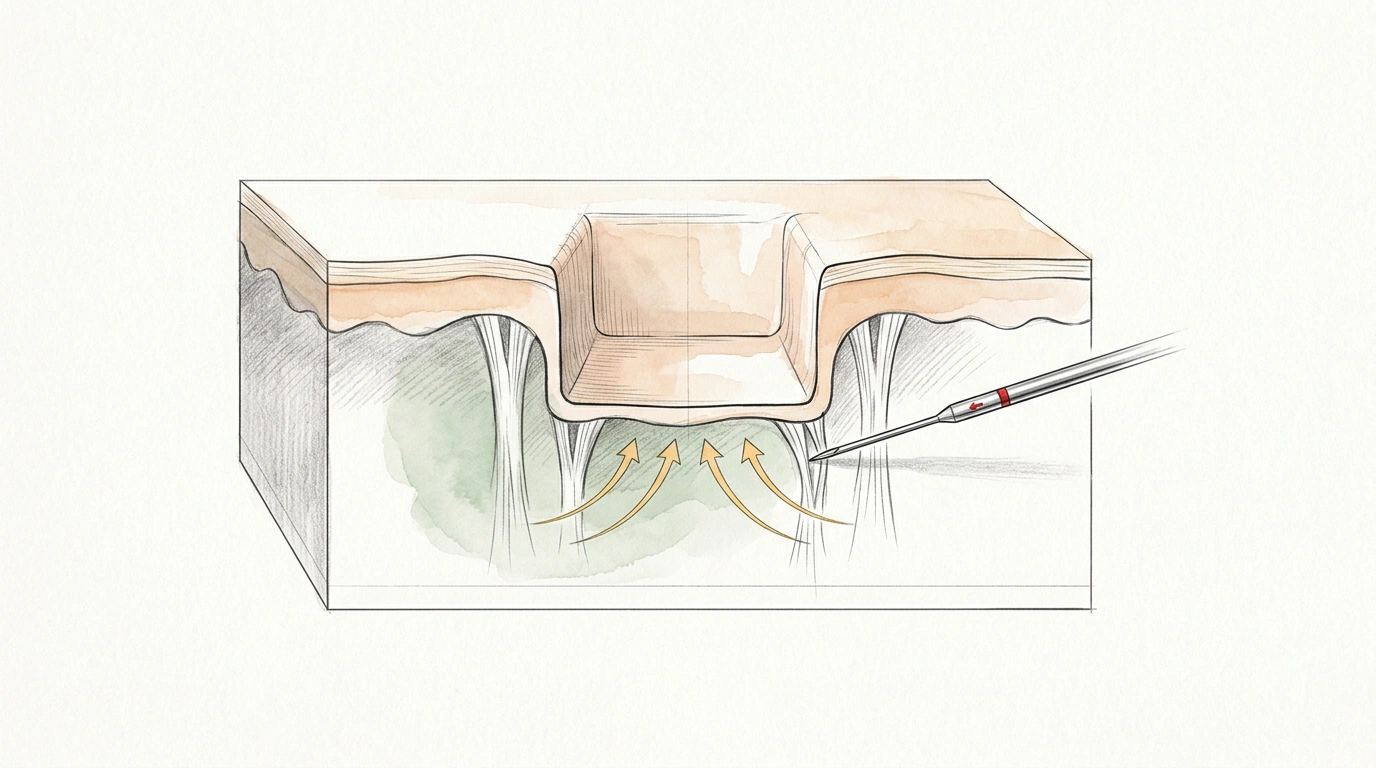
Teenage breakouts cleared up years ago, yet under side lighting your cheeks and temples still show sharp-edged pits. Autopilot kicks in next: you buy another "post-acne" serum with acids or vitamin C, and six months later the texture hasn't budged. Clinical dermatology and American Academy of Dermatology (AAD) guidelines are blunt here: topical skincare cannot raise the floor of a depressed scar, while targeted in-office procedures genuinely smooth skin texture.
Spot or scar: how boxcar scars work under the skin
First check what you're actually dealing with. Run a finger over an old acne mark: if the surface feels completely smooth and only looks red or brown, that's post-inflammatory erythema or hyperpigmentation (PIE or PIH). Your skin structure is intact there; those flat marks fade over time and respond to home care.
When your finger feels a dip with a sharp edge, that's an atrophic (depressed) scar. Deep inflammation destroyed collagen in the dermis, and tight fibrous bands often anchor the scar floor downward. Dermatologists classify three main types: narrow deep punctures (ice-pick), wide shallow waves (rolling), and boxcar scars—wide U-shaped pits with steep vertical walls. Those sharp edges catch overhead light and cast shadows inside, making texture stand out in photos and in person.
'Are retinol and acids useless then?' Where home skincare stops
If creams can't fix pits, should you quit home skincare? No—it just plays a different role. No miracle cream exists for boxcar scars: cosmetics work in the upper epidermis, while the structural dent sits deeper in the dermis, so no serum can push a scar floor upward.
Keep two daily habits as your base. Topical retinoids used consistently over months slightly soften harsh scar edges, nudge collagen production, and smooth surface texture. Daily sunscreen (SPF) is your second anchor: UV rays disrupt healthy healing, worsen scarring, and darken surrounding skin, making pits look even deeper. Toss harsh scrubs and at-home derma rollers straight in the trash—they never match clinical tools and easily tear skin or spread infection.
A multimodal plan: which procedures actually smooth skin
Dermatologists rarely rely on one tool for depressed scars. A doctor builds a multimodal plan tailored to your face, factoring in scar depth, shape, age, and skin phototype.
| Procedure | How it works | Best use and nuances |
|---|---|---|
| Subcision | Fine needle or cannula releases fibrous tethers under skin | Lifts deep tethered scar floors; often step one |
| TCA CROSS | Pinpoint application of high-strength trichloroacetic acid (50–100%) into scar floor | Sparks localized collagen growth from the bottom up; strong for boxcar and ice-pick |
| Laser resurfacing | Ablative (CO2, Er:YAG) and non-ablative fractional lasers | Smooths sharp vertical walls and remodels collagen |
| Medical & RF microneedling | Controlled micro-channels (RF adds dermal heat) | Boosts collagen induction; RF lowers surface pigmentation risk |
| Medical chemical peels | In-office clinical acid formulas | Softens shallow boxcar scars |
| Dermal fillers | Tiny placement under the scar floor | Lifts residual dips; hyaluronic acid fillers last several months to a year |
Two myths stop guys before they even book a consult. First, treatment doesn't always start with sky-high bills—pinpoint TCA CROSS remains an underrated, relatively affordable option that targets boxcar scars directly. Second, hearing "filler" doesn't mean a puffy face costing half your paycheck. Lifting a stubborn pit often takes a tiny micro-drop.
Under AAD guidelines, doctors always clear active acne first so new breakouts don't stamp fresh scars over your results. Next come subcision or TCA CROSS for deep tethered pits, followed by fractional lasers or medical microneedling to blend edges, and micro-filler for any lingering dips.
This article is informational and does not replace an in-person evaluation by a board-certified dermatologist. Every in-office procedure carries risks including bruising, irritation, post-inflammatory hyperpigmentation (especially in darker skin phototypes), and worsened scarring if performed improperly. A qualified specialist should design and perform your treatment plan.