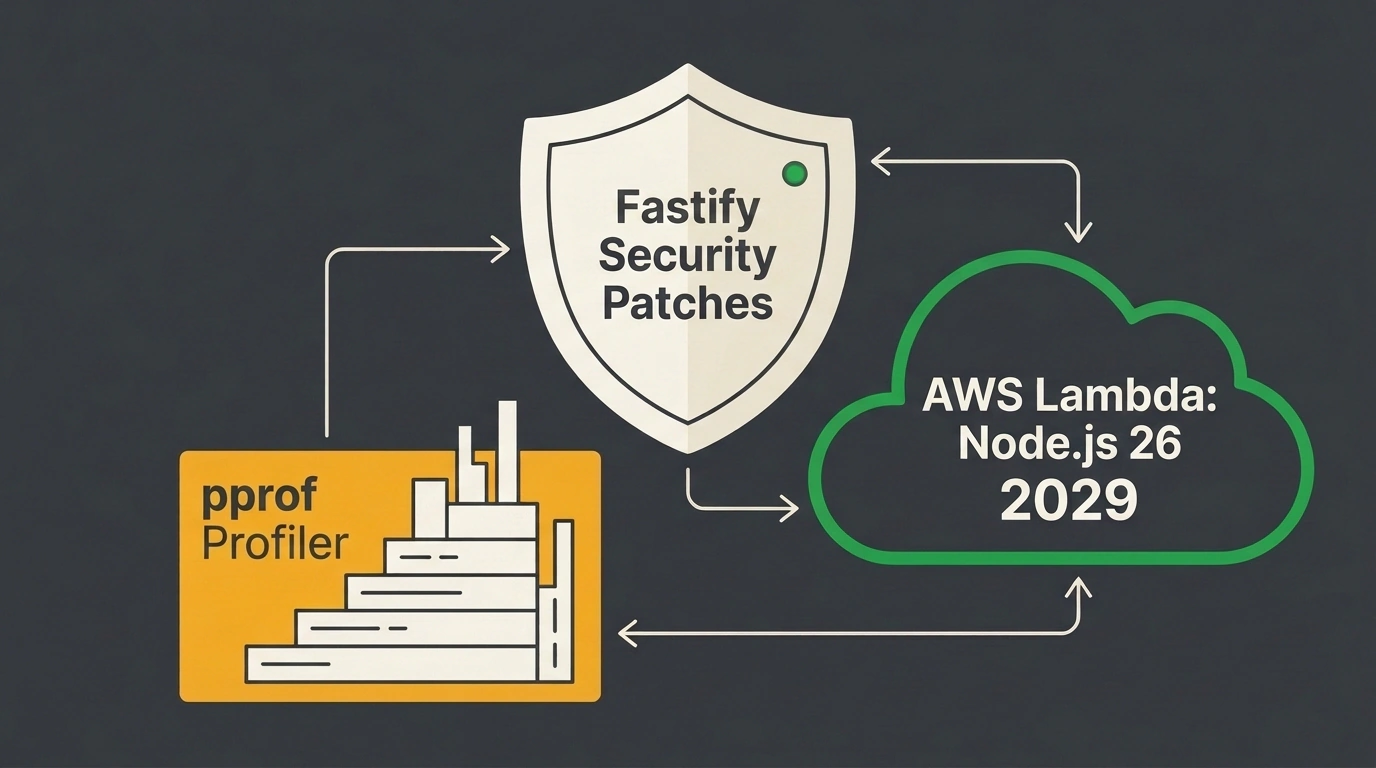
What takes down a Node.js backend at the worst possible moment: an auth bypass, an aging cloud runtime, or a silent memory leak? Here are five practical updates: which Fastify plugins to patch right now, where Node.js 26 landed in AWS Lambda, why reviewers are debating pprof, and how to tidy up NestJS and Fastify.
Critical Fastify Plugin Patches: Middleware Bypass and Request Smuggling
Between November 16 and 20, 2026, 26 advisories dropped across 8 Fastify plugins, including 6 critical ones from OpenJS Foundation CNA. According to Corgea Research, the root issue is that middleware wrappers and Fastify's router decode URLs differently. If auth lives on a path prefix via @fastify/express or @fastify/middie, that mismatch allows a path-scoped middleware bypass into restricted routes.
A second flaw in @fastify/reply-from over basic http transport enables request smuggling—an HTTP desync between proxy and backend that sneaks a hidden second request inside the first body. Since @fastify/http-proxy uses @fastify/reply-from under the hood, check transitive dependencies too. Meanwhile, @fastify/multipart (versions 7.4.0 through 10.1.9) fixed JSON body spoofing as uploaded files under attachFieldsToBody and saveRequestFiles().
| Package | CVE | CVSS | Safe Version |
|---|---|---|---|
@fastify/express | CVE-2026-133120 & 3 more critical | 9.1 | 4.0.10 |
@fastify/middie | CVE-2026-133250 | 9.1 | 9.3.8 |
@fastify/reply-from | CVE-2026-133212 | 9.0 | 12.9.1 |
@fastify/multipart | CVE-2026-124289 | — | 10.1.9 |
Patches also shipped for @fastify/http-proxy (11.6.10), @fastify/busboy (3.2.6), @fastify/static (10.1.12), and @fastify/proxy-addr (5.1.3). No public exploits were seen as of November 20, 2026, yet updating your lockfile shouldn't wait.
Node.js 26 in AWS Lambda: Managed Runtime and Base Image
On November 20, 2026, AWS Lambda launched the managed nodejs26.x runtime on Amazon Linux 2023. It brings the built-in Temporal API, Fetch API updates, and Powertools for AWS Lambda (TypeScript) support. You can deploy via AWS CLI, SAM, CDK, or CloudFormation across regions supporting Web and Event Functions.
Watch out for packaging when migrating. Managed nodejs26.x supports both Web Functions and Event Functions, whereas the base container image only launched for Event Functions. If your HTTP handlers run as Web Functions, you can't build them into an AWS base Docker image yet.
On the timeline front, there is plenty of runway: AWS handles security patches on the managed runtime, and Node.js 26 LTS support runs through April 2029.
Built-in pprof CPU Profiler in Node.js Core
Continuous profiling in Node.js often pulls in native C++ addons—@datadog/pprof alone sees around 17.6 million weekly downloads. On November 25, 2026, PR #67779 opened to bring it into core as node:perf_hooks/pprof. Originating from Go and Google, pprof is a compact binary profile format for continuous metrics and flame graphs.
The PR is still open and unmerged. Currently it covers CPU wall-time only, leaving heap profiling, context labels, and source maps for later. Although discussed with Matteo Collina back at OpenJSF 2025, reviewers are split. Reviewer @legendecas argued that pprof is a file format, not a profiler: V8 already gathers CPU samples via inspector and --cpu-prof, so converting V8 CPU profiles to pprof makes more sense than adding another collector.
Hunting Memory Leaks in Production NestJS
A container dies with OOMKilled (exit 137), logs are empty, and the memory chart looks like a sawtooth. When the Linux kernel kills a process, V8 has no time to write a heap dump. In a guide on NestJS memory leaks, framework creator Kamil Mysliwiec advises setting --max-old-space-size below the container limit first so V8 hits the ceiling itself.
Next, separate leaks from normal load using process.memoryUsage() (heapUsed, heapTotal, rss) and v8.getHeapSpaceStatistics(), watching old_space and large_object_space. NestJS providers default to singletons, and leaks usually hide in three spots: unbounded Map caches, a shared DataLoader inside a singleton, and request-scoped providers (Scope.REQUEST) subscribing to a singleton EventEmitter2 or RxJS Subject. NestJS doesn't call onModuleDestroy on request-scoped instances, so a singleton closure pins the entire Request—headers, body, and all—forever.
To prove the leak, use --heapsnapshot-signal=SIGUSR2, --heapsnapshot-near-heap-limit=2 (stable in Node 22.22.1, 24.13.1, and 25.4.0), or --heap-prof. Careful: heap snapshots block the event loop and need roughly double the heap size in RAM. On a pod near its limit, taking a snapshot will trigger OOMKilled itself, so capture dumps on an isolated replica without live traffic.
Five Steps to Refactor a Fastify Service for Tests and Growth
A single-file server.js feels great on day one, then quickly blocks port-free tests and clean database lifecycle control. In a Fastify refactoring guide, Liran Tal restructures an app using Fastify 5, Node.js 24, ESM, prisma@6.19.0 with SQLite, @fastify/autoload@6, fastify-plugin@5, and tap@21 (sticking to Prisma 6.19 deliberately since Prisma 7 changes client setup).
The layout centers on resource ownership: who creates the DB client, which routes see it, and what boots before traffic arrives. First, separate app assembly from listen() so the server builds in memory without a port. Second, move Prisma into a plugin with explicit lifecycle hooks and connection closing. Third, load infrastructure via @fastify/autoload and organize routes by feature. Fourth, co-locate JSON Schema contracts beside handlers. Fifth, write tap tests hitting routes with app.inject() and verifying startup failures without opening a network port.