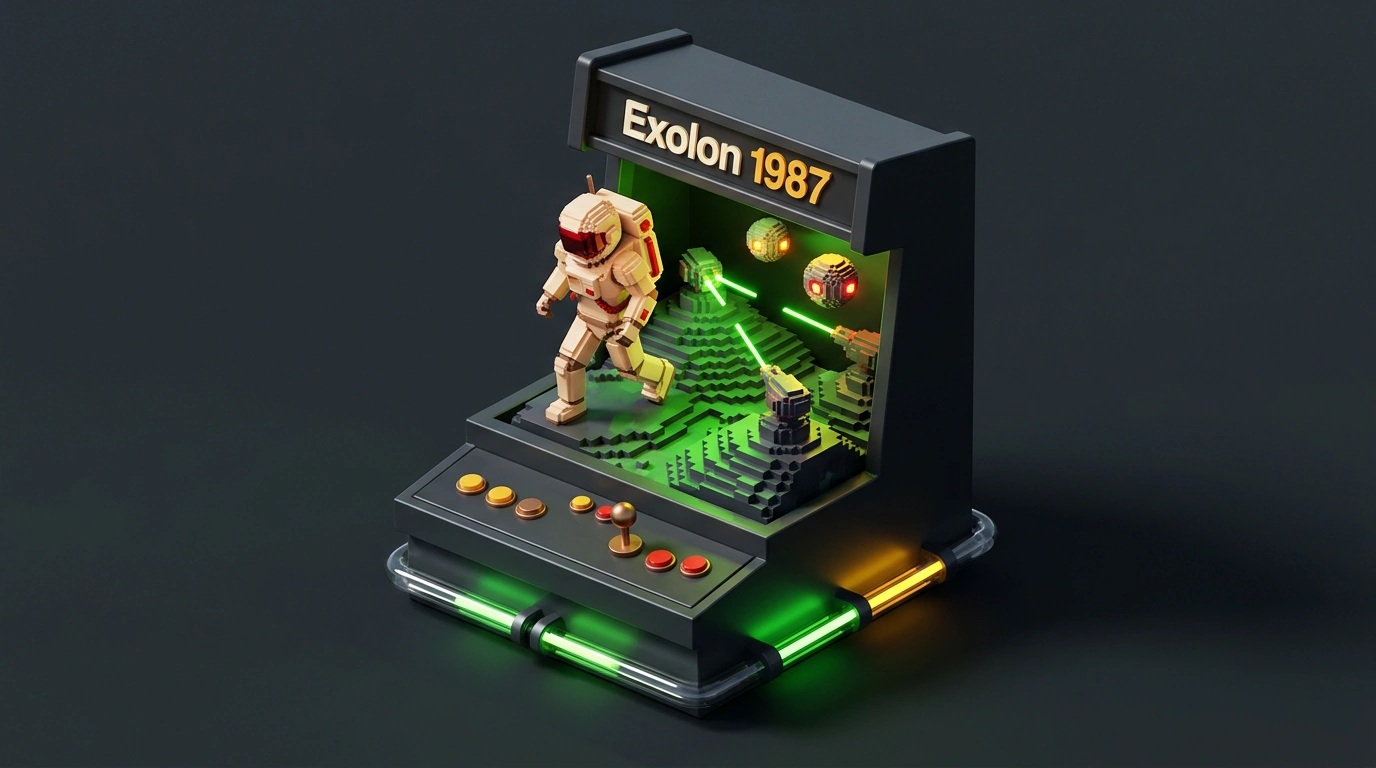
"A few recognizable elements were there, but the feel of the game wasn't." That is how developer Denis Seleznev (@hcodes) described his first attempts to build an arcade game with AI in the spirit of the classic shooter-platformer Exolon. It started with a chat with a colleague about loading ZX Spectrum games from cassette tapes and buying a modern The Spectrum retro computer on Avito—complete with rubber keys and 48 built-in games. Among them was 1987's Exolon by Raffaele Cecco and Hewson Consultants. A test of "can an AI build a retro game?" grew into a browser multi-port of Exolon for six platforms in plain JavaScript.
Why 'inspired by' generation breaks on physics
The plan sounded simple: describe the mechanics, write a few prompts, and get an arcade clone. What came out was a stiff imitation. The hero could run, jump, and shoot, yet nobody wanted to play it.
The reason became clear once Denis dropped the guesswork and rebuilt the original. Exolon's character lives in micro-details: the jump arc, the brief pause before firing a rocket, hitboxes (collision boxes), and enemy reactions. Shift the timing by two frames, and a familiar game feels completely foreign.
He turned to reverse engineering—disassembling compiled binaries without source code. From the disk images, he extracted maps of all 125 screens, sprites, fonts, sounds, and game logic. AI helped inspect the binaries and translate mechanics to JavaScript, while every piece had to be checked by hand against a real ZX Spectrum.
Then his appetite grew. First came graphics and audio from the Amstrad CPC and Commodore 64: same layout, different palettes and details. Next came the 16-bit Amiga 500 and Atari ST (1989). Harsh online reviews of the Amiga port pushed him to check it himself, uncovering subtle differences in visuals and music between Amiga and Atari ST. Later, Sharp MZ-800 plus Game Boy and Game Boy Color themes joined too.
JavaScript and Canvas instead of CPU emulation
Everything runs in the browser without emulating old hardware. Instead of virtual Z80, 6502, or Motorola 68000 CPUs, rewritten JavaScript drives the logic. The Canvas API (a built-in 2D bitmap canvas for graphics and sprites) draws each frame, while the Web Audio API synthesizes chiptune sound and music with low latency.
Think of the difference between an emulator and a native port like a museum. An emulator is an old device behind glass: authentic down to the last clock cycle, yet nothing can be rearranged. A native port rebuilds the machine from modern parts. You don't promise 100% hardware accuracy, and in return you gain freedom.
| Criterion | Hardware emulator | Native JS & Canvas port |
|---|---|---|
| Hardware accuracy | Near 1:1 with ROM | Minor differences possible |
| Visual switching | Locked to one machine | Switch platforms on the fly |
| Version comparison | Only in separate windows | Live Split slider in-game |
| Devices | Tied to emulator app | Touch, keyboard, gamepad via URL |
The architecture rests on two tracks. The 8-bit versions (ZX Spectrum, Commodore 64, Amstrad CPC, Sharp MZ-800, and Game Boy themes) share a single ZX Spectrum core, swapping sprites, palettes, and sound on the fly. Meanwhile, the 16-bit Amiga 500 and Atari ST differ too much in maps, visuals, and music, so they run as separate browser games on the same site.
Skipping emulation unlocked two signature features. First is Remastered mode with depth, lighting, detailed machinery, and modern audio layered over the classic maps. Second is the Split slider, which divides the screen mid-game: ZX Spectrum on the left, and Remastered or another 8-bit platform on the right (Amiga and Atari ST are excluded due to separate engines). The project opens via GitHub Pages on PCs, phones with touch controls, consoles, and Smart TVs (use a gamepad on TVs, as remotes are tough). To tour all 125 screens stress-free, CHEAT MODE gives infinite lives, ammo, and rockets, invulnerability, and screen retry after Game Over.
Where AI actually helps and where it stalls
The lesson from the jump arc and rocket delay applies to any AI-assisted coding. Ask an AI to build something "in the style of" with no strict reference, and it confidently paints a facade. The code runs and buttons click, yet the subtle links underneath fall apart.
The picture flips when the model has real source data and a clear verification target. Paired with the original binaries, AI removed tedious grunt work: parsing structures, extracting assets, and porting logic to the web stack. Final verification stayed with the developer, comparing the port frame by frame against an old Spectrum. You can open the finished port, drag Split, and compare six versions of a single scene right in your browser.
