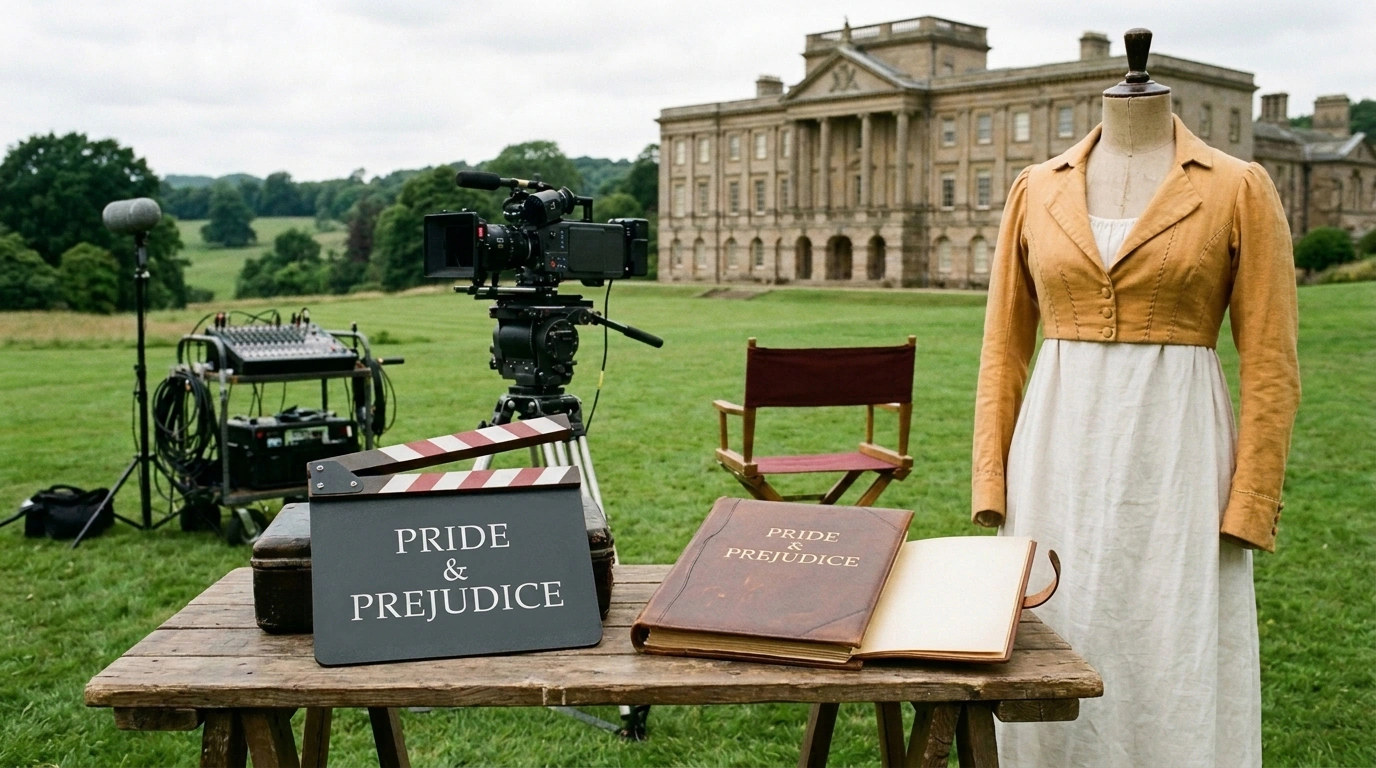
On June 10, 2025, screenwriter Dolly Alderton went over for tea with Dame Emma Thompson. She brought a long list of anxious questions, with five months of filming Netflix's new six-part Pride and Prejudice stretching ahead of her. Over a year of prep, Alderton had read dozens of books and essays on Jane Austen and listened to stacks of radio shows. Yet one hour over tea with the Oscar-winning screenwriter of Sense and Sensibility outweighed the entire archive.
That tea kicks off the behind-the-scenes diary Alderton kept right up to the final day of shooting on November 21, 2025. There is no glossy PR spin or polite studio flattery here. Instead, you get debates over whether to spend £15,000 on a single prop toilet, paparazzi crouching in the heather, vodka mixed with eucalyptus instead of laundry detergent, and an honest look at how to adapt a beloved classic without burying it in museum dust.
Emma Thompson's Lesson: Why You Shouldn't Fear the 'Janeites'
Taking on Pride and Prejudice after the iconic 1995 version with Colin Firth and the 2005 film with Keira Knightley takes nerves of steel. Jane Austen has a famously fierce fanbase known in the English-speaking world as Janeites. This passionate community of novel experts will happily spend hours debating bonnet cuts, the tone of Darcy's letter, and button counts on a waistcoat.
Alderton felt that pressure almost immediately. On June 21, she went to a Loyle Carner gig inside a sweltering church in Hackney, London, where a sweaty, slightly tipsy concertgoer cornered her. The stranger announced she was obsessed with Pride and Prejudice and earnestly hoped the new version wouldn't let her down. Quite a night out.
Against that backdrop, Emma Thompson's advice worked like cold water on an overheated engine. Thompson brushed off the fear of fan judgment with one simple line about Janeites: 'They have the books. Let them enjoy the books.' As they parted, she gave Alderton a tight hug and promised it would be brilliant. On the eve of the first shoot day, she sent a note with a thought that kept the writer afloat all autumn: Jane Austen herself would surely have rooted for her, since in her own lifetime the author was a visionary, the odd sister out, and someone who pushed hard against the tight limits of her era.
Beyond emotional support, Thompson handed over a crisp production manual. Some of her terms sound technical, but the ideas are down-to-earth. A comedy editor, for instance, is an editor with an instinct for comic timing: one extra beat of silence before or after a line can kill a joke on the spot. And over-scoring is the habit of drowning every scene in dramatic music when the actors and script simply need quiet space to breathe.
- Ninety percent of success comes down to casting: if the actors don't fit the characters, no amount of dresses or stately homes will save the show.
- A comedy editor controls the rhythm, because Austen's irony dies instantly if a cut lingers a beat too long.
- Don't drown scenes in music—when dialogue is sharp, a background orchestra only gets in the way.
- Build a glossary of additional background lines early so extras don't invent awkward 'Regency' ad-libs.
- The stakes of marriage must feel urgent today without history footnotes: for the Bennet sisters, marrying well was a matter of survival.
- Stop fearing Janeites—nobody is taking their books away, and an adaptation has to live its own life.
Rules four and six would soon echo so loudly on set that the crew remembered them all the way to November.
Script Surgery: A £15,000 Toilet and Sheep Instead of a Zucchini
The very next day after tea, June 11, brought the moment every screenwriter dreads: budget cuts. Producer Lisa tried to reassure Alderton, promising surgical trims with a scalpel rather than hacking off whole chunks. In practice, the scalpel still cut deep.
First on the chopping block was a scene where Lydia Bennet and Mrs. Forster go sea bathing. Alderton managed to save the bathing machines—enclosed wooden huts on wheels that were rolled straight into the water in the early 19th century so ladies could change and step into the sea unseen. A slapstick bit where Mr. Collins sneaks out of Longbourn down a drainpipe had to go, though. One funny second required a full shoot day, and Netflix schedules don't hand out gifts like that.
Another joke sparked a real debate. In the script, Lizzy and Jane discover a flushing toilet at Netherfield—a rare luxury and sign of serious wealth in the early 1800s. The snag was practical: no working Georgian originals survived, and building an accurate replica from scratch cost £15,000. The team seriously weighed whether one laugh justified the price tag. Alderton joked that she had lost far more than that for a good laugh in life—mostly in dignity rather than cash.
Even funnier was the saga of the autumn harvest fair in Meryton. The first draft packed in swings, puppet shows, wrestling, toffee apples, and a fortune teller. After budget cuts, the bustling scene risked shrinking to one sad extra selling a single zucchini. Lisa saved the day again by checking the 'livestock budget' and finding it was cheaper to herd sheep through Meryton's streets for market day. On camera, it delivered movement, noise, and genuine rural texture. When the crew arrived in Rye to film Meryton in September, cattle and baby goats really did fill the streets—though the goat wrangler quickly made it clear to Alderton that she wasn't thrilled by constant requests to cuddle the kids.
Period film production still life with an open script, tailoring scissors, a Regency dress sketch, and a wooden clapperboard.
After the rewrites came the read-through—a two-day table read of all six episodes on July 22 and 23. For a writer, it's an odd mix of torture and insight. On one hand, you hear real people speak your lines for the first time and immediately catch what sounds natural versus what feels stiff on paper. On the other, actors are still feeling out the material while sitting down at half-volume, which can make any script sound flat. A showrunner friend once told Alderton it feels like having your personal diary read aloud in a mocking voice. To break the ice, Dolly opened with a short speech saying she felt like a fantasy football manager allowed to draft players straight from IMDb. It worked: the first three episodes played far better than expected, Fiona Shaw as Lady Catherine knocked everyone out from her first lines, and by the final scenes of episode six the whole room was crying. Alderton pulled faces with all her might to hold back tears—crying at her own writing felt unbearably awkward.
That was also when the crew truly appreciated Emma Thompson's tip about additional dialogue—a pre-written bank of background chatter for balls and drawing rooms. Without exact lines for background murmuring, actors start improvising, and absurdity takes over. Jamie Demetriou, playing Mr. Collins, confessed on August 13 that whenever he's asked to mime Regency small talk without a script, he turns to his neighbor and asks if their father likes horses.
Historical accuracy kept throwing curveballs at every turn. On August 1, they had to quickly rewrite Wickham's line on the beach at Ramsgate: the script compared Georgiana Darcy's eyes to the color of the sea, but brown-eyed Isabella Sermon got the part. Lisa dryly pointed out that given the color of the water off the Kent coast, the line might still have worked. Later, in November, saying goodbye to Demetriou after his final shoot day, Alderton gifted him a walnut cigarette case packed with Marlboro Golds—what seemed like a spot-on early-19th-century gentleman's gift. Then she looked it up and discovered cigarette cases weren't invented until the Victorian era (after 1837) and didn't exist during the Regency (1811–1820). Almost everything modern people automatically label 'old-timey' turns out to be Victorian. She joked she might as well tackle Dickens next.
The Bennet Family, Casting Like Dating, and 'The Bennet Bitches' Chat
If ninety percent of Austen's success really does hide in casting, assembling the actors felt like a string of nerve-wracking dates. When a performer says no, you start doubting the entire project. When they say yes, it feels like someone just agreed to go to dinner with you.
On June 23, Alderton celebrated: Louis Partridge, her top choice, signed on as the charming rogue Mr. Wickham—a man who looks like he could effortlessly ruin someone's life. Off-camera, Partridge turned out to be the exact opposite of his character. Between takes, he crocheted a tiny hat for his friends' baby, wandered into a field at lunch to play guitar, and jumped up politely to offer Alderton his chair whenever she walked in. When Dolly bragged about this to executive producer Will, he asked deadpan whether Louis was treating her like his own grandmother.
The cast brought together standout British actors across generations so every storyline rested on a vivid personality.
| Actor | Role in the Series | Behind-the-Scenes Detail |
|---|---|---|
| Emma Corrin | Elizabeth (Lizzy) Bennet | On set nearly every day, brought their dog, and never complained even in Peak District frost |
| Jack Lowden | Mr. Fitzwilliam Darcy | Spent a month staying silent in carriages and questioning why Lizzy falls for Darcy |
| Olivia Colman | Mrs. Bennet | Loved shouting on camera and brought a waffle van for the whole crew in October |
| Rufus Sewell | Mr. Bennet | Insisted on eating for real in dining scenes, including a mountain of sausages one morning |
| Freya Mavor | Jane Bennet | Reshot a rocking-horse scene because the first take made her look like a jockey |
| Rhea Norwood | Lydia Bennet | Fell in love with one of her dresses and declared she wanted to be buried in it |
| Hollie Avery | Kitty Bennet | Her contagious laugh repeatedly broke takes in scenes with Mr. Collins |
| Hopey Parish | Mary Bennet | Completed the five Bennet sisters during family rehearsals |
| Daryl McCormack | Mr. Charles Bingley | Split his tight breeches on the very first day as soon as he sat down |
| Siena Kelly & Saffron Coomber | Caroline Bingley & Louisa Hurst | Formed a razor-sharp mean-girl duo at Pemberley without turning into farce |
| Louis Partridge | Mr. George Wickham | Crocheted a baby hat and played guitar out in the fields |
| Jamie Demetriou | Mr. William Collins | Improvised awkward noises and joked about liking horses |
| Jasmine Blackborow | Charlotte Lucas | Filmed with dog Brie, who barked on cue better than some actors |
| Fiona Shaw | Lady Catherine de Bourgh | Styled in a high-collared black gown as an 'elegant crow' |
| Isabella Sermon | Georgiana Darcy | Practiced piano pieces on a keyboard right inside her trailer |
| Anjana Vasan & Sebastian Armesto | Mr. and Mrs. Gardiner | Joined Lizzy on the pivotal trip to Pemberley |
Chemistry within the group clicked before the cameras even rolled. On July 21, after morning costume fittings at London North Studios (where Alderton immediately eyed Mr. Bennet's embroidered dressing gown and plotted to steal it after wrap) and a Bennet family rehearsal, the cast went to dinner at the Greek restaurant Lemonia. Over the meal, Alderton and Partridge grilled Rufus Sewell about his wild nineties youth in Primrose Hill, discussed Mary Oliver poems, and argued over where in Rome to find the best carbonara—where Daryl McCormack was heading next. Asked what jobs they'd have outside film, answers scattered wildly: Louis picked documentary filmmaking, Daryl chose wildlife photography, and Emma Corrin said primary school teaching. The night ended awkwardly when Alderton and producers Lisa and Manda were busy raving about McCormack's hypnotic eye color, only to realize Daryl was standing right behind them waiting for a cab.
From day one of filming on July 28, it was clear the set wouldn't be dull. They opened with a hungover Mrs. Bennet walking the garden with her daughters the morning after the Netherfield ball. Alderton wanted Olivia Colman looking visibly queasy; Lisa worried about pushing it too far, though they filmed one 'slightly more nauseous' take just for the writer. Later, on September 25, during a huge marital row between the Bennets, it turned out Colman genuinely loved getting to yell on camera—in real life she never raises her voice. And on September 29, she and Rufus Sewell played a drunk scene with such playful mischief that Lisa recalled an old story about an actor who got genuinely drunk for realism, terrified hair and makeup, and sent drivers out for refills until the producer snapped: wouldn't it be easier just to act?
Sewell, meanwhile, stayed old-school in everything. In rehearsals, he was the first to point out how vital the scene is where Mr. Bennet honestly owns up to failing as a father. And during meal scenes, he insists on eating for real: on September 22, across several breakfast takes, he polished off a mountain of sausages and buttered toast without a single complaint. Others faced simpler but equally funny mishaps. Daryl McCormack split his tight breeches on day one, Rhea Norwood adored Lydia's dress enough to be buried in it, and on November 18 Freya Mavor reshot a rocking-horse scene because an earlier take made her look like a jockey at the Aintree races.
The clearest proof that the on-screen family had bonded for real surfaced on August 13: Olivia Colman, Emma Corrin, and all the Bennet sisters had started a group chat called 'The Bennet Bitches.' On October 17, the whole crew took over Netflix's box at the O2 Arena for British rapper Little Simz's concert. It was a surreal sight: the Bennet sisters out of their corsets, hanging by the open bar, dancing to hip-hop. The night peaked when Emma Corrin walked onstage in a brown pinstriped suit—their voice had once been sampled on Little Simz's album Sometimes I Might Be Introvert, and now Corrin opened the show live to deafening screams from their screen sisters.
The Riddle of Mr. Darcy: Why Staying Silent in a Carriage Is Harder Than Talking
If the Bennet sisters power the show with lively noise and emotion, Mr. Darcy is the biggest headache for both writer and actor. For nearly half the story, he stays closed off, brooding, and sparse with words. Playing a character hidden behind a stone face is far harder than tossing out witty lines.
The first month of filming turned into an endless marathon of silence for Jack Lowden. He stared thoughtfully out of carriage windows and climbed in and out of coaches a hundred times a day. When the team watched dailies in the evening (known in the UK industry as rushes—raw, unedited footage reviewed right after shooting), Alderton overheard Lowden's gloomy self-deprecation on playback: he muttered that nothing was happening behind his eyes and he'd made a mistake taking the part.
On August 4, during a drizzly lunch break holding plates of cheesecake, Lowden asked the writer point-blank: why does Elizabeth even fall in love with Darcy? Alderton explained that he is a reliable man of action who fixes problems instead of talking. Lowden shot back instantly: 'His servants do everything for him!' It was an airtight comeback, forcing a long chat about how taking responsibility for people isn't the same as knowing how to hang a shelf.
The turning point came with Lizzy and Darcy's surprise reunion at Pemberley, filmed on August 19. The team held more meetings over that single episode than any other scene across all six parts. Here, Darcy's high-status armor has to crack so viewers finally see the living human underneath. Reaching the right draft meant walking through a graveyard of bad ones. The funniest reject was nicknamed the 'horny tree' version, where Darcy showed Lizzy the estate's oldest trees and delivered clumsy metaphors about how you only see the true color of bark up close. Everyone hated that draft except producer Lisa—driving onto the estate, she and Alderton even joked about picking out a sufficiently impressive chestnut tree near base camp to 'play' the part.
Chatsworth House in Derbyshire, England—a classic visual reference for Pemberley's aesthetic (Source: Flickr / Openverse, CC BY)
The exact estate used for Pemberley in Netflix's series isn't named in the diary—only that the crew worked around Harrogate and the Peak District, with Derbyshire's Chatsworth House serving as the traditional benchmark for that scale and spirit. During the decisive take, Alderton stood on the terrace beside director Euros Lyn's monitor. Corrin and Lowden's performance came out fragile and hesitant—exactly what the grand setting needed. Before the final take, Lyn called out a brief note to Emma: remember, he's the north to your south, action.
Off-camera, Lowden broke the tension with dry Scottish humor. Back on July 23, at Netflix's mandatory 'respect workshop,' someone asked if it was okay to date co-workers on set. Lowden, who is married to actress Saoirse Ronan, immediately replied that he bloody well hoped so since he'd married one. On October 14, on his tenth silent take in a row—asked to look first 'intrigued and thoughtful,' then 'intrigued and charmed'—he burst out laughing at how ridiculous acting is as a job. And on November 7, during the Meryton ball shoot, a silent farce unfolded: Alderton saw Jack waving energetically through a glass door and cheerfully waved back. Only a minute later did she realize he had been accidentally locked in a vestibule and was frantically signaling for help while the whole crew waited for him on set.
The season's two biggest romantic scenes had their own live hiccups. On October 11, they filmed Lizzy and Darcy's first kiss. It had sparked plenty of debate back at the script stage until historical consultant Dr. Fiona Stafford reminded everyone of a simple truth: 19th-century people felt the exact same desires we do. Lowden backed the kiss with characteristic pragmatism, noting that the Irish are romantics while Scots see things soberly. Mid-scene, the director asked Emma to lightly adjust their spencer—a short, fitted Georgian women's jacket ending at the bustline. Lowden looked genuinely baffled and asked: 'Like Marks & Spencer?'
And on October 27, when Alderton flew in on a morning flight from Los Angeles straight to set for the proposal scene, she met both tears of joy and an unexpected technical snag. Behind the monitor with a mug of tea, she wept silently at Corrin and Lowden's acting, yet Lizzy's run just wouldn't work. The moment Emma broke into a sprint, modern bent 'jogging' arms popped into frame—way too 20th-century. It took several takes to find a natural 19th-century stride.
Vodka for 1800s Fabrics, Paparazzi in the Heather, and Saving Snow
From late July through late November, the crew's true home was Golden Parsonage in Hertfordshire, transformed into the Bennets' Longbourn. They picked it for two reasons. First, all the surrounding land is private property, raising hopes of hiding from prying cameras. Second, the interiors were painted 'aquatic blue': cinematographer Chloe explained that the shade works beautifully with wood, candlelight, and skin tones all at once. The facade was constantly 're-dressed' with fresh greenery so viewers could feel the seasons shifting—in Austen's novels, the turning calendar sets the pace for the whole story.
Outside Hertfordshire, shooting scattered across England. London scenes were filmed on August 8 in Spitalfields; Hansford interiors were wrapped on August 13 in a house near Shepperton during muggy, overcast heat; Pemberley lived in the Peak District and around Harrogate; and Meryton was shot on September 8 in the historic town of Rye in East Sussex.
Historic Mermaid Street in Rye, East Sussex, where Meryton scenes were filmed (Source: Flickr / Openverse, CC BY)
The day in Rye proved one of the toughest: the crew staged a massive seven-page scene with crowds of characters constantly entering and exiting the frame. Executive producer Laura's daughters appeared as extras (and got to keep their bonnets), while Charlotte Lucas's dog Brie somehow showed up on set even though she wasn't in any of those scenes.
A point of special pride was costume designer Charlotte's wardrobe truck. She had sourced genuine 19th-century fabrics from the 1800s. The material was so old and fragile that ordinary washing with detergent would have shredded the dresses into rags. They used a tried-and-true theater trick instead: after each shoot day, costumes were misted with a mix of vodka and eucalyptus to freshen the fabric without harming the fibers.
Meanwhile, the plan to hide from paparazzi on private land failed completely. As early as August 4, a photographer climbed a tree nearly a mile from Golden Parsonage and snapped Emma Corrin and Freya Mavor on Longbourn's roof chatting and scrolling their phones between takes. The photos leaked to the press, sparking a comment that became an instant hit inside the crew: an outraged reader wrote that Lizzy Bennet didn't own a mobile phone and the show was historically inaccurate.
Soon the team had its own 'resident' stalker named Ralph. On August 8 in Spitalfields, he complained to producer Lisa that the shots weren't turning out well and didn't pay what they used to—Lisa grumbled they ought to add him to the catering budget. Then on August 20, out in the wilds of the Peak District, Ralph was spotted buried armpit-deep in heather with a telephoto lens. Asked who leaked the location, the photographer deadpanned that his father happened to drive past, saw the filming signs, and called his son. Leaks even reached Hollywood: on August 13, director Nancy Meyers posted online that she was tired of stumbling on leaked set photos and wanted the new Pride and Prejudice kept a surprise until premiere day. In response, Jack Lowden and Rufus Sewell traded their own absurd paparazzi stories: Jack once panicked during a park jog and faked an elaborate stretch, while Rufus made headlines just for buying an ordinary frying pan.
The final week of November packed in everything filmmakers simultaneously love and hate about the job. On November 17, Alderton managed to break a finger pushing a friend's child too enthusiastically on a swing and spent four hours in A&E. The next day, a sharp cold snap hit, and the whole crew pulled thermal underwear on beneath their jeans.
Then on the morning of November 19 came a genuine Christmas miracle. Around seven a.m., right before call time, thick, heavy snow suddenly blanketed Longbourn—completely unusual for November in England. The crew sprinted out with cameras to film the snow-covered manor. That unscheduled weather gift saved the production tens of thousands of pounds in visual effects for the winter episode. By happy coincidence, that exact day was scheduled for the crew's Christmas lunch: people in holiday sweaters ate roast beef, roast potatoes, and cauliflower cheese to festive music blasting from the catering trucks. That evening, Alderton tucked farewell gifts into the Bennet sisters' trailers—vintage black-and-white photos of Golden Parsonage in gold frames, keepsakes of their noisy, beloved Longbourn.
On November 20, only Olivia Colman and Emma Corrin remained on set for their most emotional scene together. The schedule had been built smartly: by that day, both actresses had lived through their characters' entire arc, and once again everyone behind the monitor was in tears. On November 21, Corrin spent the final day without the rest of the cast, filming Lizzy walking alone across a cold field—just as the series begins. Emma had carried nearly every shoot day without a single complaint, even freezing in the Peak District and walking around the next day with a hot-water bottle strapped on. For director Euros Lyn, the crew secretly teamed up with his husband to restore an old trombone. After the final takes of Lizzy running through the field, first AD Chris called wrap. Hugs, tears, Lisa's order to 'pull yourselves together'—and ten months of editing ahead.
| Date | Production Stage | Key Behind-the-Scenes Moment |
|---|---|---|
| June 10, 2025 | Script prep | Tea with Emma Thompson and her six rules for adapting Austen |
| June 11, 2025 | Budget cuts | £15k 19th-century toilet debate, cutting Collins's drainpipe, sheep in Meryton |
| June 23, 2025 | Casting | Louis Partridge cast as Wickham |
| July 21–23, 2025 | Rehearsals & read-through | Dinner at Lemonia, six-episode table read ending in tears, 'Regency boot camp' |
| July 28, 2025 | First day of filming | Opening shoot at Golden Parsonage (Longbourn) and hungover Mrs. Bennet |
| August 4–13, 2025 | London & Hansford | Rooftop phone photos, 'The Bennet Bitches' chat, Nancy Meyers's post |
| August 19–20, 2025 | Pemberley shoot | Lizzy and Darcy's reunion, 'horny tree' draft, paparazzi Ralph in the heather |
| September 8, 2025 | Meryton shoot | Seven-page crowd scene in Rye with livestock, baby goats, and Brie the dog |
| September 22, 2025 | Longbourn interiors | Novel's famous opening line, vodka and eucalyptus spray for 1800s fabrics |
| October 11–27, 2025 | Key romantic scenes | First kiss, Little Simz gig at the O2, proposal scene, and Colman's waffles |
| November 19–21, 2025 | Filming wrap | Surprise snowfall (VFX savings), restored trombone, and final wrap |
| December 3, 2026 | Netflix premiere | All six episodes release simultaneously |
Why 2026 Audiences Still Need Another 'Pride and Prejudice'
On October 14, mid-shoot, British news buzzed about Austen again: legendary writer Andrew Davies, creator of the 1995 version, announced plans to explore darker sides of Emma and Mansfield Park. BBC Radio 4's Today immediately invited Alderton on air to comment on the fresh wave of 'Austenmania.' She declined, figuring that if she started talking about Austen a year before launch, audiences would be sick of her before episode one even dropped.
The reason for this endless fascination is simple. The creators of the new miniseries didn't rewrite the novel in modern slang or break Regency speech discipline. Instead of surface-level modernization, they turned up the emotional and everyday mechanics that 2026 viewers recognize instantly. Unmarried daughters with no inheritance facing homelessness after their father dies is a very relatable financial anxiety. Mr. Wickham's toxic charm maps straight onto modern love-bombing, breadcrumbing, and ghosting. And the restrained romance between Lizzy and Darcy runs on real attraction between people whose desires haven't changed a bit in two hundred years.
Painterly cinematic scene of two actresses in Regency gowns by an old window overlooking a cloudy English garden.
Alderton felt that timeless link most vividly on the night of October 17, at that Little Simz concert. Sitting in the box, she caught herself peppering her friend, Netflix executive producer Alice, with nosy questions about her love life, handing out unsolicited advice, and listing eligible men she needed to meet right away. In that exact second, her literary agent Claire's words popped into her head: sooner or later, every woman discovers a Mrs. Bennet living inside her.
All six episodes of the new Pride and Prejudice from Lookout Point (a BBC Studios company) premiere together on Netflix on December 3, 2026. Off-screen remain five months of British rain, genuine 19th-century fabrics, a snow-saved budget, ten months of editing, and a rare attempt to tell a classic story so it feels alive and funny all over again.