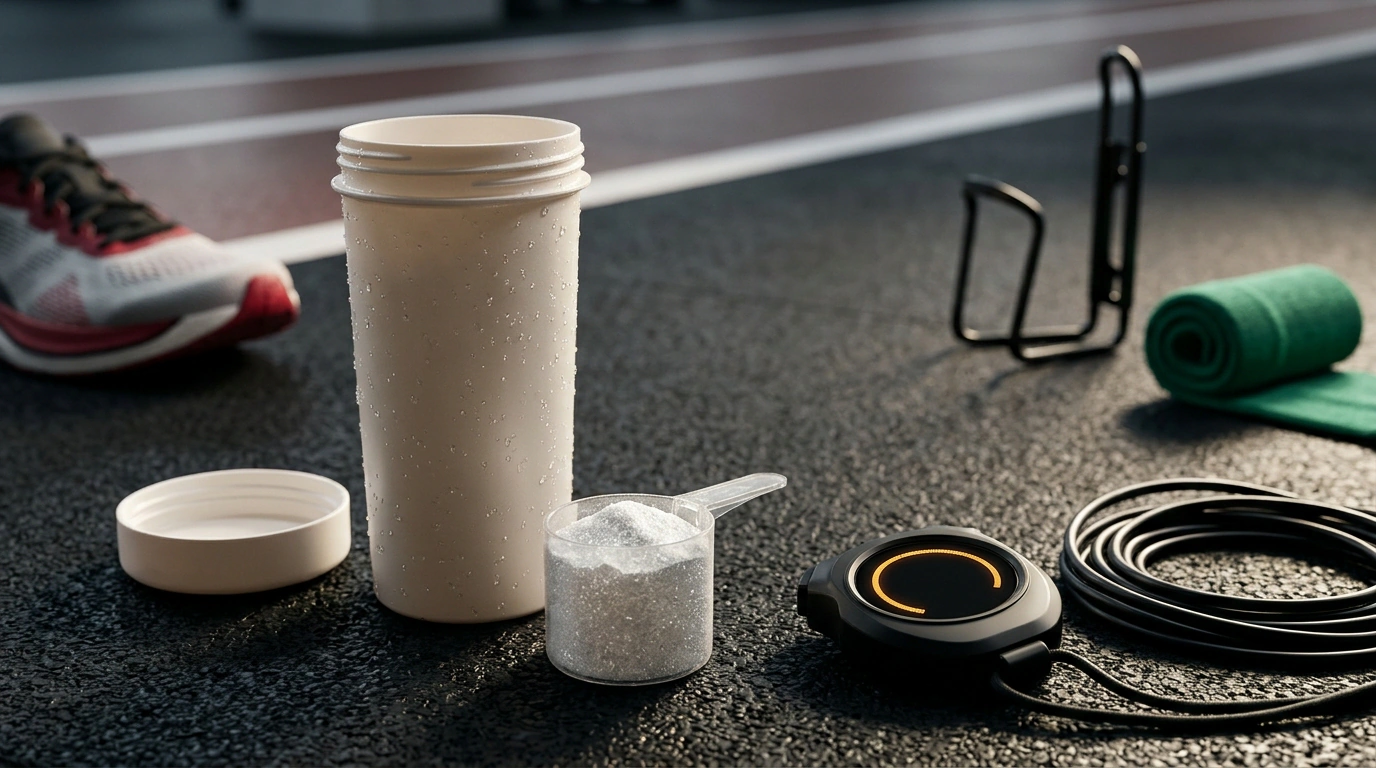
When a 14- or 16-year-old comes home from practice asking for a tub of creatine, parents usually hit one of two reflexes. First: shut it down instantly with 'no chemicals until you're grown.' In practice, that often ends with the powder landing in their gym bag anyway—bought pooled together with teammates and taken unsupervised. Second: shrug it off, since the supplement is popular and adults have used it for years.
Both reactions fall short. A flat ban ignores the real question of why your teen wants the tub in the first place. Meanwhile, applying adult fitness habits to a growing body runs straight into real medical gaps.
This article is for informational purposes only and does not offer individual medical advice or dosing. Decisions about any sports supplements for teenagers should be made with a pediatrician, sports medicine doctor, or sports dietitian.
How Creatine Works in Muscles and Why Adult Data Doesn't Apply to Teens
During short, explosive bursts—sprinting, jumping for a ball, lifting a barbell—muscles need fast energy. That fuel comes from ATP (adenosine triphosphate), a tiny rechargeable battery inside muscle cells. ATP stores are small and burn out in seconds.
That's where creatine steps in. Your body makes it naturally and gets more from everyday food, mainly meat and fish. Most of it sits in muscles, helping 'recharge' ATP faster. Taking a supplement simply tops up that muscle reserve so athletes can push slightly longer during intense short sets.
For adult athletes, creatine is backed by decades of peer-reviewed research: paired with strength training, it speeds up strength gains and boosts short-burst performance. That fuels the wave of TikTok and YouTube clips convincing school athletes that powder is mandatory gear.
Yet a teenager is not a smaller adult athlete, warns sports medicine physician Laura Scott of Dayton Children's Hospital. Adult pros get a boost from creatine on top of an already dialed-in foundation: sleep, calorie intake, recovery, and technique. For school athletes, that foundation is almost always shaky. Plus, between ages 13 and 17, the body is moving through puberty—bones lengthen, hormones shift, and muscle tissue develops. Doctors won't assume a growing body reacts the same way as a 25-year-old athlete.
What Science Actually Shows: A 2026 Review, Industry Funding, and Pediatric Guidance
Close social media and open medical journals, and the picture looks far more modest. In April 2026, Cureus published a systematic review (Rubinchuk et al.) searching global databases specifically for safety studies on creatine in children and adolescents. Across the entire world, only five such studies existed.
In the short term, the supplement was well tolerated: researchers found no consistent disruptions in liver, kidney, blood, or cardiometabolic markers, and no serious side effects.
Sounds reassuring? Not so fast. Hope College kinesiologist Nigel Jiwan draws a clear line: a lack of long-term studies during growth doesn't prove creatine is harmful, yet it strips doctors of the evidence needed to confidently call it safe and effective for teens. There is a wide gap between 'no harm spotted over a few months' and 'proven safe across years of puberty.'
Performance data tells a similar story. Certain papers, such as a 2021 Nutrients review, reported improved athletic metrics in teens. Overall, though, results vary widely and the study pool is a fraction of adult research. Worse, some papers—including that Nutrients review—were funded by supplement makers like Alzchem. Scientists call this risk of bias: when a manufacturer pays for the study, optimistic conclusions call for double-checking.
Another common mix-up involves the U.S. FDA's GRAS (Generally Recognized as Safe) status. Creatine monohydrate holds GRAS status, including notice GRN 931. The catch is that GRAS applies to creatine as a food ingredient for adults, not as an approval stamp for supplement tubs aimed at teens. Sports supplements don't go through drug-style pre-market testing, leaving risks of contamination or mislabeled ingredients. That's why sports doctors insist on third-party purity testing like NSF Certified for Sport for any supplement.
With that in mind, major medical groups stay cautious. Both the American Academy of Pediatrics (AAP) and the American Medical Society for Sports Medicine (AMSSM) advise against routine creatine use in children and teens. Their reasoning is practical: long-term data is thin, the supplement market lacks strict oversight, marketing is aggressive, and most young athletes are already falling short on food and sleep.
Is There a 'Safe Age' and When Should a Doctor Weigh In?
Parents often hope for a neat cutoff: is 16 fine while 14 is too young? Science has no magic number. Nothing flips a biological switch at 16 or 18 to suddenly make a supplement safe. There is no universal starting age.
Isometric 3D model of a muscle fiber cell showing ATP and phosphocreatine energy molecules.
In practice, the decision comes down to training load and daily habits.
| Teen's Situation | Is Creatine Needed? | Where to Focus Instead |
|---|---|---|
| Recreational sports, gym 'for fun,' school teams | No | Balanced meals, workout snacks, water, and sleep |
| Any teen under 16 at any training level | No | Fuel energy with food and rest; see a pediatrician or dietitian if fatigued |
| Older teen (16+) in elite competitive sports (college recruiting, national or pro track) | Case-by-case | Joint in-person review: teen, parents, pediatrician/sports doctor, and sports dietitian |
For the vast majority of teens eating well enough for their training, creatine isn't necessary. Requests for a tub almost always come from social media, sports idols, or locker-room chatter.
The exception is older teens (16+) competing at a serious level, such as preparing for college athletics or pro pathways. Sports dietitian Amanda Rossetti (founder of Fuel First Nutrition) recommends tackling the question together with a pediatrician, sports physician, or sports dietitian. A specialist can check whether the basics are covered, set realistic expectations, and explain which potential side effects to watch for.
What Actually Builds Teen Strength—and How to Start the Chat
Set aside flashy supplement tubs, and a young athlete has levers that deliver a far bigger jump in strength and stamina. A teen's body works double duty: it needs fuel for both workouts and physical growth. Skimp on food or sleep, and progress stalls completely.
Real gains rest on simple, steady habits. Regular, full meals cover three needs at once: carbs fuel training, protein repairs muscles and keeps hunger away, and healthy fats support growth. Simple snacks around practice work better than complicated 'protocols'—yogurt with berries or a banana with peanut butter. Add steady hydration all day, solid sleep, and injury prevention: missing a season from a torn ligament sets an athlete back months. Under heavy training loads, checking in with a dietitian helps confirm a teen gets enough calories and protein for growth plus sport.
Yet even a smart meal plan won't land if the conversation at home opens with a lecture. Behind a request for creatine sits a specific motive, and it often has little to do with shaving seconds off a clock. Maybe the whole team takes it and your teen doesn't want to feel left out. Maybe they genuinely love their sport and want an edge. Or maybe anxiety is hiding underneath—feeling behind peers, not strong enough, or worried they 'don't look like an athlete should.'
Instead of an instant ban, try genuine curiosity and one open question: 'What specifically are you hoping this will help you with?'
That approach lowers defenses and turns a fight over a tub into a calm chat about competition, confidence, and body image. When teens feel heard, they're far more likely to take in the core truth: roster spots and real strength come from training, food, and recovery—not powder off a shelf.