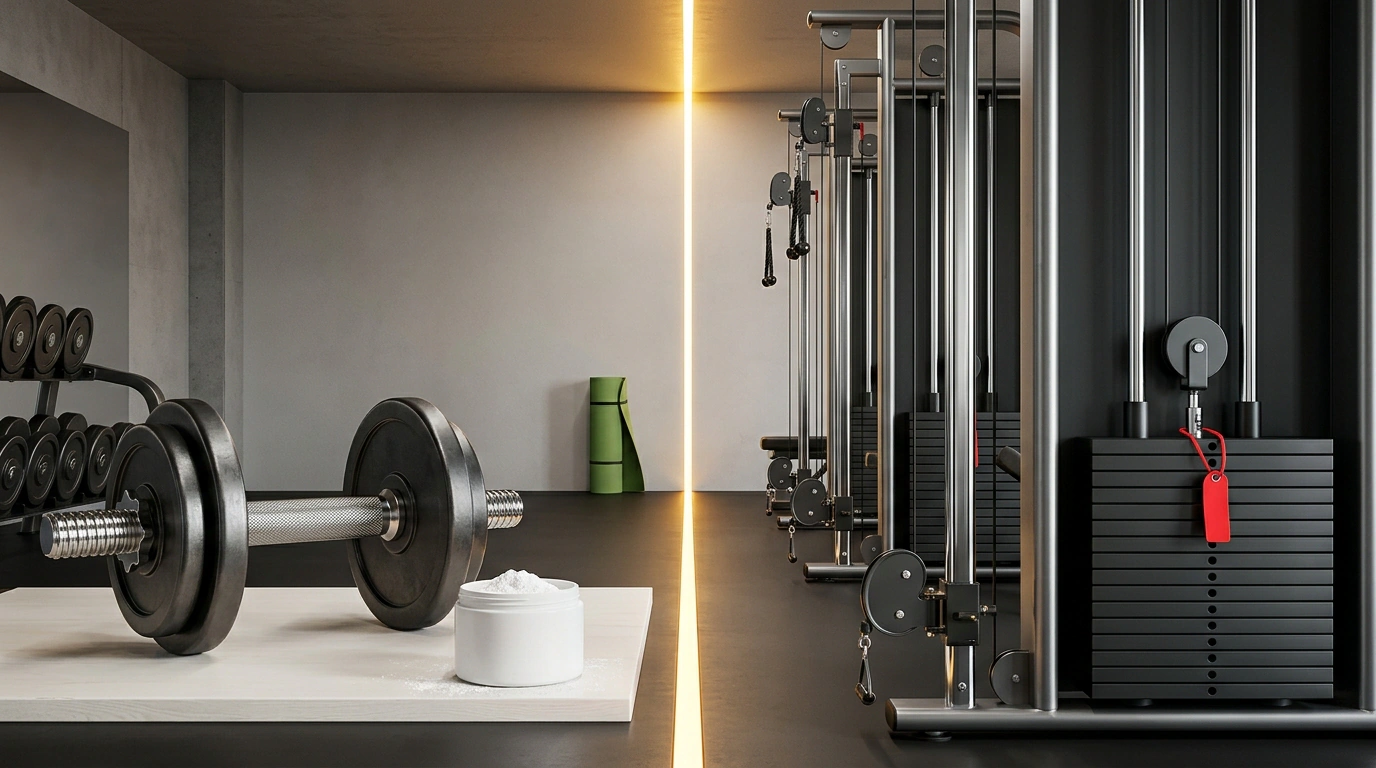
Muscles grow just as well on machines as they do with a barbell. Steady progress without a tweaked back or endless waiting in gym lines comes when you stop picking sides and simply put each tool in the right spot during your session.
Machines look tempting for a reason: a diagram on the frame highlights the target muscle with brief instructions. After two wobbly sets with dumbbells, it's easy to wonder whether you can just stick to machines entirely. You certainly can build a full routine on machines alone and hit every major muscle group. The real question is what you gain—and what you give up.
Free Weights: Balance, Open Racks, and the Cost of Fatigue
Free weights cover anything that moves freely in any direction without tracks: dumbbells, barbells, kettlebells, medicine balls, and even ankle weights. Without a backrest or guide rail, your body controls both the weight and its own balance.
The difference shows up immediately on a single goal—training your quads. Pick up dumbbells and do reverse lunges. To keep from tipping sideways, your core, back, hips, knees, and ankles all fire together: your brain and body learn to coordinate joints under load. Now move to the leg press. Your torso is braced against the pad, the path is locked in, and if a rep stalls, you simply latch the safety stop. Your legs worked hard, while balance and coordination took the round off.
There's a practical perk too. On Tuesday at five p.m., a line usually forms behind the gym's only leg press, whereas space by the dumbbell rack opens up right away.
The price of that freedom is clear: mistakes cost more. Grab too much weight, try an unfamiliar lift, or step under a barbell on shaky legs at the end of your hour—form breaks down and injury risk climbs fast.
What Machines Offer and What 13 Studies Show
Machines handle torso stability for you and deliver targeted muscle isolation—loading one specific group without tiring out stabilizers. For beginners, a fixed path helps build the mind-muscle connection and learn basic patterns. For experienced lifters, it allows pushing heavy loads with lower injury risk, while older adults gain steady support when balance gets trickier. During rehab or around joint limitations, an all-machine session remains a solid, effective choice.
Researchers put the 'which builds more muscle' debate to the test in an August 2023 meta-analysis by Markus Haugen's team in BMC Sports Science, Medicine and Rehabilitation. They pooled 13 studies totaling 1,016 participants aged 18 to 60 following programs of six weeks or longer. For hypertrophy (muscle fiber growth) and vertical jump performance, there was no meaningful difference between free weights and machines.
Maximal strength followed the principle of specificity: people who trained with barbells and dumbbells improved more on free-weight tests, while machine trainees scored higher on machine tests. Unless you're chasing a specific barbell number, both tools deliver equal strength and physique gains.
| Factor | Free Weights | Machines |
|---|---|---|
| Movement path | Open; you control it | Fixed, with torso support |
| Biggest advantage | Balance, coordination, stabilizers | Muscle isolation; safer with heavy loads |
| Main risk | Form breakdown when tired | Less balance work; rush-hour lines |
| Place in workout | Start of session, while fresh | Finish of session, as fatigue builds |
The Hybrid Formula for One Workout
Open your session with 1–2 compound (multi-joint) exercises using free weights—lifts that recruit several joints and large muscle groups at once, like squats, deadlifts, or reverse lunges. While your nervous system and stabilizers are fresh, you hold clean form and sharpen coordination.
Once fatigue creeps in, shift to 2–3 machines targeting specific muscles. Here it's much safer to push close to failure—the point at the end of a set where you couldn't complete another rep with clean form. Getting close to that edge triggers muscle growth, and the machine's support protects your lower back from jerking or overstraining.
Two Practical Pairings for Leg Day
On squat day, after your main free-weight sets, move to the leg extension machine to push your quads close to failure safely.
On deadlift day, after your main barbell or dumbbell work, finish the session with machine leg curls for your hamstrings.
Training close to failure always means clean form right to the last rep, never bouncing or jerking. If you have joint or spine injuries, ask a qualified coach or physical therapist to tailor your exercises and weights.