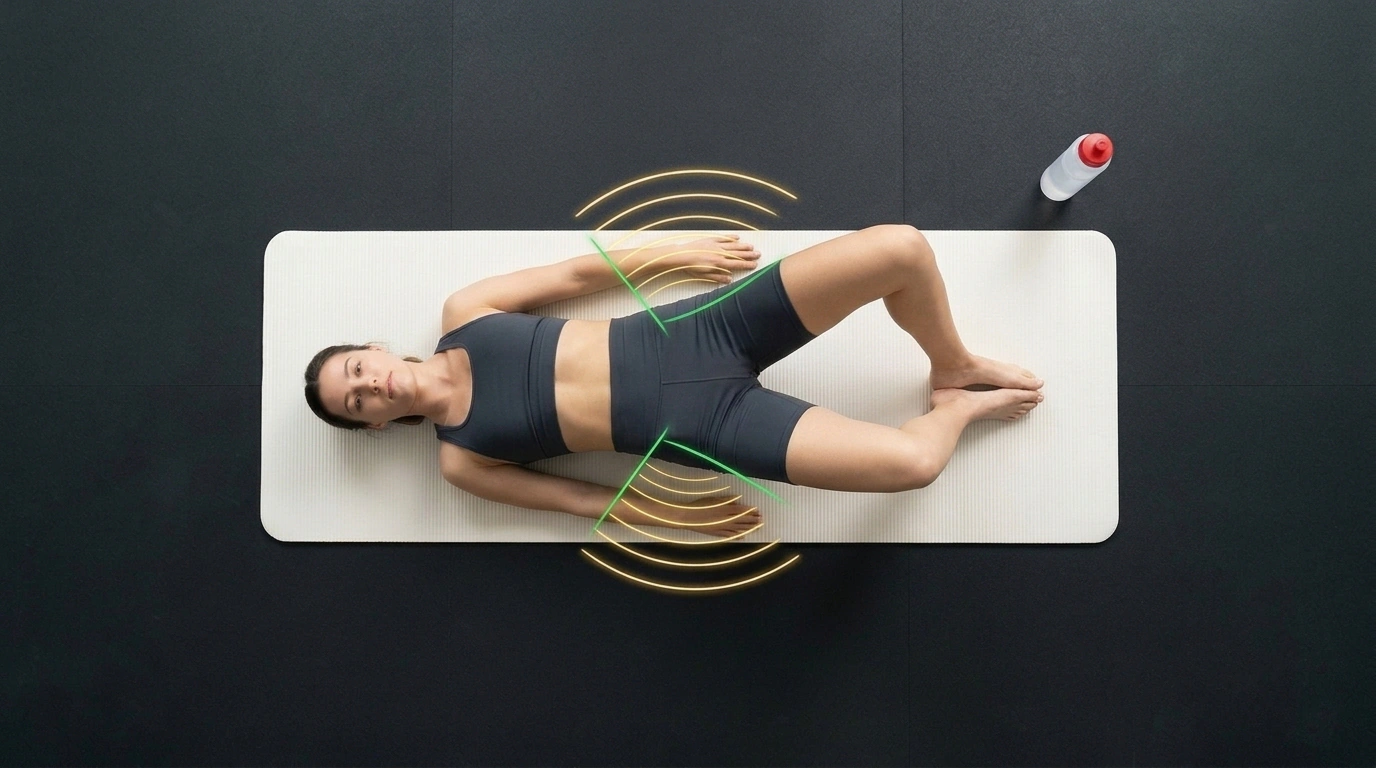
You stand up from your desk after eight hours at a screen and lie down on a mat for glute bridges. From the outside, everything looks normal: hips rise, thighs extend. Behind the scenes, your body pulls a switch. Glutes dulled by sitting stay half-asleep, so your lower back and hamstrings quietly take over the job. By rep ten, your back aches, your hamstrings burn, and your glutes feel like they skipped the workout.
How Frog Pumps Shut Down Lower-Back and Hamstring Cheating
Your glutes keep your pelvis level, protect your lower back, and power walking, running, jumping, and stair climbing. Sitting all day doesn't erase muscle strength outright, yet your brain forgets how to fire the right fibers on cue. Coach Daniel Booth of MyoLab Performance Concierge describes this as losing access to your own strength—a drop in the mind-muscle connection.
Picture a three-person moving crew where the strongest worker dozes off in the corner. To keep the job moving, two smaller teammates start hauling boxes for him. In your body, those teammates are your lower-back extensors and hamstrings. As long as they carry the compensatory load, the main worker stays asleep and knee mechanics suffer too. To wake your glutes up, you have to take the boxes out of the helpers' hands.
Frog pumps solve this through leg placement. Lie on your back, press the soles of your feet together, pull your heels close to your hips, and let your knees fall open to the sides. Your thighs rotate outward (external rotation) and move away from the midline (hip abduction), while your knees stay deeply bent.
EMG testing by biomechanics researcher Bret Contreras shows that in this position, the hamstrings shorten and lose leverage—like a slack rope you can't pull hard on. The hamstrings step back. Your gluteus maximus takes over hip extension, your gluteus medius, minimus, and deep rotators stabilize the joint, and your front core keeps your torso from arching. That's why frog pumps work even with bodyweight alone: they're ideal for warm-ups, low-energy days, or easing back after a break.
Step-by-Step Form and the Biggest Mistake With Lift Height
All you need is a mat. Set your position calmly and check your torso alignment before the first rep:
Step-by-Step Frog Pump Form
- Lie on your back, press the soles of your feet together, and pull your heels close to your glutes.
- Let your knees drop open naturally to the sides, resting your arms along your body or on your hips.
- Drop your ribcage down and tuck your pelvis slightly to flatten any arch under your lower back.
- Press the outer edges of your feet firmly into the floor.
- Squeeze your glutes and lift your hips until your thighs reach full extension without arching your back.
- Pause at the top for 1–2 seconds, then lower smoothly back down.
The biggest trap in this move is chasing height. Out of habit from regular bridges, it's tempting to shove your hips as high toward the ceiling as possible. The moment you do, your ribs flare up, your lower back arches, and your spine steals the load again. Use a simple test: if your lower back tires faster than your glutes, you've lost pelvic control. Height doesn't matter here—a hard glute squeeze and a steady torso do. Shorten the range, keep ribs down, and drive through the outer edges of your feet.
There's an anatomical caveat too. In Bret Contreras's observations, frog pumps hit the glutes cleanly for roughly 75% of people, while around 25%—due to hip socket anatomy—barely feel them or cramp in the inner thighs. There's no reason to push through discomfort: simply swap them for standard bridges or hip abductions. And if you have sharp lower-back or hip pain, check with a doctor or physical therapist first, since home activation exercises don't replace rehab.
Three Load Levels Without Compressing Your Spine
Once the basic version feels solid, it's easy to scale the challenge to your fitness level. In all three variations, you work lying down or supported on a bench, completely avoiding axial spinal loading—the vertical compression you get from barbell squats.
For beginners or anyone returning after a break, try a partial-range version. Lift your hips slightly lower than usual and press your palms lightly into the floor beside you for extra balance and a clean glute squeeze.
Ready to add resistance without weights? Slip a fabric mini-band just above your knees and actively press your knees outward on every rep. Resistance against hip abduction spikes, firing up your upper and side glutes while sharpening pelvic control.
For heavier strength work, move to weighted frog pumps or bench-supported frog thrusts. Rest a dumbbell or barbell across your hips, or place your shoulder blades on a bench like a hip thrust. Resistance climbs, your spine stays unloaded, and your glutes build strength for heavy compound lifts.