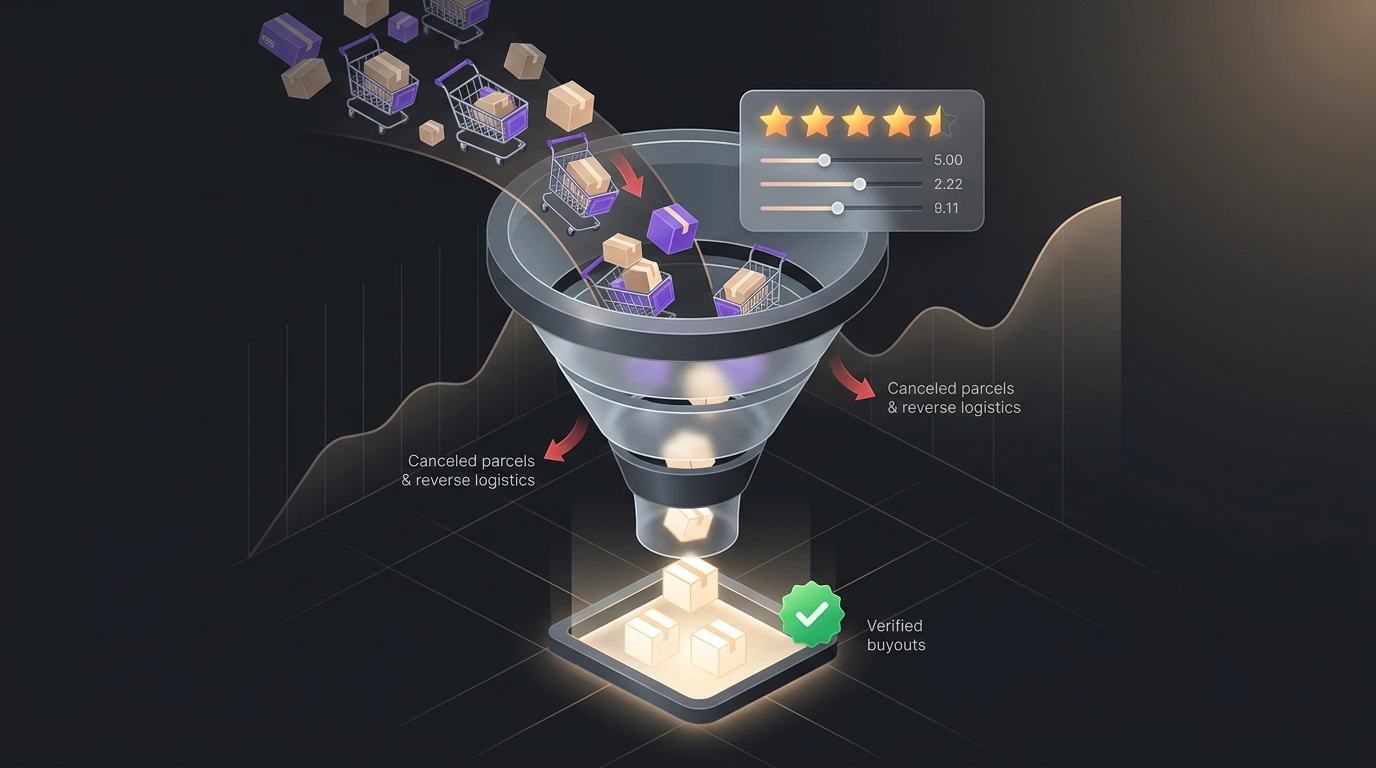
In e-commerce, nothing is more deceptive than great-looking vanity numbers. You pay an influencer 100,000 rubles, see a thousand orders in your dashboard, and start counting profits in your head. Three weeks later, you open the financial settlement report and realize less than a third of those items were actually bought. The rest came back at your return-shipping expense, turning the whole campaign negative.
WB Partners announced a package of product updates for the seller dashboard. What stands out is how the marketplace is shifting focus away from surface-level clicks toward hard unit economics, benchmarking, and risk control. Let's look at how these tools help protect your margin.
End of illusions in replacement SKUs: why net buyout data matters
Replacement SKUs ('Sales Growth' → 'Replacement SKUs') were built to protect organic rankings. You create a clone of your main listing for external traffic—like influencers, Telegram, or search ads—so irrelevant clicks don't drag down your main card in search.
Until now, that section had a blind spot: it only showed clicks, cart adds, and orders. Sellers calculated their ad spend ratio (DRR) based on orders. Yet in apparel and shoes, actual buyout rates average just 30–45%. Sellers paid influencers while buyers rejected most items at pickup points.
Adding the 'Purchased items' metric changes the math. The replacement SKU table now tracks units customers actually took home, not just intent. You can calculate true ROAS in real time and shut down influencers whose audience only generates empty traffic and return logistics bills.
Bulk cloning: faster discount testing
Alongside buyout tracking, Wildberries launched bulk creation for replacement SKUs. Previously, sellers had to build each tracking link one by one.
Now you can generate dozens of listing clones in a couple of clicks, each with its own promo price and discount. This makes A/B testing simple: you can test several price points across different audience segments at once, find the highest-margin sweet spot, and roll that winning setup out to your main SKU.
The 'Purchased items' metric and bulk creation live under 'Sales Growth' → 'Replacement SKUs'. The standalone funnel report sits in 'Analytics', and the rating calculator is built into the 'Product Rating' tab.
New 'Sales Funnel' report: where listings lose money
The second major update turns the 'Compare with Marketplace' tab into a standalone 'WB Sales Funnel' analytics module.
The tool breaks the buyer journey into five stages: impressions, listing clicks (cover CTR), cart adds, orders, and net buyouts at pickup points.
Its real power is comparing your numbers against category benchmarks across Wildberries. You spot leaks immediately:
- CTR below category average: Fix your main photo, infographics, or price.
- Strong clicks but weak cart adds: Check for missing size charts, unclear descriptions, or negative top reviews.
- Buyout rate below market: Look for color mismatches against studio photos, defects, or damaged packaging.
Rating calculator: measuring listing resilience
Inside the 'Product Rating' report, sellers now have a rating calculator. Wildberries calculates product ratings as a weighted average that gives extra weight to recent reviews.
The calculator lets you run quick scenarios:
- Enter a target score (say, raising a listing from 4.6 to 4.85), and the system tells you the exact number of five-star reviews needed.
- Test your safety margin: see how much your rating drops if one or two negative reviews land.
This helps you act early. You can enable 'Points for Reviews' ahead of time and build a reputation cushion before your listing slips in search.
Partner fulfillment centers
Rounding out the release are guidelines for opening partner fulfillment centers (PFC). Wildberries is expanding its distribution network by inviting regional entrepreneurs to handle cargo processing.
The platform published warehouse, CCTV, and accounting integration requirements along with payback estimates. For regional sellers, a wider PFC network means faster drop-offs, shorter shipping distances, and better product availability for buyers.
Today, every marketplace runs on strict math. Sellers who master net buyouts and forecast funnel conversion will capture the biggest market share this season.