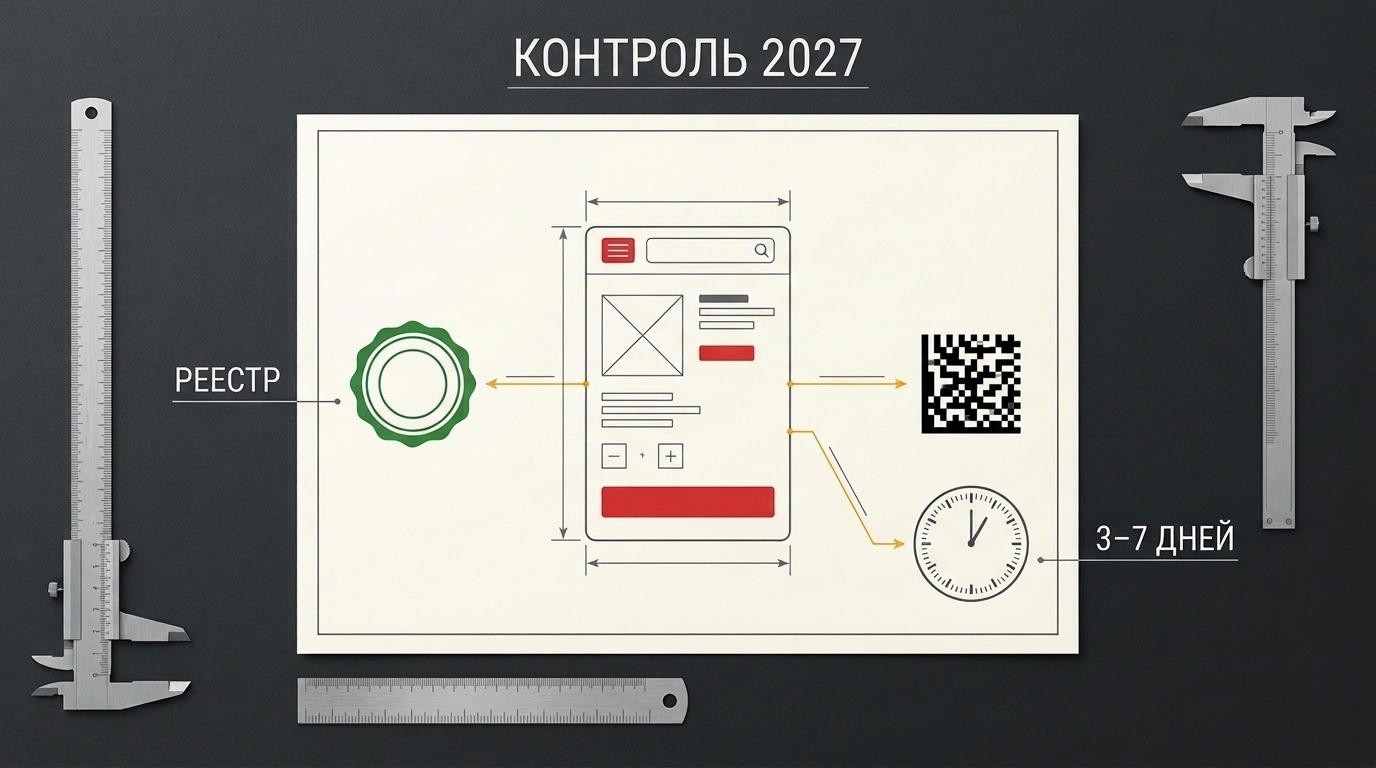
When you upload a new listing to Wildberries or Ozon, the surface looks routine: photos, specs, and a certificate link. Behind the scenes, state verification machinery fires up that same second. Back in fall 2026, platforms enabled automatic link checks against the Rosaccreditation registry, and on October 1 the Platform Economy Law (No. 289-FZ) took effect.
By early 2027, three new enforcement layers will sit on top of that system—from the Ministry of Economy, the Russian Government, and Rosaccreditation. One is already signed into law awaiting implementing rules, the second is in the State Duma, and the third is announced as the next GIS phase. Let's look at how each works, where its limits lie, and what to clean up in your catalog before winter ends.
Out-of-Court Blocks via Chestny Znak Starting March 1, 2027
Until spring 2027, stopping sales of a dangerous item requires a court order, even during mass poisoning risks. Federal Law No. 331-FZ changes that on March 1, 2027: sales will be halted out of court by agency order. Under this law, the Ministry of Economy drafted a Government Decree published on regulation.gov.ru.
Authority to issue blocks splits between two tracks. The first covers regional chief sanitary doctors and their deputies (under separate rules drafted by Rospotrebnadzor). The second covers heads of oversight agencies like Rosstandart or Rosselkhoznadzor and their deputies, which the Ministry of Economy's draft defines.
Triggers include confirmed inspection results, accident investigations, mass illness findings, and other threats to life or health. Once triggered, the chain moves fast:
- Within 1 business day, the agency logs the order in ERKNM (the Unified Register of Control and Oversight Activities—a federal inspection database required before any block activates) and sends a copy to the seller.
- The data goes public on the agency's website and feeds into Chestny Znak (Russia's mandatory digital product-marking system), immediately blocking labeled goods from scanning at checkout.
- Rosaccreditation receives an alert. If the item holds a serial certificate, the certification body is notified and must run an inspection audit to check the entire series for systemic defects.
Chestny Znak Data Matrix marking code on product packaging (Source: Wikimedia Commons, CC BY-SA 3.0)
The block is surgical—it targets only the specific flagged batch. The rest of the manufacturer's catalog and other batches of the same product stay on sale.
You can appeal, but first you must run your own internal check on the cited violations. Agencies must review appeals within 5 business days. If an order is overturned, the agency publishes a retraction—as AKIT president Artyom Sokolov noted, this helps "rehabilitate" the product in buyers' eyes so sales recover. Businesses can also claim budget compensation for wrongful blocks, including lost revenue during downtime. While Law No. 331-FZ is already enacted, the decree remains in draft, and the exact list of risk categories may still shift before March.
AI Certificate Cross-Checks: Ending the 'Borrowed Document' Workaround
Since September 1, 2026, a certificate or declaration link has been mandatory on product listings, and since October 1, platforms verify it automatically via GIS. Missing or expired links get listings pulled immediately.
Sellers quickly found a workaround: attaching a valid certificate from a similar or unrelated item. A basic status check sees "active" and lets the listing pass.
Rosaccreditation's system already handles 30,000 to 40,000 queries a day during listing creation, checking against over 4 million certificates and declarations plus more than 75 million test protocols. Half of connected platforms are already running live, while the other half test integration.
Marketplace Connections to Rosaccreditation Service
At the All-Russian Forum of Oversight Bodies in Khabarovsk on November 23, 2026, Rosaccreditation head Dmitry Volvach announced the next step: AI will cross-check certificate data against the listing's description, photos, and HS (TN VED) codes. If it spots a mismatch, the product gets blocked.
No exact launch date has been set for AI matching, but bogus paperwork is already being purged. Throughout 2026, inspectors ran 1,301 enforcement actions through the "Inspector" app (88.8% of all checks, up from 120 in 2025). Across the EAEU, 12 certification bodies were blocked: over 2,500 certificates failed Russian registration, and another 10,500 papers from one Kyrgyz body uploaded after its block were suspended. Gray-market EAEU documents can halt your sales even before the AI goes live.
Rospotrebnadzor Takedown Orders in 3–7 Days Without On-Site Audits
The third lever is slated for January 1, 2027, if the State Duma passes Government Bill No. 38773-9 (introduced in November 2026). It amends Article 40 of the Consumer Rights Protection Law (No. 2300-I) alongside Law No. 289-FZ.
Under the baseline State Control Law (No. 248-FZ), agencies can only issue orders from remote monitoring without an on-site visit if the sector-specific law explicitly allows it. Law No. 289-FZ lacked that clause for Rospotrebnadzor, and this bill closes the gap.
Rospotrebnadzor will remotely monitor compliance with Article 7 of Law No. 289-FZ (accurate seller and product info, marking, certificates, and safety) and send orders straight to platform operators with the exact URL of the offending listing. The compliance deadline is 3 to 7 calendar days.
This rule targets intermediary digital platforms meeting Government Decree No. 54 criteria from January 28, 2026: at least 100,000 daily Russian users over the prior year and at least 10,000 partners with at least one transaction. Wildberries, Ozon, Yandex Market, and other major storefronts qualify directly. Facing a 3–7 day clock, platforms will hide disputed listings immediately and push urgent fixes onto the seller.
Timeline Summary and Catalog Readiness Checklist
Here is how all current rules and pending bills line up.
| Mechanism | Status (Nov 2026) | Planned Launch | Response / Appeal Window | Scope | | --- | --- | --- | --- | --- | --- | | Automatic link checks (FSA) | Active | Sep 1 / Oct 1, 2026 | Instant at upload | All listings requiring certification | | AI matching of photos, text, and HS codes (FSA) | Planned | Not announced | Auto-block on mismatch | Connected marketplaces | | Rospotrebnadzor orders (Bill No. 38773-9) | Bill in State Duma | Jan 1, 2027 | 3–7 calendar days | Platforms with 100k+ users and 10k+ partners | | Chestny Znak blocks (Law No. 331-FZ) | Enacted; decree drafted | Mar 1, 2027 | 1 day to ERKNM; 5 days to appeal | Specific unsafe batch only |
You have a short window before January–March to clean up your catalog without an emergency sales freeze.
What to audit in listings and documents before 2027
- Match every listing's description, photos, and HS code against your certificate or declaration text, and remove any 'neighboring' or borrowed documents.
- Check your certification body's status in the Rosaccreditation registry, especially for EAEU documents, since many have already been blocked or suspended.
- Set up batch-level tracking for marked goods in Chestny Znak so you can isolate a flagged batch, run an internal check, and file an appeal within 5 business days.
- Verify all mandatory listing fields under Article 7 of Law No. 289-FZ (seller details, marking, ingredients/composition, and safety) so platforms don't hide top sellers under 3–7 day Rospotrebnadzor orders.