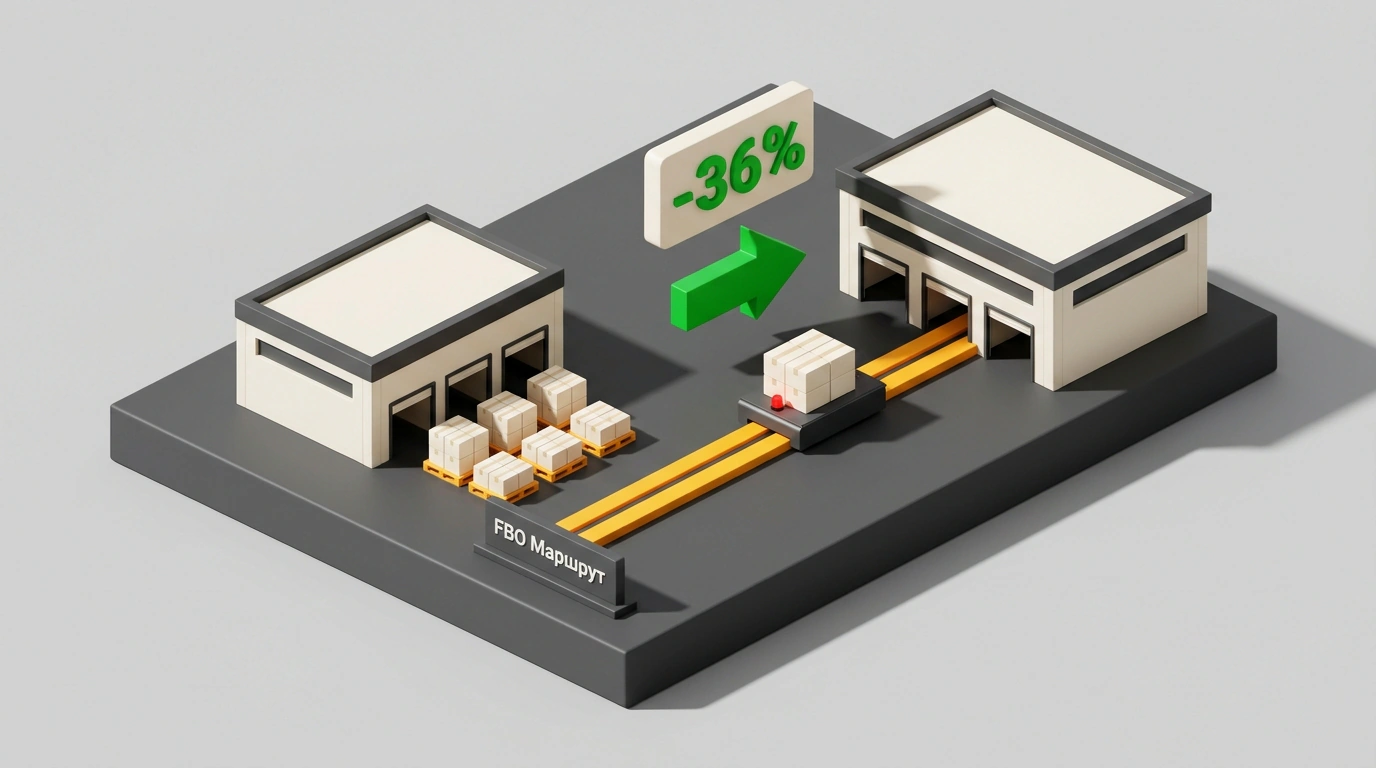
By late November, FBO sellers (where stock sits in Ozon warehouses and Ozon packs and ships orders) often hit the same imbalance. A hundred boxes sit stuck in a distant regional warehouse where sales crawl and paid storage ticks up. Meanwhile, Moscow or St. Petersburg only has three days of stock left, risking a stockout right before December. Buying a fresh batch is expensive, and until recently, paying Ozon to move stock between warehouses cost too much.
What changed on November 25 and where the catch hides
On November 25, 2026, Ozon cut rates for seller-requested transfers between its facilities by an average of 36%. The platform picks up FBO stock already sitting in one warehouse and moves it to another without your involvement. The update covers Russian and Belarusian sellers.
Against steady commission hikes, the discount looks like a holiday gift—with one catch: rates dropped on only half of all routes. The other half kept old pricing, and Ozon hasn't published a public list of discounted warehouse pairs. Live rates sit inside the 'Commissions and Tariffs' table in your portal (and in the extra services help section for Belarusian sellers). Submit a request blindly, and it's a coin flip whether you pay full price.
Cost vs. benefit: when a transfer pays off
Per-unit pricing depends on item volume in liters and the specific pair of warehouses or clusters (Ozon's major zones like 'Moscow-West,' 'St. Petersburg & NWFD,' or 'Ural'). Compact SKUs under one liter get softer rates, while cross-country hauls cost more than neighboring legs. You can move stock between clusters or within the same cluster if supported. Each request covers one origin and one destination warehouse, with a minimum of 20 units for sortable goods (down from 40).
Look at the upside of this convenience. Stock moves closer to shoppers, reaches pickup points faster, and your card holds conversion and search rank. Your localization index (share of orders fulfilled from the buyer's own cluster) climbs, average delivery time drops, and last-mile logistics costs less than cross-cluster shipping. Plus, you don't pull working capital for a new purchase.
Two hidden costs remain. First is size: bulky items with high liter volume eat margin even with the discount. Second is transit time. While boxes ride between Ozon warehouses, those units cannot be sold. Cut it too close, and your batch sits inside a truck right through December's peak.
| Factor | FBO transfer via Ozon | New shipment from your warehouse |
|---|---|---|
| Working capital | Stock is already paid for at Ozon | Requires new purchase or dispatch |
| Item size | Better for compact SKUs | Better for bulky goods |
| Tariff risk | Pays off on discounted route half | Depends on your carrier or cross-docking |
| Stock downtime | Units don't sell during transit | Existing stock sells until intake |
If your route falls in the discounted half, the item is compact, and paid storage is ticking at the old warehouse, a transfer wins. For bulky SKUs and non-discounted routes, it's cheaper to restock the cluster via a standard shipment or cross-docking.
What to check in the portal before submitting a request
Create transfer requests in Ozon Seller under FBO → Stock Management ('Transfer Requests' tab), where you can also track packing status and estimated arrival dates. Run four quick checks before launching one.
Pre-request checklist for FBO warehouse transfers
- Check your exact warehouse pair in 'Commissions and Tariffs' to confirm the route got the discount instead of keeping the old rate.
- Calculate the per-unit transfer cost by liter volume and compare it against cross-cluster shipping from the current warehouse and a new shipment.
- Check 'Analytics → Sales Geography' to pinpoint clusters facing December shortages and warehouses holding slow stock.
- Review the estimated arrival date in 'Transfer Requests' to make sure stock goes live before peak sales.