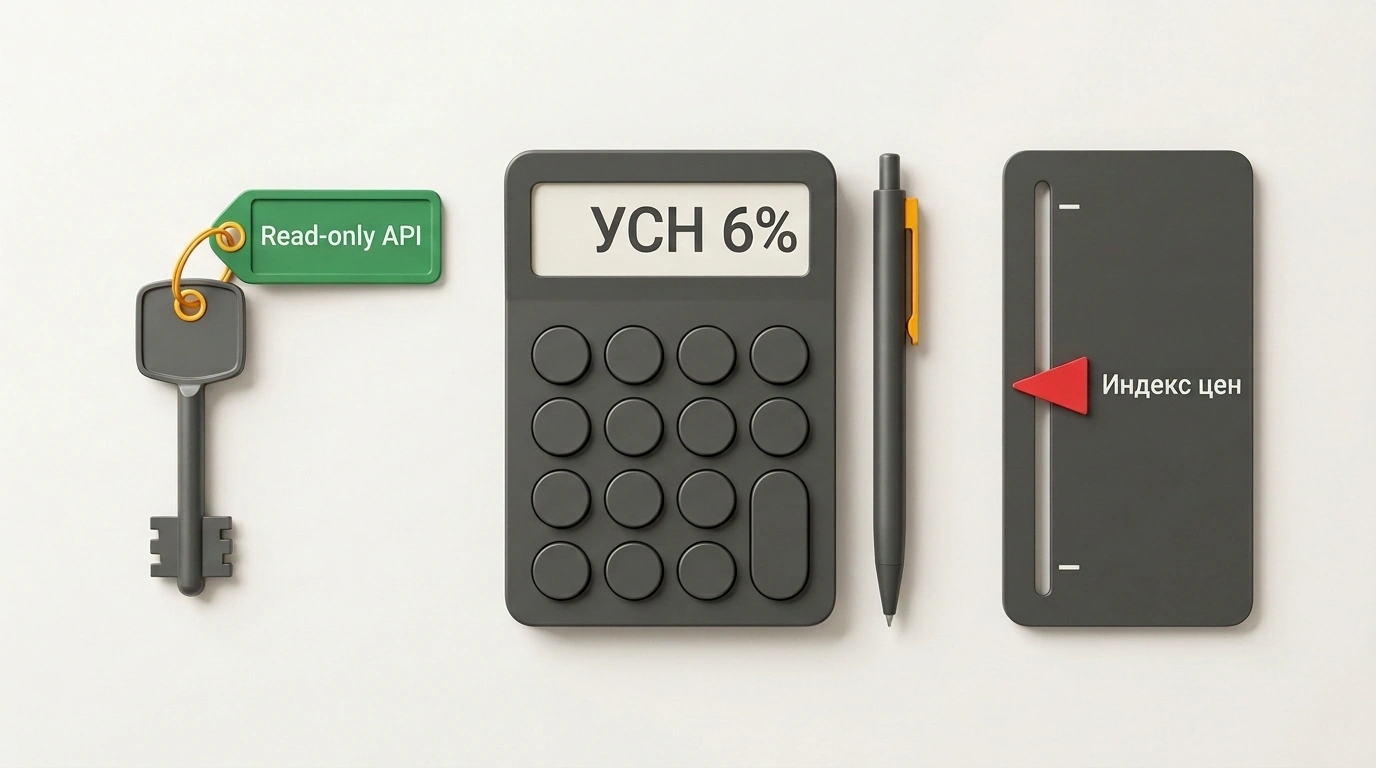
'Looks like human support is completely turned off there too.' Every Ozon seller hits that feeling when stuck in a loop of bot replies. In daily operations, three weak spots cause the most trouble: sharing API access, calculating sales tax, and fixing broken Price Index links. Guessing wrong here costs you leaked bestsellers, back taxes from the FTS, or dropped search visibility. Let's settle all three using platform docs and tax law.
Is it safe to share your Client ID and read-only API key with analytics tools?
Connecting external analytics requires your Client ID (your Ozon portal ID) and an API key. It's easy to assume a read-only API key is completely safe: nobody can change prices, delete cards, or cancel orders.
Under Settings → Seller API → Generate Key, the token is shown only once. The Admin read only role does block edits, yet it opens every informational endpoint at once: products, warehouse stock, prices, orders, analytics, reports, and financial accruals.
For competitive intelligence, nobody needs to edit your account—the value is in the data. Combining SKU, sales velocity, stock, and returns exposes your high-margin winners. Major tools usually anonymize stats, yet weak security or an employee leak can hand your best items straight to third-party product scouts.
You don't have to hand out broad Admin read only access to everyone. Ozon's Seller API role and method mapping includes narrow read-only roles limited to specific sections—pick only what a tool actually needs.
API key hygiene on Ozon
- Create a separate key for each service with a clear, descriptive name.
- Replace
Admin read onlywith narrow read-only roles wherever a tool supports them. - Never share keys with sketchy bots or 'winning product' finders.
- Delete the token in your portal immediately after a trial ends or you stop using a tool.
This audit takes two minutes and clears out forgotten keys you'd otherwise remember only after a leak.
Which amount is taxed under 6% USN on Ozon: gross sales or bank payouts?
A classic beginner mistake is calculating tax on the cash that hits your bank account. Under Russia's 6% Simplified Tax System (USN 'Income'), your tax base includes all revenue paid by buyers without deducting any of your expenses.
Under Arts. 346.15, 249, and 346.18(1) of the Tax Code, Ozon's commission, logistics, storage, acquiring, ads, and fines are seller expenses and do not reduce the tax base. FTS Letter No. SD-4-3/5416@ of May 8, 2024 (agreed with the Finance Ministry; see also letters No. 03-11-11/26872 and No. 03-11-11/83988) confirmed this rule, and courts back it up (for example, Ural District Commercial Court ruling No. F09-2251/26 of August 5, 2026, in case No. A71-3590/2025).
Do the simple math. Buyers keep 100,000 ₽ worth of goods. Ozon deducts 30,000 ₽ for commission and logistics, and wires 70,000 ₽ to your bank. You pay 6% tax on the full 100,000 ₽ (6,000 ₽), not on 70,000 ₽ (4,200 ₽). Always pull numbers from your Sales Report (agent's report), not your bank statement; under cash-basis accounting (Art. 346.17(1) of the Tax Code), it's safer to recognize income on the date the buyer pays the agent.
One Ozon quirk involves discount points. Since October 2023, Ozon reimburses loyalty discounts with virtual points (1 point = 1 ruble) that automatically offset Ozon service fees and aren't paid out in cash, aside from rare leftover balances. Under Art. 346.17 of the Tax Code, points spent inside the platform don't create separate cash income: your tax base includes actual buyer payments (net of discount) plus any cash payouts of leftover points.
Since there is no single federal FTS letter on points yet, local tax offices sometimes flag gaps between reports and bank statements. Don't agree automatically: in Ozon points dispute rulings (including case No. A40-740/2026), courts have already overturned regional back-tax assessments—reply with an explanation citing Art. 346.17 of the Tax Code and the restricted nature of points.
Yandex Market Price Index links vanished, and the bot won't reject a different bundle
Ozon's Price Index compares your price against the same item on other marketplaces, including Yandex Market; a poor index cuts your listing's visibility. Sellers keep hitting the same dead end: old Yandex Market links disappear, trying to re-add them triggers a 'link already exists' error, and adding a new URL says it won't open. Worse, the bot refuses to unlink a competitor selling a different bundle size, claiming shoppers view them as identical.
The reason is simple. The Price Index scraper matches cards mainly by main photo and broad keywords, often ignoring item count, weight, or bundle contents. Meanwhile, Yandex URLs break due to redirects and URL updates—the match vanishes from your screen yet lingers in Ozon's archive database.
Ozon doesn't publish a guaranteed way to bypass bot replies, yet a four-step workflow works in practice.
First, open Prices & Promos → Price Index and submit a standard complaint about a mismatched bundle if the button is active. If the bot sends a canned rejection, open a support ticket (Prices & Promos → Price Index) with dry facts: two screenshots (your Ozon card and the Yandex Market card highlighting bundle contents or volume), a bulleted list of differences, and a direct request to unlink that exact URL from your SKU.
If tier-one support sends a template refusal, ask to escalate the ticket to a senior specialist or the pricing department. At the same time, fix the root cause in your own card so it doesn't re-match: put bundle contents and unit count at the start of the title, fill in every spec (contents, dimensions, pack count), and add clear bundle infographics to your main photo—visual differences retrain the matcher fastest.