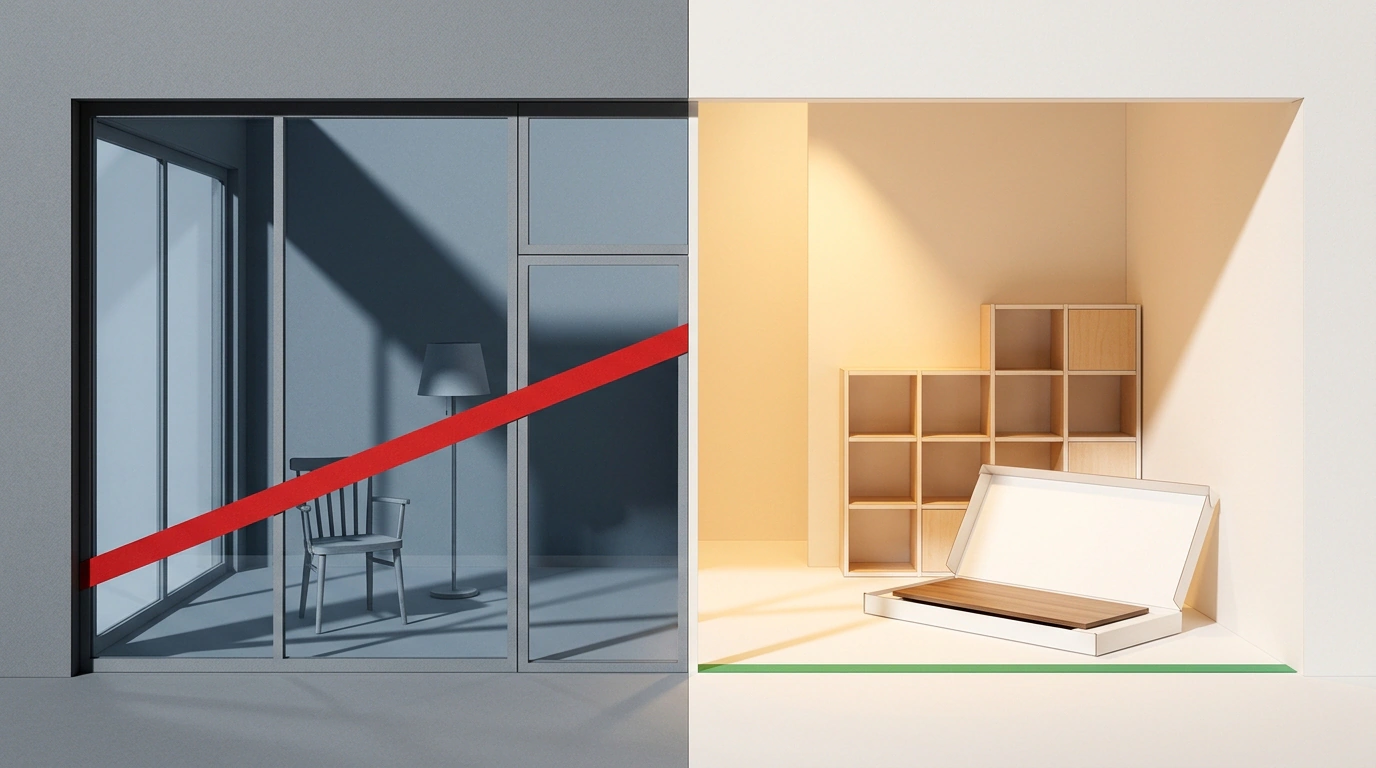
You'd think shoppers would keep buying dishes and bulky furniture in physical stores until the very end. People want to touch cabinet fronts, test hinges, hold a plate, and avoid worrying if a wardrobe will arrive chipped. In practice, a different habit took over: shoppers walk into a showroom as a free display hall, inspect the item in person, and place the order in a marketplace app where it's cheaper and easier to deliver.
That 'showrooming' wave is already hitting brick-and-mortar retail. According to 2GIS data as of early November 2026, 12% of home-goods stores across Russia's million-plus cities closed over the past year, leaving roughly 25,087 locations. St. Petersburg and Nizhny Novgorod saw the steepest drops (-15%), followed by Omsk and Krasnodar (-14%) and Novosibirsk (-13%).
Why Neighborhood Hardware and Home Stores Yield to Pickup Points
The contraction hit every segment of home retail, though unevenly (row totals exceed the overall store count because some shops carry multiple formats).
| Offline store category | Remaining locations | Year-over-year change |
|---|---|---|
| Tableware & dishes | ~6.9k | -18% |
| Furniture | ~6.4k | -12% |
| Home textiles | ~7.6k | -9% |
| Household goods | ~10.4k | -8% |
Offline stores got squeezed from two sides: shoppers check app prices right beside the shelf while rent, wages, and wholesale costs keep climbing. A shift in new residential developments finished the job. Fresh apartment blocks used to be prime ground-floor real estate for neighborhood hardware stores; now pickup points (PVZs) take those units. Why pay a markup at a local shop when a PVZ sits next door?
Even so, store closures don't promise easy money online. Seller economics on Wildberries and Ozon face tight pressure too: commissions, logistics, and ad bids wipe out margins if you trade blindly. Demand moved online, yet within categories it flows unevenly.
What Captures Furniture Demand on Wildberries
Peak furnishing season runs from October through January as people finish renovations and set up apartments. Shelving units, shoe racks, coat stands, and entryway furniture lead the early wave.
The real money sits in a heavier segment: 35% of all Furniture category sales on Wildberries come from cabinet furniture and storage systems. Growth rates inside that segment show clearly where buyer interest shifted.
Sales growth in Wildberries cabinet furniture subcategories
The gap between the top and bottom of the chart jumps right out. Complete modular living rooms, kitchen sets, and furniture bundles grow several times faster than standalone wardrobes. Shoppers are tired of piecing a room together across different listings and risking three mismatched shades of 'Sonoma oak.' Buying a ready-made set to finish a room in one order is simply easier.
Keep realistic expectations, though: Wildberries' report didn't state the exact comparison baseline or ruble sales volume. Percentages alone don't guarantee easy revenue, yet the shift toward bundled sets is unmistakable. Buyer tastes are shifting too: plain white and beige fronts are losing their monopoly, while routed MDF and bold accent colors have crossed from niche design into mass demand.
How to Rebuild Your Catalog Without Burning Out on Bulky-Item Logistics
Entering the furniture category today with one basic nightstand or solo wardrobe sends you straight into a price war with dozens of near-identical listings. A smarter play is a capsule offer, or serial matrix: group several listings into one collection sharing a color, hardware, and finish so a buyer can furnish a whole room from your store. Adding routed MDF and accent colors—already proven in the autumn-winter peak—fits naturally into that lineup.
Before launching sets, crunch the numbers for bulky cargo (KGT). Cabinet furniture carries its own storage and shipping tariffs plus far stricter packaging rules than small goods. One chipped corner or a delivery refusal easily wipes out the profit from several completed sales, so reinforce your cardboard and bake return-logistics costs—adjusted for real buyout rates—into your pricing before the first shipment.