It's Friday, 9:30 a.m., in Naberezhnye Chelny. A crowd is already waiting outside a store's closed metal shutters. Most are people over fifty who don't have to sit in an office on a weekday, and many brought sturdy bags from home. At ten sharp, the shutters roll up. An employee steps into the doorway and announces the rules: everything is 750 RUB today, minimum three items, come on in. He barely has time to step aside before the crowd rushes the boxes like runners at a starting line. In the rush, almost nobody notices a Chinese knockoff iPhone 15 Pro Max and a smartwatch sitting right by the register for the same 750 RUB.
Over the past six months leading up to November 2026, these offline 'marketplace remnants' shops have multiplied across Tatarstan and spread into neighboring regions. From the outside, it looks like a gold mine: lines before opening, empty boxes by evening, and zero headaches with product listings, search ads, or marketplace fees. Let's look inside this business with a calculator and the law in hand. Where do these pallets actually come from, why does a single store drown in a cash deficit, and what risks do owners take when they hide behind a consignment-shop sign?
How the '750 to 100' Storefront Works and Why Crowds Rush In
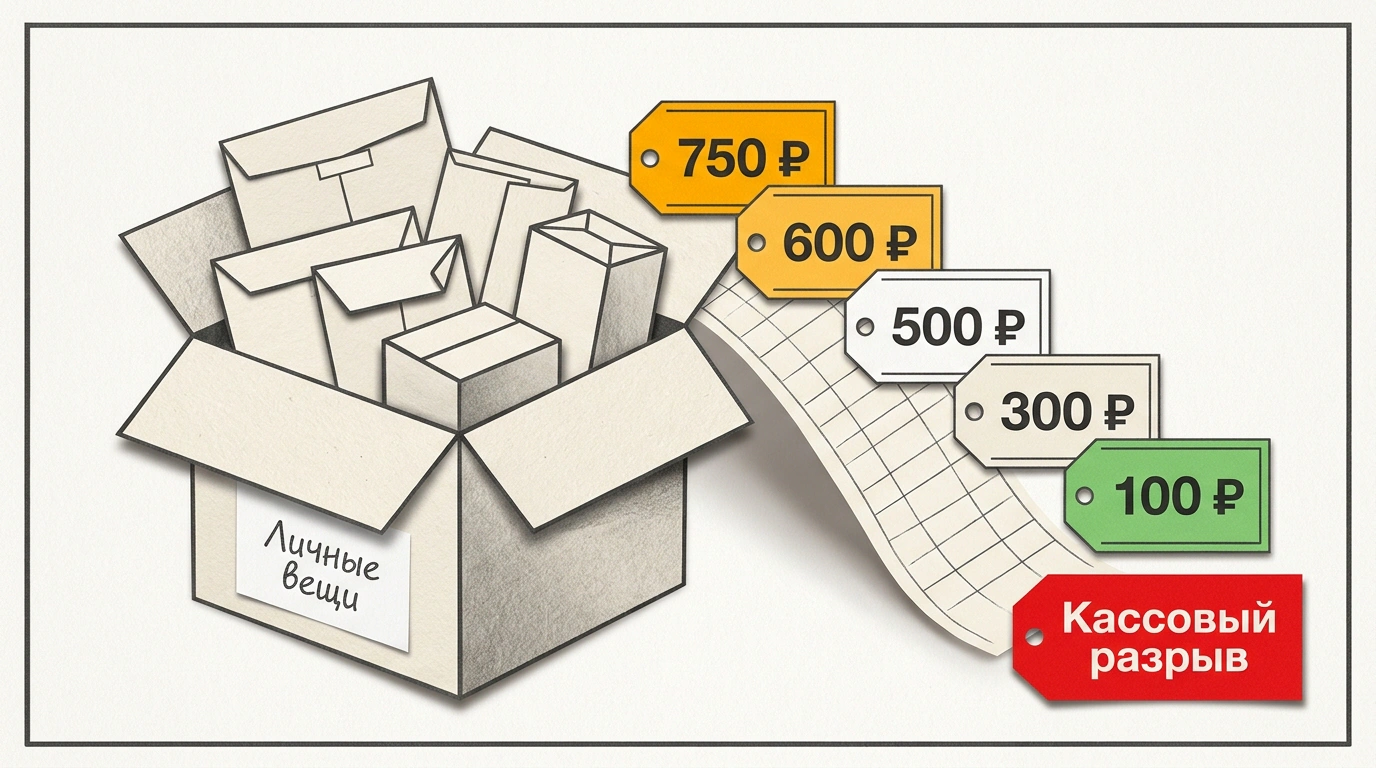
At its core, this is a new twist on old 'everything for 99 RUB' chains, upgraded with a game-like mechanic. On the day a new batch opens, every item on the floor costs 750 RUB, sometimes with a minimum purchase of three pieces. Every 24 hours after that, the price drops in steps. In a typical five-day cycle, it goes from 750 down through 600, 500, and 300 to 100 RUB per item (some stores set day four at 550 RUB).
Isometric cutaway infographic of a marketplace overstock store floor: boxes of clothing, shelves of unsold goods, and shopper traffic across a five-day discount cycle.
Pure treasure-hunt excitement drives the model. On social media, these shops lure shoppers with videos promising a sewing machine, a cordless drill, or a Dyson hair dryer with all attachments for 500 RUB. Opening-day clips show people literally waiting for a 'one, two, three' countdown to reach fresh boxes first. To keep buyers hooked, almost every store runs restock and price-drop alert channels in the Max messenger, barely using Telegram. Just one shop in suburban Kuyuki gathered around 800 active subscribers there.
As of November 2026, Kazan alone has at least 15 of these shops under names like Pochti Darom, Sharom Darom, Khalyava Market, and Arzan Market. Naberezhnye Chelny has at least five more. The largest Chelny location took over a former Eldorado space in the 105 mall, where staff open roughly a hundred large boxes per drop. Stores are already operating in Nizhnekamsk, Yelabuga, Almetyevsk, and Buinsk, and Kazan entrepreneurs have expanded across the Volga region and Bashkortostan into Ulyanovsk, Volzhsk, Cheboksary, Ufa, and Sterlitamak.
Nobody tracks national stats for the format, but it is spreading fast. The idea itself isn't brand new: Denis Vetrennikov, founder of the seller ecosystem SellerDen, spotted similar schemes back in 2022–2023. Back then, trading happened in closed chats. In the Moscow region, for example, people sold goods claiming to be Wildberries employees until police shut the group down. By late 2026, gray-market resale moved out of private chats onto the ground floors of malls and apartment buildings.
Early in the wave, staff simply dumped open cardboard boxes on the floor for the crowd to tear through. Now some stores try to keep basic order by sorting items onto shelves by rough category. Still, basic merchandising rules are ignored: household chemicals or car accessories often sit right next to children's toys. When shoppers ask where the goods come from, clerks give a rehearsed answer about 'marketplace remnants' and end the conversation.
What's Actually Inside the Boxes and What Brands and Marketplaces Say
Once the hype settles and you calmly dig through the bins, the magic of a '500 RUB Dyson' fades fast. Roughly 90% of the assortment is cheap Chinese mass-market goods with Chinese characters on the tags: low-cost clothes, shoes, bags, wigs, nail-drying lamps, sunglasses, projectors, wireless chargers, and small kitchen tools. Many items are still sealed in recognizable gray polybags with cross-border shipping labels, most often from Ozon Global. The original buyer's personal details are sloppily blacked out with a marker.
Sometimes unexpected items turn up in the mix. During an unboxing at a Kazan store, staff pulled out black trousers with an MNG tag, a 29.99 EUR European price sticker, and standard Inditex/Mango labeling for Spain, Portugal, and Greece. The fabric felt genuinely branded. In the same boxes sat adult items (intimate lubricant, a masturbator, and a dildo, which owners promised to move to separate labeled bins), a hunter's camouflage suit, seat covers for a LADA Vesta, and an ironing board.
Wooden pallet stacked with 30-piece cardboard boxes from China, typical of wholesale lots for fixed-price overstock stores (Source: Openverse / Flickr, juhansonin, CC BY)
Even the bargain factor looks shaky when you open a marketplace app and compare prices directly. On a table at a Kazan shop on Tatarstan Street (which opened on November 14, the day after the owner registered an IP sole proprietorship, with balloons and 'Freebie' flyers on the windows), collectible LEGO Marvel Studios minifigures were priced at 550–750 RUB. On Ozon, the same figures sold for 600 to 1,600 RUB. Even clearer was a VOIS niacinamide face wash gel: on November 19, 2026, it cost about 566 RUB on Ozon and 550 RUB in the shop. That's a 16 RUB saving for a dented box. Incidentally, the Chestny ZNAK tracking code on that gel scanned as authentic with full permits.
Beyond Chinese stock, shelves also held well-known Russian and regional brands: Librederm balm, Molodoy Lite D3+K2 vitamins from Krasnodar, an Almaz compressor nebulizer from Rostov, a Kukmara frying pan, an Aurora smart TV box, and VMPAUTO gun oil from St. Petersburg.
Do the brands know their products are being dumped in bins for 550 RUB? It turns out they don't. Aurora stated directly that it sells its TV boxes exclusively on Ozon and never authorized offline discount sales. Most customer returns at marketplace warehouses have already been opened and lost their retail appearance, so the brand doesn't take them back and sends them for disposal under Ozon's internal procedures.
VMPAUTO in St. Petersburg was equally surprised. Regional manager Vadim Smelov explained that the company ships only to official partners and directly to marketplaces. Most of its range, including Berezka gun cleaner (SKU 8518), is easy to verify in Chestny ZNAK. In his view, returns and write-offs leak into these shops after their tracking codes were either withdrawn from circulation or never applied, which explains why stores avoid issuing receipts. On the bottle found in the shop, the marking code was indeed missing. The manufacturer also opposes this trade for a practical reason: nobody guarantees proper storage conditions, shelf life, or warranty.
The marketplaces themselves deny any involvement. RWB (the merged Wildberries and Russ company) stated it has no connection to goods in third-party shops. Ozon went further and urged shoppers not to buy these items, calling it dangerous. On paper, Ozon's process looks strict: unsellable goods that cannot return to stock go to specialized disposal contractors with destruction equipment, photo and video reports are required, and violations trigger contract termination.
The gap lies in how that control works on the ground. Denis Vetrennikov shared a specific case: he found a warehouse on the outskirts of Yoshkar-Ola stacked with marketplace goods, sent an employee to photograph the products, barcodes, and delivery vans, and handed the evidence to Ozon. After several follow-ups, Ozon only replied that it planned to terminate the contract with its regional disposal contractor. Whether the origin of all batches was ever traced or anyone faced real penalties remains unknown.
Legally, the chain of responsibility is clear. If a contractor takes a batch for destruction and diverts it to a wholesaler instead, the client can claim damages for breach of contract. But if the marketplace itself promised the seller it would dispose of the goods, the marketplace generally remains liable to the owner even if a third-party contractor cheated.
Four Supply Channels and the 'Pallet Clearinghouse'
How do such random goods travel from online storefronts into neighborhood cardboard boxes? Without conspiracy theories, four main channels explain the flow:
- Legal buyouts from exiting sellers. A seller winds down their marketplace store and dumps remaining stock wholesale at a steep discount. The owner sold their own goods, so the deal is legal.
- Disposal leaks. Damaged returns, defects, or batches a seller failed to pick up from a warehouse on time. On paper, these go to destruction, yet some boxes surface at wholesale depots. Without the owner's consent, reselling them is illegal.
- Cross-border returns and unclaimed parcels. This mostly involves Chinese sellers on Ozon Global. Shipping a cheap item back to China after a customer refuses it costs more than the product, so it's abandoned in Russia. That accounts for the 90% share of Chinese goods in gray bags.
- Direct wholesale of cheap Chinese goods with a 'marketplace' story. This is the most grounded explanation, pointed out by Wildcard manager school founder Dana Malkina. She doubts massive theft from marketplace hubs given tight warehouse security. Buying cheap lots in China and slapping on a 'WB and Ozon remnants' label is simply a strong marketing hook. The myth of a '300 RUB smartphone' is enough to draw a crowd at opening.
There is also an unconfirmed fifth theory: natural cosmetics brand Awaiaskin founder Ramilya Nurizyanova suggests recent months may have been fed by surviving stock from warehouses hit by drone-attack fires. There is no documentary proof, though market players take the hypothesis seriously.
From the outside, a shop selling legitimate seller buyouts looks identical to one selling leaked disposal stock. Between suppliers and retail stores, a whole layer of wholesale middlemen has formed. On Avito in Kazan alone, around 800 listings offer pallets with delivery across Russia and the CIS, volume discounts from ten pallets, and prices ranging from 4,000 to 70,000 RUB and up.
Below is a real price list from a major supplier, Paletny Mir, showing typical category pricing.
Wholesale Pallet Price List from Supplier Paletny Mir
At the top of the price list sit marketplace lots and bulky items. Resellers promise that 'Yandex' pallets taped with 'Return' labels might contain an adult bicycle, a hoverboard, or even a BMW steering wheel, while AliExpress pallets hold power tools, kids' items, and home appliances. At the bottom are simple single-category lots like backpacks and auto chemicals.
The catch is that you are buying a blind mystery box. You cannot inspect a pallet beforehand. Wholesalers give no itemized receipts or warranties and warn openly that sorting centers shovel goods in bulk, items are unbranded or mixed, and you will run into swaps, missing parts, dirty items, and signs of theft. At the same time, they casually understate the defect rate as 'one item in five hundred', arguing the buy-in price is still below market.
Shipping paperwork is even more revealing. According to one wholesaler, pallets are dispatched under a waybill (TTN) labeled 'personal belongings'. How the buyer legalizes that mountain of boxes in a retail shop is not the supplier's concern. Their advice is simple: peel off or black out shipping stickers to remove identifiers, then sell the goods as marked-down stock, secondhand items, or individual Avito listings.
Single-Store Math: Why Paper Profit Doesn't Stop a Cash Deficit
At first glance, the unit economics look like a dream. Buy an item in a pallet for pennies, sell it on day one for 750 RUB, and pocket a massive markup. Let's open a calculator and model a typical 50-square-meter shop in a Kazan residential district using baseline market assumptions. (This isn't a specific store's ledger, just a sober unit-economics model on average numbers.)
Fixed costs are modest. Rent for 50 sq. m at 1,000 RUB per meter is 50,000 RUB a month. A full-time clerk working daily shifts at 3,000 RUB per shift adds 90,000 RUB. That's 140,000 RUB in mandatory monthly overhead, before utilities, ads, sole-proprietor social contributions, shoplifting, or damaged boxes.
Now look at inventory purchases. To pull a crowd to 'fresh box openings' every five days, the store buys three pallets a week at 60,000 RUB each including delivery. That's 180,000 RUB per week, or roughly 770,000 RUB per month. An average pallet holds 16 boxes of 30 items (480 pieces). Over a week, 48 boxes enter the floor—1,440 items, or about 6,200 per month. Assume a realistic 10% defect and unsellable rate (ignoring the 'one in five hundred' fairy tale). That leaves about 1,300 sellable items a week, or 5,500 a month. Cost per sellable item comes to roughly 139 RUB.
Then the five-day cycle runs: 750 → 600 → 500 → 300 → 100 RUB. On day one (fresh-drop hype) and day five (100 RUB bargain hunters), the store hits peak volume of up to 50 sales a day. On days two, three, and four, traffic thins out to an average of 12.5 items a day. One cycle moves 137.5 items for 60,000 RUB at an average ticket of about 436 RUB. Over a month (six full cycles), 825 items pass through the register.
Here is the trap that sinks newcomers in physical retail: the gap between accrual-basis paper profit and actual cash in the bank.
Model 50 sq. m Store per Month: Paper Profit vs. Cash Flow
If you use accrual accounting and count only the cost of the 825 items actually sold (around 115,000 RUB), the business looks profitable. On paper, the store breaks even at 470–520 sales a month (16–17 receipts a day) and still shows a modest profit after paying the 6% simplified tax (USN).
Now check the bank account. You pay the pallet wholesaler in cash every week upfront, not as items sell. Out of 5,500 sellable items brought in during the month, shoppers bought 825. The remaining ~4,700 units sit as dead weight in the backroom and on shelves. Your working capital has turned into a pile of Chinese phone cases, mismatched shoes, and cheap plastic gadgets. No wonder single-store owners admit in private: we're running in the red, and all our money is sitting right here in inventory.
Just to break even on real cash flow, this store needs to sell about 2,100 items a month before taxes, or around 2,200 after USN. That's roughly 70 purchases every single day, or 490 items a week—about 40% of all sellable stock brought in, which is 2.5 to 3 times higher than the baseline model. And if you try to clear the entire shipment, your average selling price cannot drop below ~164 RUB per item. Everything that survives to day five and sells for 100 RUB is sold at a direct cash loss.
That's why a single pallet store is almost a guaranteed trap. Stronger operators build multi-region chains, buy pallets by the truckload at wholesale discounts, sort the goods at their own depots, and resell part of the stock to smaller entrepreneurs. In a single neighborhood storefront, the math falls apart.
Why Stores Are Already Up for Sale on Avito and the 'No Barcode' Myth
Proof that the numbers don't add up for everyone is easy to spot on classifieds boards. Before the opening wave even peaked, owners in Tatarstan began listing turnkey overstock shops for sale. A store on Pobedy Avenue in Kazan is listed for 300,000 RUB. The Kuyuki shop—which only opened in July 2026 and built that 800-member Max channel—is up for 550,000 RUB.
A typical 'turnkey business' bundle includes shelving, unsold inventory, the last month's prepaid rent, two weeks of onboarding, and supplier contacts who supposedly assemble custom mixes or single-category pallets (sellers say clothes and shoes move best). Buyers are promised a 2x payback. In reality, the seller is trying to pull some cash out of thousands of unsold items.
Another common illusion is legal invulnerability. One owner selling her store claimed a tax-office mystery-shopper check passed with zero issues because the goods had no barcodes or Chestny ZNAK labels, and the shop had two cash registers.
It sounds like a clever loophole until you ask a lawyer. Elena Anoshkina, head of the Argument law firm, explains why it fails: if Chestny ZNAK marking is mandatory for a product category by law, missing labels aren't an exemption—they are an instant violation under Part 2 of Article 15.12 of the Administrative Offenses Code (KoAP RF). And if an item doesn't require marking, the store must still hold documents proving the batch's origin and legal right to sell it. Stripping labels doesn't erase liability; it draws inspectors straight to you.
Legal Breakdown: Fake Consignment Shops, Receipts, Chestny ZNAK, and Criminal Risks
Reselling returns or overstock isn't illegal in Russia by itself. The law requires three basic things: prove who sold you the batch, prove you have the legal right to sell it, and follow product rules for each item on the shelf. An Ozon or Wildberries shipping sticker on a gray bag only proves a parcel was once mailed to someone, not that you own it.
To dodge standard retail rules, owners widely register an IP sole proprietorship under OKVED code 47.79 ('Retail trade of secondhand goods in stores') and hang up a consignment-shop sign. Sometimes it borders on the absurd: a receipt from one Kazan store listed an IP whose primary OKVED code was for restaurants and cafes. At the 105 mall in Naberezhnye Chelny, staff didn't issue receipts at all, taking cash, card transfers, and QR payments.
The 'consignment shop' cover collapses on the first serious audit. Under Chapter 51 of the Russian Civil Code (Articles 990–1004), a commission agent sells someone else's item in their own name on behalf of the consignor—the actual owner who handed it over under a consignment agreement. Until the sale happens, the item belongs to the consignor (Article 996 GK RF), and the shop only earns a commission fee. If the store owner bought the pallet with their own money and no consignor or contract exists, it is ordinary retail, and a consignment sign removes zero obligations to buyers.
Even for real consignment stores, the rules are strict. Government Decree No. 657 of May 30, 2026 (updating retail and consignment trade rules) in Clause 35 explicitly bans consignment sales of personal hygiene items, sewn and knitted underwear, hosiery, household chemicals, and home medical/prevention goods. Yet underwear, cosmetics, lubricants, and household chemicals sit openly on these stores' shelves. Clause 36 of the same decree requires attaching a tag to every consignment item stating its condition (new or used, any defects), conformity documents, and expiration date. Loose items dumped in boxes obviously have no tags.
Below are the main legal risks facing store owners under current Russian law.
| Violation in Store | Legal Provision | Potential Penalty |
|---|---|---|
| Operating without cash-register receipts (cash, transfers, QR off the books) | Art. 14.5 Part 2 KoAP RF | IP: 25–50% of payment amount (min. 10,000 RUB); LLC: 75–100% (min. 30,000 RUB) |
| Selling or storing goods without mandatory Chestny ZNAK marking | Art. 15.12 Part 2 KoAP RF | IP: 5,000–10,000 RUB; LLC: 50,000–100,000 RUB plus confiscation (up to 1.5M RUB for tobacco/alcohol) |
| Banned categories and missing tags in a 'consignment' shop | Clauses 35–36 Decree No. 657, Ch. 51 GK RF | Reclassification as standard retail, administrative penalties from Rospotrebnadzor |
| 'No returns or exchanges' signs | Arts. 16, 18, 25 Consumer Protection Law (ZoZPP) | Clause is void; 10-day refund for defects, 14-day exchange for new goods, inspection at store's expense |
| Owner reclaiming a stolen batch | Art. 302 GK RF | Seizure of goods even from a paying buyer; low price without paperwork voids good-faith buyer defense |
| Knowing sale of stolen goods or unsafe products | Arts. 175 and 238 Criminal Code (UK RF) | Criminal liability (Art. 175 requires proof of knowledge; Art. 238 requires real health/safety danger) |
Personal data and 'no returns' signs form a separate layer of risk. Gray marketplace bags routinely carry shipping labels with the original buyer's full name, address, phone number, and QR code. Lawyers warn that a quick swipe with a black marker isn't enough if the name shows through or the QR code still scans. The shipping sticker must be peeled off and destroyed completely while keeping any mandatory product marking intact.
A sign at the register saying 'no exchanges or returns' also has zero legal force. Under Article 16 of the Consumer Protection Law, any store rule that restricts buyer rights is void. A new, undamaged non-food item (outside the official non-returnable list) can be exchanged within 14 days excluding the purchase day, or refunded if no replacement fits (Article 25). If an item has a hidden defect you weren't warned about, Article 18 applies.
Not getting a paper receipt doesn't strip your right to a refund. You can prove the purchase with a bank transfer or QR payment statement, messages with the store, or witness testimony. File a written claim in two copies: the store must refund a hidden defect within 10 days. If the seller disputes the cause of the fault, they must pay for an independent inspection. You have the right to attend it, and you only reimburse the cost if the expert proves you caused the damage.
The harshest consequences hit when a pallet turns out to be stolen or hazardous. As Viktor Smirnov, managing partner at Smirnov, Kornilova & Partners, explains, an internal write-off doesn't prevent resale if the owner consents (Elena Anoshkina agrees), but goods marked for mandatory destruction cannot be sold. Under Article 302 of the Civil Code, the owner of stolen property can reclaim it even from someone who paid for it. Claiming 'good-faith buyer' status is nearly impossible when an abnormally low price and a 'personal belongings' waybill without an inventory list work against the reseller. And if boxes contain expired cosmetics, unsafe toys, or faulty electronics that harm someone's health, the case quickly moves into Article 238 of the Criminal Code.
Does the Format Have a Future? US Lessons and a Question for Russian Marketplaces
In its current semi-underground form, the 'everything for 750' format has a short runway. Denis Vetrennikov rates the model's sustainability as low: either a wave of coordinated tax and police raids or one high-profile injury from expired cosmetics, food, or toys with unknown storage history would be enough to shut down entire supply chains.
Right now, the trend poses no real threat to marketplaces or traditional retail. Combined revenue across these shops is a drop in the ocean of Russian e-commerce. Their audience is narrow: bargain hunters and box-diggers willing to gamble cash for a slim chance at pulling something worth more than 750 RUB.
Interestingly, liquidating marketplace returns and overstock can be completely legal, transparent, and profitable—it just needs proper infrastructure instead of 'personal belongings' waybills. In the US, an entire official industry grew around returns. Amazon, for instance, runs a legal B2B marketplace called Amazon Liquidation Auctions on the B-Stock platform. Customer returns, overstock, and warehouse-damaged items ship by the pallet or full truckload directly from Amazon fulfillment centers. Only registered businesses with a resale certificate can bid. Most lots include an itemized manifest with ASIN codes, quantities, stated condition, and retail value, and the platform charges a clear buyer's premium (around 10%) plus shipping. No gray bags with strangers' names, and no mystery over where the batch came from.
Warehouse racks stacked with pallets and cardboard boxes inside a distribution center, showing organized inventory logistics (Source: Openverse / Flickr, Gwan Kho, CC BY-SA)
For Russian sellers, those lines outside shutters in Tatarstan hit an old nerve. Today, a seller faithfully pays the marketplace for storage, logistics, returns, and then even pays for defect disposal—yet has no way to verify whether their goods actually went into a crusher instead of a wholesale depot in Yoshkar-Ola or Kazan. Until platforms offer a clear choice in the seller dashboard—take remaining stock back, view a verified destruction certificate, or send unsellable items to an official discounted liquidation sale with revenue sharing—gray pallets will keep flowing into 'everything for 750' boxes.