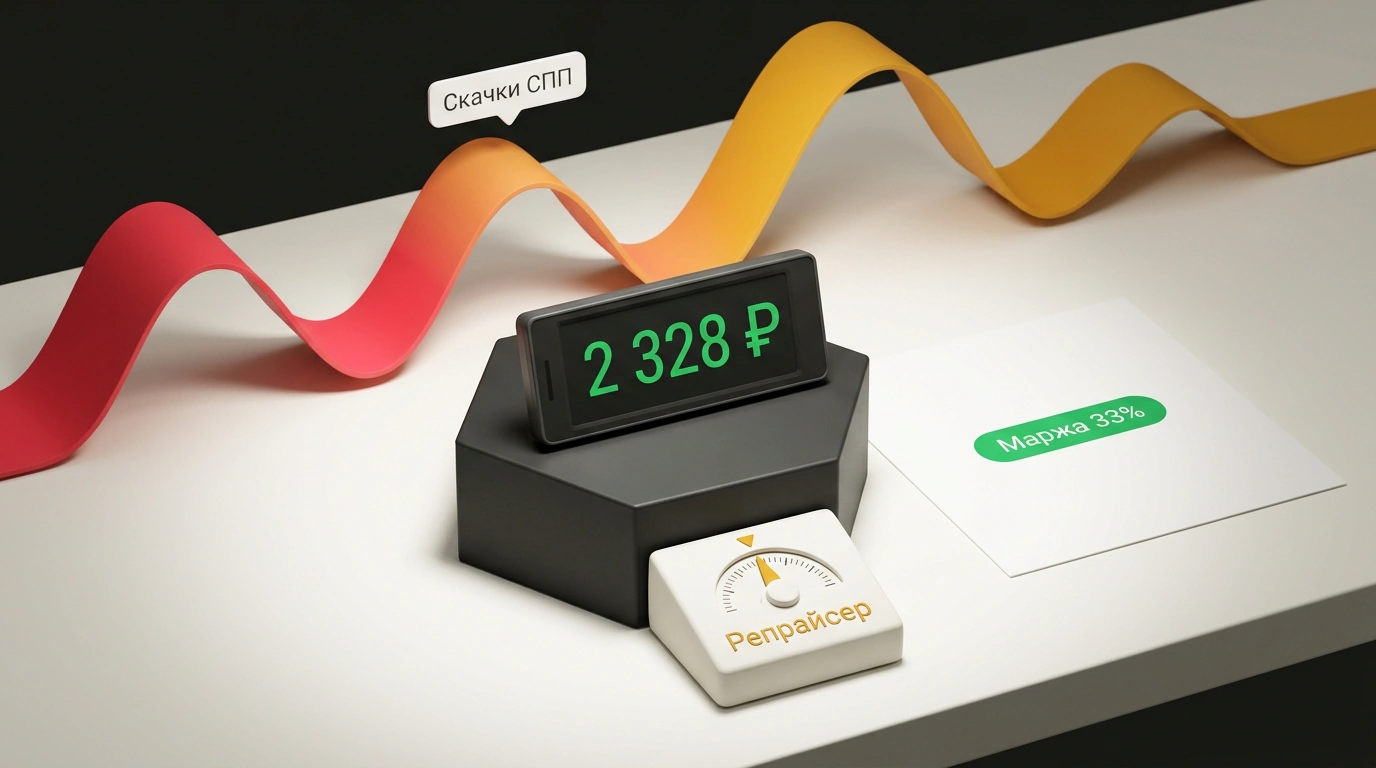
When a marketplace suddenly boosts its permanent customer discount (SPP), it feels like a gift: the storefront price drops on the platform's dime, and orders should speed up. In reality, that generosity has a costly side effect. SPP on Wildberries and Ozon fluctuates daily—sometimes several times in 24 hours. If a 1,000 RUB item drops by 50 RUB (just 3–7%), a buyer whose parcel is already heading to a pickup point spots the lower price, cancels the first order, and places a new one. You end up paying for two-way logistics out of your own pocket.
Why Manual Excel Breaks at Fifty SKUs
When your store has ten items, you can still watch prices by hand. Once you pass 50 SKUs, daily Excel exports, recalculations, and uploads turn into a grind. The seller portal only shows your base price, not net profit after an edit, while auto-promos quietly eat into margins from above.
The costliest risk in manual updates is a simple typo. Drop a zero or stack a discount onto an already reduced base, and a 3,000 RUB batch sells out at 300 RUB in two hours. At that catalog size, sellers hand the job to a repricer—a tool that connects via read/write API and updates prices automatically under preset rules.
Inside a Repricer: Reverse Math, Margin Forecasts, and Two Strategies
Let's look at how this works using the TrueStats repricer for Wildberries and Ozon (included in all plans at no extra fee). On Wildberries, the final shopper price builds through a chain: base price, seller discount, pre-SPP price (the base the platform calculates from), SPP itself, and the WB Wallet discount.
The repricer runs that formula in reverse. Suppose you want a steady 2,328 RUB on the storefront while SPP is 25% and the WB Wallet discount is 3%. The tool calculates the required pre-SPP price: 3,200 RUB (3,200 × 0.75 × 0.97 = 2,328 RUB). If SPP shifts, the algorithm adjusts your base so the shopper sees the same price.
Before pushing an update, the tool displays a unit-economics forecast. Say you have 18 units left in stock and the next shipment arrives in 6 days. To avoid running out of stock, you raise the pre-SPP price by 5% from 3,200 to 3,360 RUB. You immediately see projected margin rise from 31% to 33.1%, and profit per unit jump from 992 to 1,113 RUB. For thousands of SKUs, you can upload changes via Excel or filter listings by stock and turnover.
Two automated strategies are live now, with a third (custom rules by orders, stock, and schedule) in development. First is target price holding: you lock a target price for buyers, and the tool adjusts your discount as SPP moves. Second is competitor tracking: you add up to 10 listings by URL or WB SKU, including your own linked variants. The benchmark can be the minimum, maximum, average, or median storefront price (including SPP and WB Wallet) plus a ruble or percentage offset—say, 90 RUB below the average (1,410 RUB if the average is 1,500 RUB). Check intervals run from every hour to once a day, and when a campaign ends, prices revert to base or lock at the last level.
Guardrails and Limits of Automation
Because a repricer uses a write-enabled API token, you never run it without safety limits. Standard protection rests on three controls. First is a min/max price corridor (for example, 2,900–3,600 RUB) that neither auto-strategies nor manual edits can cross. Second are per-update and daily price-change caps: if a shift exceeds the limit, the update pauses for manual approval. Third is an action log filterable by date, staff member, and status so you can trace every change.
Wildberries does not pass the WB Wallet discount percentage through its API, so you set it manually at the store level (for example, 3%). If the platform changes that rate, you must update the setting by hand.
There is also a structural limit. Both marketplaces run personalized discounts: individual SPP, WB Wallet, Ozon Card, and Ozon Premium. A repricer only controls your base price and seller discount, so it can't equalize the price to the exact ruble for every shopper in the country. Its real job is different: eliminating intraday price swings for a given buyer so they have no reason to cancel a parcel in transit over a 50 RUB drop.