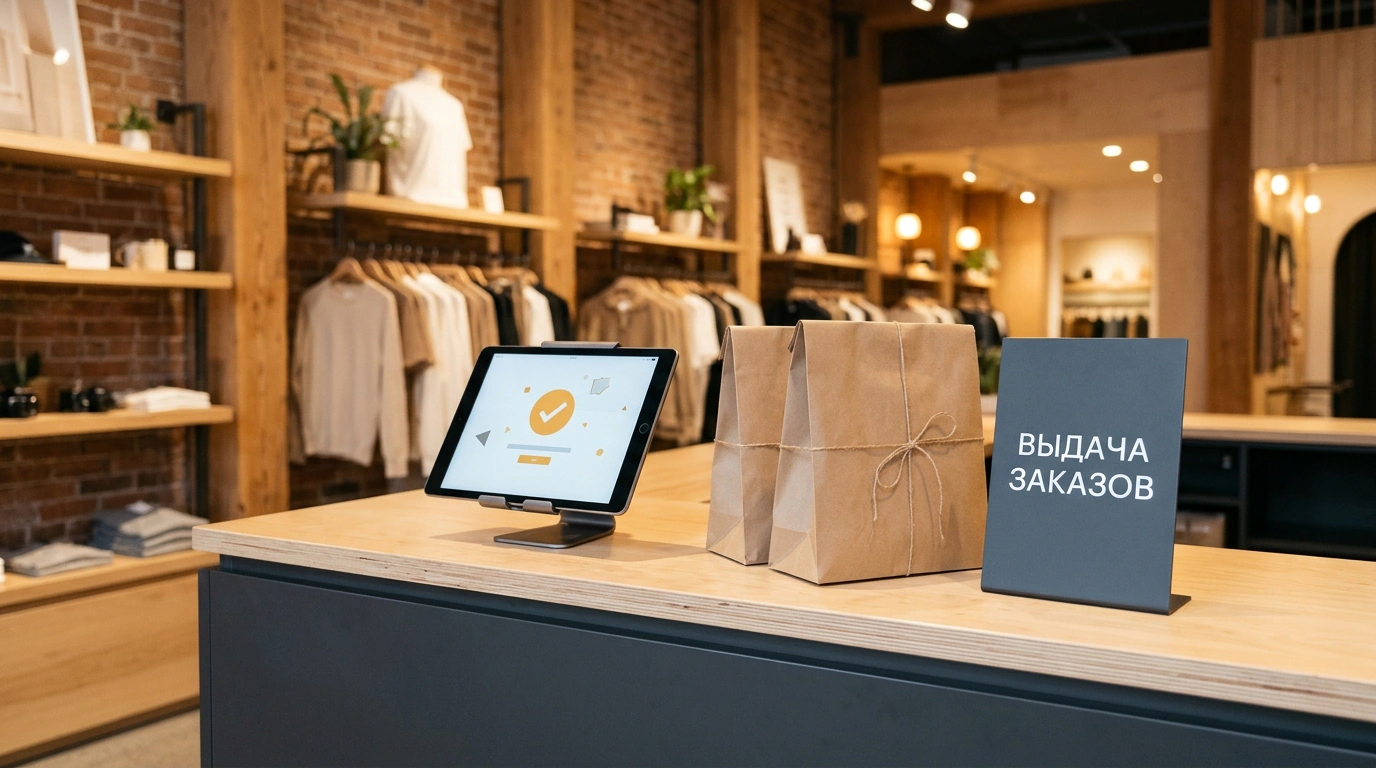
In the first half of the year, self-pickup sales from seller stores on Wildberries in Belarus grew by 763%, and the buyout rate hit 86% in July 2026. These figures were shared by Marina Ovsyannikova, Head of Seller-Fulfilled Delivery at Wildberries Belarus. A regular brick-and-mortar store, showroom, or local warehouse gets order flow from the marketplace without spending money on WB logistics, warehouse storage, or sorting-center boxes. There is one strict rule: in-store stock and Wildberries storefront stock must sync in real time, or the first sale at the cash register turns into a cancellation and a fine.
The Click&Collect model works on a phygital principle, blending online browsing with a regular store visit. A shopper on Wildberries.by or in the app compares prices, reads reviews, checks a map of nearby locations with readiness and storage windows, and pays for the order. In many stores, pickup is available the same day.
Where the 86% buyout comes from and what a store actually saves
Anyone who has sold via FBW or FBS knows the main leak in unit economics: round-trip shipping and storage eat up margins, especially on frequent returns. With Click&Collect, the item stays with you and the customer comes to pick it up. Three costs drop to zero at once: Wildberries logistics, paid marketplace storage, and heavy-duty transport packaging.
Of course, the storefront isn't free. You still pay the standard Wildberries sales and payment-processing commission. The rate depends on the category and sits in the 'Tariffs' section of WB Partners. Your real savings come from delivery, storage, and boxes.
Any business entity can join, including sole proprietors, with no minimum floor space or format requirements. A neighborhood shop, showroom, or local warehouse works fine as long as buyers can pick up orders at the listed address during posted hours.
Returns bring another advantage. If a customer inspects an item and decides not to take it, your staff marks the decline in the system. The money goes back to the buyer automatically, and the item goes back on your shelf a minute later. There is no reverse logistics and no crushed boxes. While customers are in the store, cross-selling small accessories and upselling to a higher-tier model happen naturally. During peak sales, self-pickup also takes pressure off your own courier delivery.
| Parameter | Click&Collect | FBW | FBS | DBS |
|---|---|---|---|---|
| Item storage | Seller's location | WB warehouse | Seller's warehouse | Seller's warehouse |
| Who delivers | Buyer picks up | WB logistics | WB logistics | Seller's courier |
| WB logistics & storage | None | Yes | WB logistics | None |
| Transport packaging | Minimal | Per WB rules | For WB sorting | Own standards |
| On decline | Back on shelf immediately | WB reverse logistics | To WB warehouse or back | Courier return |
| Platform commission | By category | By category | By category | By category |
As the table shows, self-pickup removes the most unpredictable variable costs and keeps you in clear offline-store economics with extra traffic from the app.
Why people drive to a store for 10 BYN pet food and what sells best
At first glance, it seems customers will only travel to a seller's store for expensive or bulky goods. Home appliances, electronics, furniture, power tools, DIY supplies, watches, and premium perfumes indeed sit at the top. Buyers feel more comfortable inspecting a fridge or trying on a watch in person, while Wildberries credit and installment options boost high-ticket orders.
Yet Wildberries.by data breaks that stereotype. Urgent everyday items priced at 10, 30, and 50 Belarusian rubles (BYN) perform just as strongly: pet supplies when a cat runs out of food or litter, auto parts and tires on the way to a tire shop, books, and stationery. When someone needs an item tonight, nobody wants to wait two days for delivery to a standard pickup point.
Click&Collect also opens the platform to categories unavailable at regular pickup points: groceries, restaurants, live plants, and large home appliances. In Russia and parts of the CIS, WB instructions for certain regulated categories even allow pay-on-pickup in store, with the commission deducted from the seller's account balance. On top of that, the online storefront removes shelf-space limits: instead of displaying a few hundred items on the floor, you can list your entire warehouse of thousands or tens of thousands of SKUs.
Four steps of an order: from map to shelf
Take a typical offline store or sole proprietor on Wildberries.by that connects a virtual self-pickup warehouse with urgent 10–50 BYN goods and bulky items. Inside, each order follows four stages.
First, the customer finds the product, picks a location on the map with a convenient readiness time, and pays online. Next, a picking task arrives in WB Partners (or in your inventory system via API). Your team picks the item from store or warehouse stock and switches the status to 'Ready for pickup'—the maximum assembly window is 72 hours. Before the buyer arrives, you can message them in chat or call via WB's masked number, for example to let them know the order is ready early.
Then the customer visits during business hours, gives the order number, inspects the purchase, and takes it home. If the item doesn't fit, step four kicks in: the seller logs the decline in the system, the buyer gets an automatic refund, and the product immediately returns to store stock.
Five pre-launch processes and the cost of one stock mismatch
Technical setup in WB Partners is straightforward: registration, a virtual self-pickup warehouse, product cards, prices, and stock levels. The real trap sits in the last-unit problem on the shelf. Someone just paid for the last bag of pet food in the app, and a minute later a walk-in shopper buys that exact bag at the register. You have nothing to hand over, so you have to cancel.
For a seller-fault cancellation or failure to confirm stock, Wildberries' offer charges a fine based on double commission multiplied by the cancellation timing factor (KSO): from 100 ₽ to 10,000 ₽ per unit, capped at 50% of the retail price. Your delivery rating drops at the same time, and falling below 95–97% creates serious account risks.
Cancellation timing factor (KSO) in the Wildberries fine formula
The longer your team waits to react and lets an order hit auto-cancellation, the harder the multiplier hits your wallet. With a small catalog, you can manage orders manually in the dashboard. With hundreds of SKUs and active walk-in traffic, inventory without API stock sync quickly falls out of alignment.
The second common mistake is setting unrealistic timing. The platform allows an assembly window up to 72 hours and storage from 24 hours to 30 days. Stores offering same-day pickup get more clicks, but promising two-hour readiness with one cashier on shift is a fast way to rack up late penalties.
Two practical tasks remain on the shop floor: train staff (where assembled orders sit separately, how to hand them over quickly by order number, and how to log declines) and put up clear signage. You don't need a renovation—a simple sign reading 'Wildberries.by Order Pickup' or 'Self-Pickup Orders Here' helps customers spot the counter right away.
Five settings before launching Click&Collect
- Choose your integration mode: manual WB Partners dashboard for a small catalog, or API sync for large assortments and high turnover.
- Sync point-of-sale stock with the Wildberries storefront to prevent cancellations and KSO fines.
- Set realistic assembly windows (up to 72 hours) and storage periods (24 hours to 30 days) based on actual shift capacity.
- Train staff on storing picked orders separately, handing them over by number, and logging declines.
- Put up clear in-store signage reading 'Wildberries.by Order Pickup' or 'Self-Pickup Orders Here'.