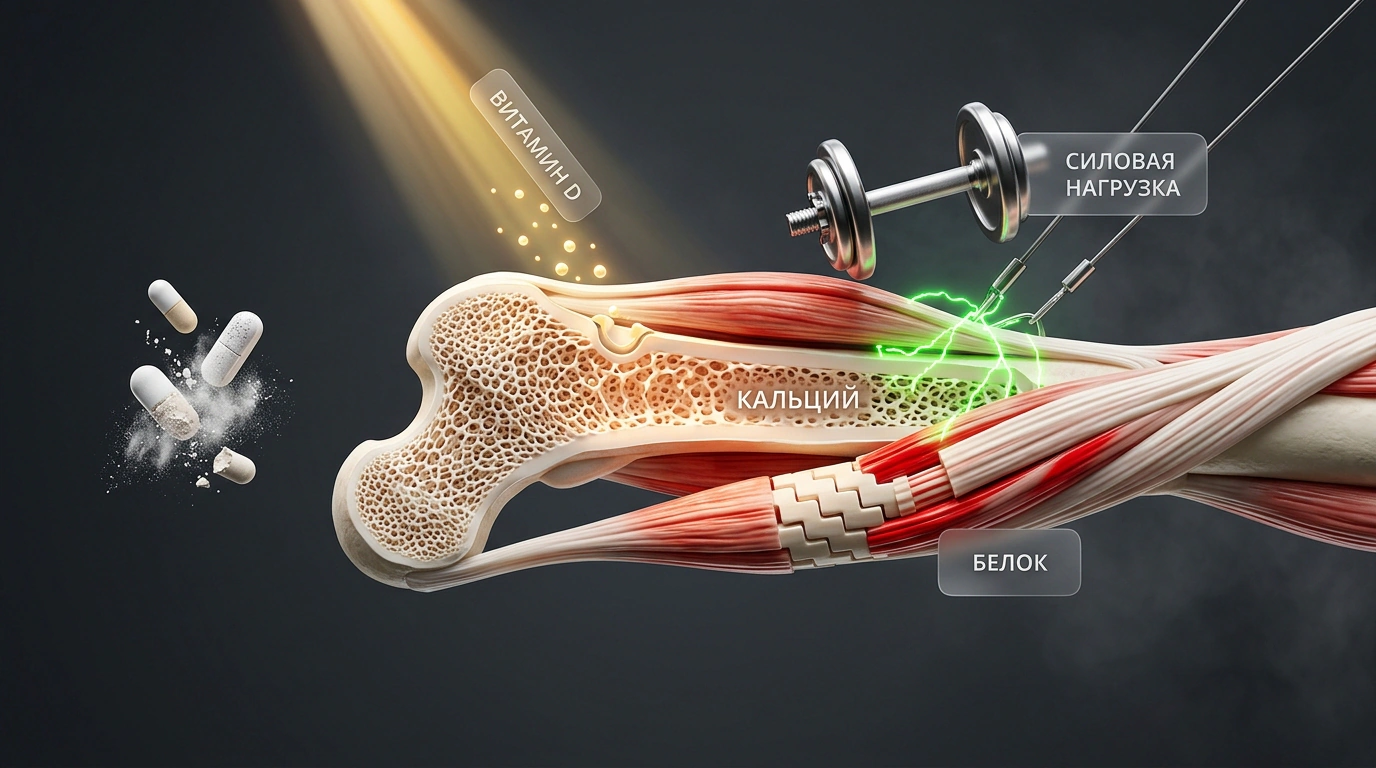
For decades, the go-to advice for protecting aging bones from fragility was a simple calcium pill. Menopausal women and men over fifty buy mineral complexes hoping to prevent fractures. Yet medical studies reveal a surprising reality: people who take calcium supplements for years break bones almost as often as those who take nothing at all. Meanwhile, the body gradually loses muscle strength, walking feels less steady, and climbing stairs takes more effort. Why don't isolated minerals save us from injury, and how does human physiology actually keep our skeleton strong?
The construction metaphor: why bones need a full crew
To understand how your skeleton works, picture a construction site. You can't build a sturdy house by dumping a pile of cement on bare ground. A solid building needs strong bricks, mortar, a delivery permit for the trucks, and an experienced site manager directing the crew.
In your body, those roles work the exact same way:
- Protein is the bricks. Up to 50% of bone volume is an organic matrix made of collagen protein fibers. Protein is also the only building material for muscles, which support the skeleton and absorb impact.
- Calcium is the cement. It mineralizes the bone's protein frame, giving it stiffness and resistance to compression. Without a protein net, calcium has nothing to hold onto.
- Vitamin D is the site permit. It regulates your gut so calcium can enter the bloodstream. Without enough vitamin D, your body absorbs only 10–15% of the calcium you eat.
- Strength training is the site manager. Your body is strictly economical: it never spends energy reinforcing tissues that aren't under mechanical stress. Only muscle contractions and pressure on your bones give the order to start building.
Without strength training, building materials sit unused. Unable to anchor in the skeleton, extra calcium is simply flushed out by the kidneys or settles in blood vessel walls.
The age threshold: how anabolic resistance develops
After age 45, the body begins to experience sarcopenia—the gradual loss of muscle mass, strength, and function, affecting up to 22% of adults over 65. Losing muscle isn't just about appearance. Weak muscles lead to an unsteady gait, accidental falls, and dangerous hip fractures.
At the root of this process is anabolic resistance. As we age, muscle cells become less sensitive to standard doses of amino acids from food. In clinical trials, healthy men around age 75 synthesized muscle protein after a meal 16% more slowly than 22-year-olds, and their response to a protein load was more than three times weaker.
The modest protein portions that worked in your youth simply go unnoticed by mature muscles. To cross this threshold and trigger tissue renewal, each meal needs a larger dose of protein than before.
Simple tests can spot early sarcopenia. If handgrip strength on a dynamometer drops below 27 kg for men or 16 kg for women, or if it takes more than 15 seconds to stand up from a chair five times without using your hands, your muscles already need support.
Protein targets: how many bricks you need after 50
Standard WHO guidelines for young adults (0.8 grams of protein per kilogram of body weight) aren't enough for older adults. The European Society for Clinical Nutrition and Metabolism (PROT-AGE consensus) and ESCEO set higher targets:
- The baseline target for adults over 65 is 1.0–1.2 grams of protein per kg of body weight per day (70–85 grams of pure protein for a 70 kg person).
- With regular strength training, needs rise to 1.2 g/kg or more.
- During recovery from illness, targets reach 1.2–1.5 g/kg.
In a three-year study, older volunteers with high protein intake lost 40% less muscle mass than peers on a low-protein diet.
Spreading protein evenly across the day matters just as much. Starting the morning with plain oatmeal in water or tea with toast leaves your muscles without stimulation. A better strategy is splitting your daily total into three or four meals, aiming for at least 25–30 grams of protein per meal and up to 35–40 grams in your main meal.
Fears that protein overloads healthy kidneys have been disproven by science. In healthy adults, protein-rich food actually supports bone density. Adjustments are only needed for diagnosed chronic kidney disease under a nephrologist's care.
Calcium as a threshold: why extra pills don't save bones
Calcium follows a strict threshold rule. When you're deficient, your bones lose strength. Once you hit your daily physiological target, taking extra pills brings no added benefit.
High-dose calcium supplements boost bone density by just 0.6–1.8% before hitting a plateau, while raising the risk of kidney stones and blood vessel calcification. Adults over 60 need 1,200–1,300 mg of calcium per day, and everyday food is the best way to get it.
A two-year trial in Australian care homes proved this clearly. Instead of giving residents pharmacy pills, staff simply added four daily servings of dairy—milk, yogurt, and cheese—to their menu. Total fractures dropped by 33%, hip fractures fell by 46%, and falls decreased by 11%. One liter of milk provides about 1,200 mg of calcium and 32 grams of protein, so eating cottage cheese and hard cheese covers two core needs at once.
Vitamin D: a team player and the risk of mega-doses
Vitamin D is essential for calcium to cross the gut wall. Yet taking it alone doesn't work. The five-year VITAL trial of 25,000 participants showed that without an existing deficiency, isolated vitamin D does not reduce fractures.
A 16% drop in hip fracture risk only happens when vitamin D works alongside enough dietary calcium. Mega-doses are also risky: large bolus doses actually led to more falls and injuries among older adults. A safe maintenance dose is 600–800 IU per day.
Strength training: the main command to rebuild
In international EWGSOP2 clinical guidelines, strength training ranks first as the only method with the highest level of evidence. When a muscle contracts under load, it pulls on its tendon. That creates a piezoelectric effect inside the bone, activating bone-building cells while triggering new fiber growth in muscles.
Biomechanical diagram of the piezoelectric effect in bone: a stretched tendon under strength load and an electrical impulse triggering osteoblast renewal.
WHO guidelines for staying active are clear: strength exercises for major muscle groups should happen at least twice a week. Adults over 65 should also add balance and coordination exercises at least three days a week to prevent everyday falls.
- Protein: 1.0–1.2 g/kg per day, split into 25–40 g at each main meal.
- Calcium: 1,200 mg per day, mostly from dairy products and bone-in fish.
- Vitamin D: a maintenance dose of 600–800 IU per day if you aren't deficient.
- Exercise: strength training with dumbbells, resistance bands, or body weight at least twice a week.
Step-by-step plan: how to build lasting protection
Simple daily habits can protect your skeleton and muscles:
- Calculate your protein goal: multiply your weight in kg by 1.1 or 1.2. For a 70 kg person, that's 75–85 grams of protein per day.
- Upgrade your breakfast: start the day with eggs, cottage cheese, fish, or poultry to give your muscles 25–30 grams of protein early.
- Get calcium from food: include 3–4 servings of dairy or canned fish with soft edible bones (like sardines or pink salmon).
- Check your vitamin D: get a 25(OH)D blood test. If you're deficient, a doctor will set a treatment dose; if levels are normal, take 600–800 IU daily.
- Add strength work: start with chair squats, wall push-ups, resistance bands, and single-leg balance holds.
- Stay safe: if you have confirmed osteoporosis, clear your exercise plan with a physical therapy specialist.
A strong skeleton and confident movement come from nutrition and training working together. Give your body the bricks and cement, put the site manager to work, and your frame will stay reliable for years to come.