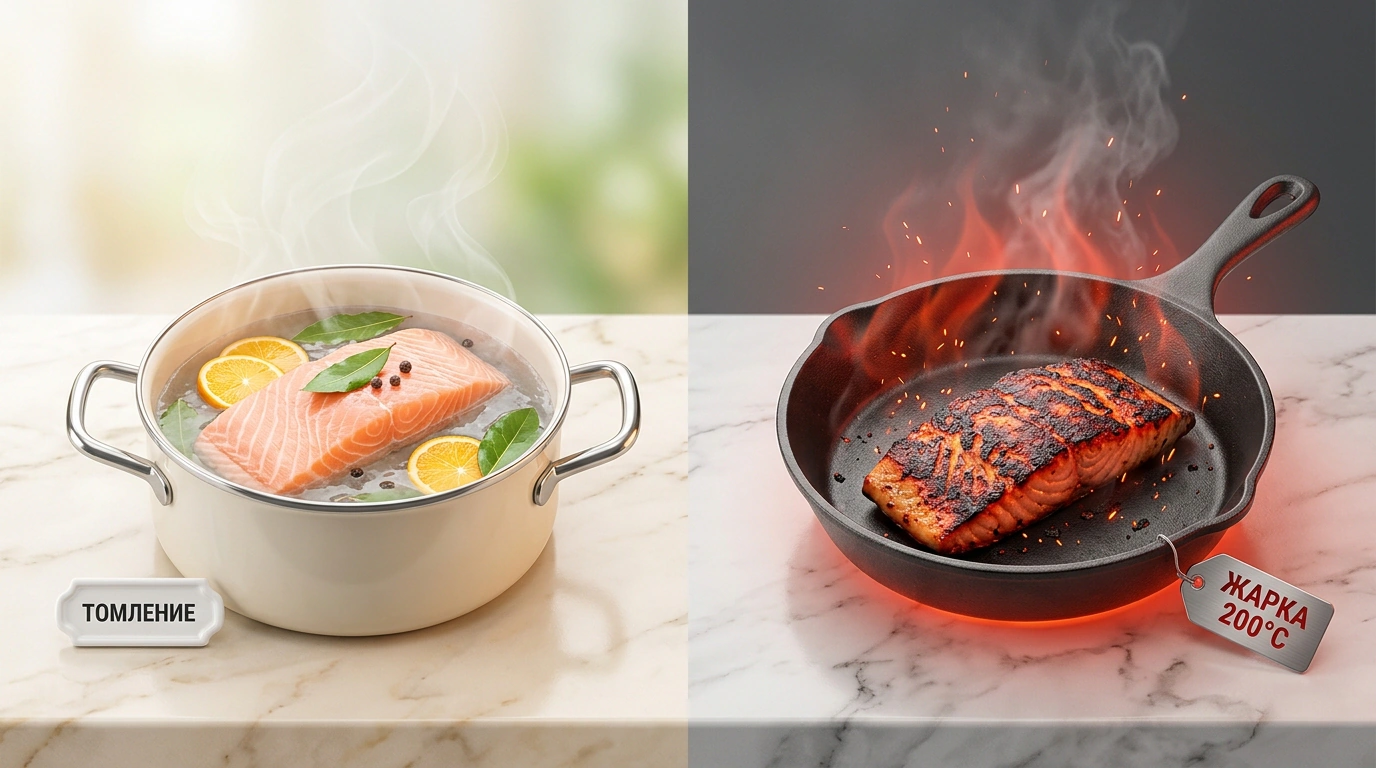
When a heavy, sleepy feeling settles in your stomach after a hearty fish lunch, it is easy to assume you simply ate too much. In nutrition research, however, how you feel often depends less on portion size and more on how the food was cooked.
Years ago, Alexander Alekseyevich, author of the blog Athletics for Everyone, gave up pan-frying fish in oil and switched to simple boiling and gentle simmering. Let's look at what happens to nutrients on a molecular level and why gentle heat works wonders for digestion.
What Happens to Protein in a Skillet
In raw fish, protein is folded into tight little coils. For digestive enzymes (pepsin in the stomach and trypsin in the intestine) to break it down into amino acids, those protein chains must unfold neatly. This process is called denaturation.
During boiling or simmering, water stays between 80 and 100 °C. In these gentle conditions, protein strands relax smoothly, giving enzymes direct access to every bond. In a frying pan, temperatures reach 160–200 °C. Extreme dry heat causes rigid thermal cross-linking of amino acids. Fibers tighten into dense clumps that are 20–30% harder for your stomach to break down.
How to Protect Omega-3s from Oxidation
Saltwater fish is rich in valuable polyunsaturated omega-3 fatty acids (EPA and DHA). These molecules are extremely sensitive to heat.
Frying in an open pan exposes fats to oxygen in the air at high temperatures. This triggers rapid lipid peroxidation, forming toxic aldehydes and advanced glycation products that irritate the lining of your stomach and small intestine. Water during boiling shields the fish from air contact, keeping beneficial fatty acids intact.
Why Boiled Fish Sometimes Tastes Bitter
Many people avoid boiled fish because of a distinct bitter taste and try to mask it with mayonnaise or breading. That problem has a simple anatomical explanation.
The off-flavor sits in the thin black membrane lining the inside of the fish's belly cavity, where oxidized pigments collect. If you gently scrape away that membrane with a knife blade before cooking, the bitterness disappears completely. Adding a couple of lemon slices removes fishy odors and lightly firms up the outer layer of the fillet, while bay leaf and allspice bring out a clean flavor.
Digestion Starts Long Before the Stomach
Even the most tender protein digests poorly if you swallow it in a rush. Your stomach has no teeth, so unchewed chunks travel through your digestive tract mostly intact, causing bloating and discomfort.
The first stage of processing begins in your mouth. Thorough chewing multiplies the surface area exposed to stomach juices. Saliva does more than moisten food: mucin shapes a smooth food bolus, alpha-amylase begins breaking down carbs, and natural lysozyme helps sanitize each bite. The better you chew your fish, the easier it is for your body to absorb its protein.
Five Simple Steps to Tender Fish
You only need a regular pot to boil fish that turns out juicy and tender:
- Thaw safely: defrost only in the fridge so ice crystals don't tear the muscle fibers.
- Clean thoroughly: scrape the dark belly lining completely clean with a knife.
- Use hot water: lower the fish into already hot or gently simmering water to seal the protein right away.
- Build an aromatic broth: add half an onion, a couple of lemon rounds, a bay leaf, and whole peppercorns.
- Simmer gently: turn the heat down to low and cook for 7–12 minutes until the flakes separate easily.
You can save the fish broth for soup or cooking rice to keep water-soluble minerals and B vitamins.
A Lighter Body and the Limits of Self-Care
Skipping oil-frying instantly saves 100–250 kcal per serving and helps prevent heartburn. It is a simple, practical kitchen shift if you want to feel lighter after meals.
Still, gentle cooking supports digestion—it does not replace a doctor when chronic conditions flare up. If you regularly get pain under your right ribs, persistent nausea, or a constant bitter taste in your mouth, changing your recipe won't be enough. Those symptoms call for a gastroenterologist visit and an abdominal ultrasound to rule out gallbladder or pancreatic issues.