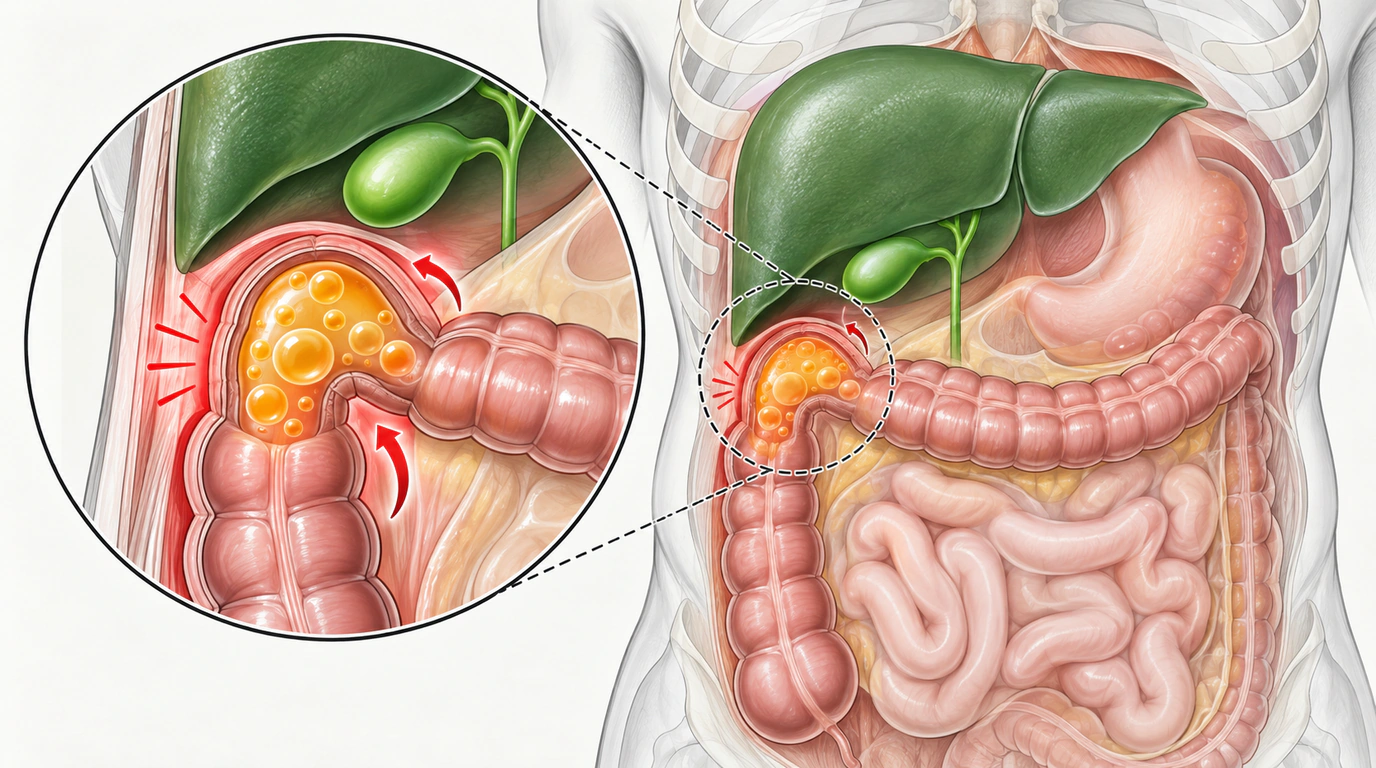
Heaviness, sharp twinges, or an aching fullness under the right ribs is one of the most common reasons people visit a doctor. Almost everyone assumes their liver is acting up or their bile is backed up. They rush in for an abdominal ultrasound expecting to see gallstones or inflammation, only to hear the technician say: "Your liver and gallbladder look completely normal."
That leaves patients confused. How can an organ hurt if the scan is spotless? The answer is simple: liver tissue has no pain receptors and cannot hurt on its own. In many of these cases, the true culprit is your large intestine—specifically, its hepatic flexure.
Close Neighbors and a Trap for Gas
Your colon takes a winding path through the abdomen. Rising up the right side, it reaches the lower edge of the liver and makes a sharp, nearly 90-degree turn to the left. Anatomists call this corner the hepatic flexure (flexura coli dextra).
It sits right next to the gallbladder. When gas gets trapped in this tight bend or the smooth muscle spasms, the stretched intestinal wall sends pain signals straight to the upper right quadrant.
Gastroenterologists point to three main reasons gas builds up here:
- Bacterial fermentation: Undigested carbohydrates pass from the small intestine into the start of the colon, where gut bacteria ferment them into carbon dioxide, hydrogen, and methane.
- Physical bottleneck: At a sharp turn, stool and gas slow down. Gas bubbles float to the top of the arch, creating localized pressure.
- Visceral hypersensitivity: In irritable bowel syndrome (IBS), nerve endings in the gut wall overreact to normal amounts of gas. Your brain reads routine stretching as an alarm signal.
How to Tell Colon Pain From Gallbladder Pain
Doctors separate the two using simple everyday clues:
- Link to bowel movements: Pain from the hepatic flexure noticeably eases or vanishes after passing gas or having a bowel movement. True biliary colic doesn't improve at all after using the bathroom.
- Pain character: Intestinal pain tends to come in waves—aching, cramping, or sharp—often with gurgling and bloating. Gallbladder pain is intense, steady, and squeezing.
- Triggers: Colon discomfort follows gas-producing foods (beans, raw cabbage, sweets) or hours of slouched sitting. Gallbladder pain usually strikes 1–2 hours after a heavy, fatty meal.
- Where it radiates: Gallbladder pain classically spreads to your right shoulder blade, right shoulder, or neck. Colon pain stays in your side or shifts toward the center of your belly.
We've previously debunked myths about sluggish bile and fatty liver and warned against aggressive home "liver flushes." Taking bile-stimulating herbs during a bowel spasm is risky: it only worsens diarrhea and gut irritation.
Never try home liver flushes or choleretic herbs for unexplained right-sided pain. If the cause is an intestinal spasm, you will aggravate your gut. If hidden gallstones are present, you risk blocking a bile duct.
Practical Ways to Ease Colon Discomfort
To help trapped gas clear the hepatic flexure, try three proven habits:
- Walk after lunch: A calm 15–20 minute walk stimulates gentle gut motility and keeps gas from pooling in intestinal bends.
- Short-term Low-FODMAP tweaks: For 1–2 weeks, cut back on fast-fermenting carbs like apples, pears, beans, sodas, and sorbitol gum. Your gut doesn't need gimmicky detoxes, as we explained in why your colon doesn't need alternative cleanses.
- Check your posture: Leaning forward over a desk physically squeezes your upper right abdomen. Lean back now and then and open up your chest.
Red Flags That Need Urgent Care
Call a doctor or seek emergency care immediately if right-sided rib pain comes with:
- Yellowing of the eyes or skin;
- Dark urine and pale stools (signs of blocked bile flow);
- High fever and chills;
- Uncontrollable vomiting.
Those symptoms point to acute cholecystitis or a blocked duct requiring urgent surgical care. Otherwise, a calm look at your diet and a check-in with a gastroenterologist usually restore comfort quickly.