Every day, people open fresh blood test results and freeze. Next to "TSH" (thyroid-stimulating hormone), a red flag highlights a number like 5.2 or 7.8 mIU/L above the 4.0 upper limit. Immediately, you connect it to morning grogginess, dry skin, and a few extra pounds, concluding: "My thyroid is failing, I need hormone pills!"
Online, plenty of "integrative" coaches will gladly confirm your fears. They'll urge you to start synthetic levothyroxine right away, buy expensive selenium, iodine, and tyrosine blends, and cut out gluten.
Yet clinical endocrinologists and international guidelines agree: a mild, isolated TSH rise between 4.0 and 10.0 mIU/L rarely needs medication. We've already covered key questions for an endocrinologist about thyroid health, and subclinical readings deserve a calm, measured response.
How Thyroid Regulation Works: Why Tissues Aren't Starving
To understand the medical logic, look at how the system communicates:
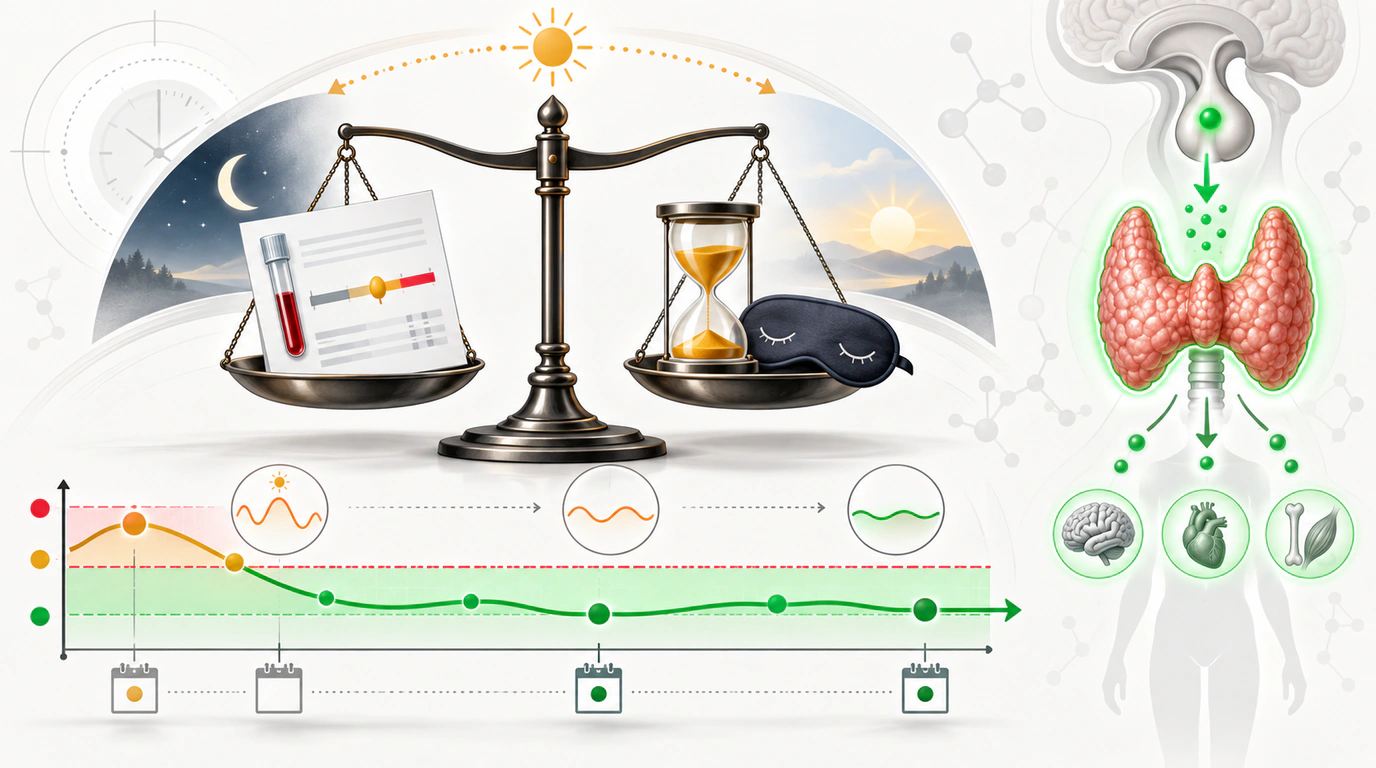
- TSH comes from the pituitary, not the thyroid: Made in your brain, it acts like a volume knob. If your thyroid slows down slightly, the pituitary raises TSH to nudge it along.
- What subclinical hypothyroidism means: Normal TSH sits around 0.4–4.0 mIU/L. When TSH is 4.0–10.0 mIU/L while your active hormone—free thyroxine (free T4)—remains strictly normal, doctors call it subclinical hypothyroidism.
- Your organs have enough hormone: Because free T4 is normal, your heart, brain, and muscles aren't running on empty. Fatigue at a TSH of 6.0 mIU/L is almost never caused by your thyroid; sleep debt, stress, or hidden iron deficiency are far more likely. Hormone therapy requires caution: just as we saw when reviewing hormonal traps and hidden risks, altering the endocrine axis without clear need disrupts a delicate balance.
Daily Swings and Spontaneous Recovery
American and European Thyroid Association (ATA / ETA) guidelines highlight two key facts:
- Daily swings up to 50%: TSH follows a strong circadian rhythm. A blood draw at 8 a.m. after a poor night's sleep might read 4.3 mIU/L, while a noon draw in the same person reads 2.4 mIU/L—both completely normal.
- Reaction to stress and colds: TSH often spikes briefly after viral infections, hard workouts, or emotional stress.
- Natural recovery in 50–60% of people: Meta-analyses show that in more than half of patients with a first-time TSH between 4 and 10 mIU/L, levels return to normal on their own within 2–3 months without treatment. That explains fake "miracle cures" online: people take useless supplements, retest three months later, and credit the pills.
Taking levothyroxine when TSH is under 10 mIU/L won't cure fatigue, but it can cause drug-induced hyperthyroidism, triggering rapid heart rate, atrial fibrillation, and faster bone loss.
The Evidence-Based Approach: Watch and Wait
International standards for isolated subclinical TSH (4.0–10.0 mIU/L) are straightforward:
- Don't medicate off one lab result: A single test isn't a reason to start lifelong hormone therapy.
- Retest in 2–3 months: Repeat TSH, free T4, and thyroid peroxidase antibodies (TPOAb) after 8–12 weeks while well rested.
- The "Rule of 10": Medication is clearly justified when TSH stays persistently above 10.0 mIU/L.
Exceptions When Treatment Starts Early
Doctors do treat TSH below 10 mIU/L in specific situations:
- Pregnancy or actively trying to conceive (maternal thyroid hormone is vital for fetal brain development);
- High thyroid antibodies combined with free T4 dropping below normal (overt hypothyroidism).
What to Do for Ongoing Fatigue
If your TSH is mildly elevated and free T4 is normal, don't panic. Check serum ferritin (low iron often mimics thyroid symptoms) and vitamin D, prioritize 8 hours of sleep, and ease up on overwork. Most of the time, your body needs rest, not thyroid pills.