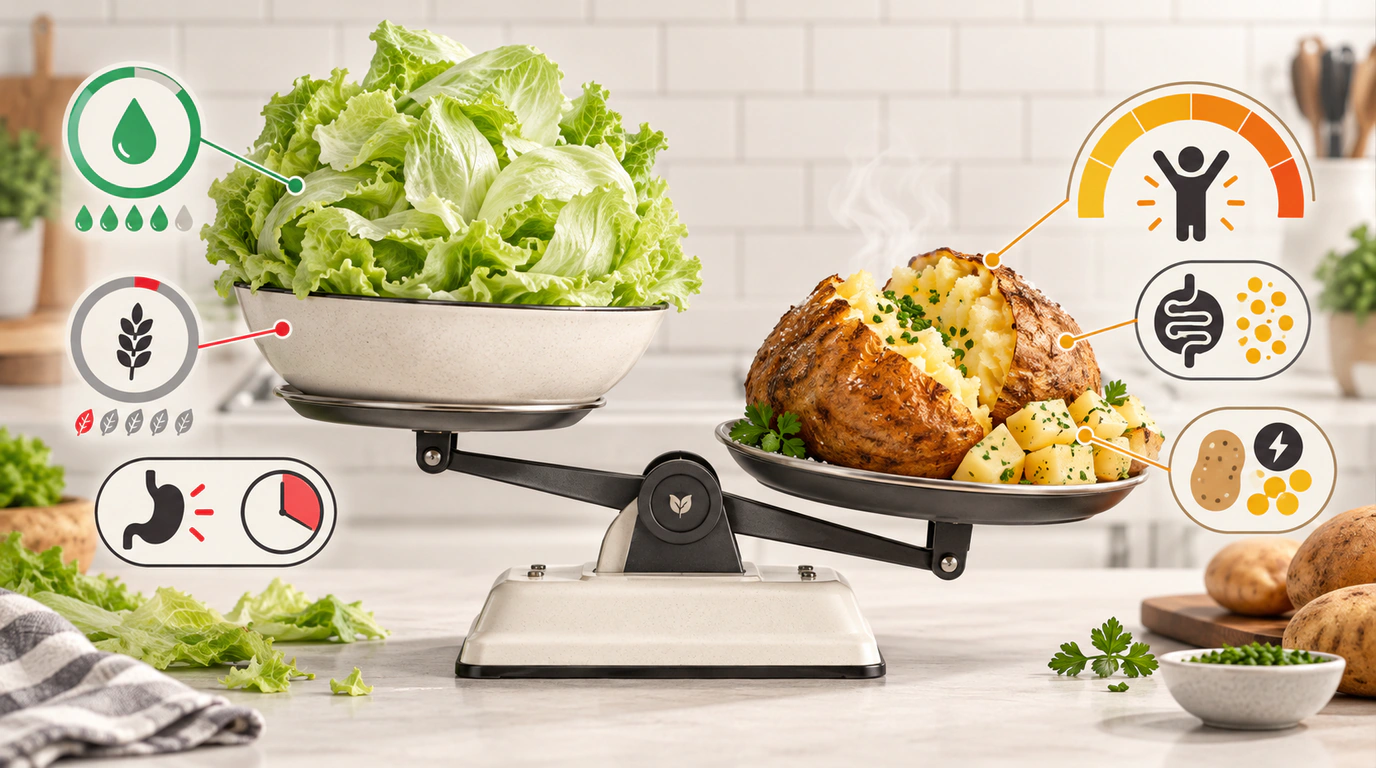
Why does a giant bowl of salad leave you starving 40 minutes after lunch, while a simple boiled potato—feared by strict dieters—keeps you full for hours?
Two opposite myths dominate fitness culture:
- Iceberg lettuce is treated as a health-food gold standard, piled onto plates by people assuming it covers their daily vegetable and fiber needs.
- Potatoes are demonized as "empty starch" that goes straight to your waistline.
Compare their actual biochemistry, and the reality flips: crisp iceberg is nutritionally near-empty, while plain potatoes are one of the strongest natural appetite controllers around.
What's Inside Iceberg Lettuce
People love iceberg for its crunch, freshness, and mild taste. Yet its nutrient density is tiny:
- 95.6% water: A serving of iceberg is mostly water held in a light plant scaffold.
- Almost no fiber: Every 100 g of leaves holds just 0.2–0.5 g of dietary fiber. To hit the daily 25–30 g target with iceberg alone, you'd need to eat up to 10 kg of lettuce a day.
- An illusion of fullness: Fluffy leaves fill half your plate, tricking you into thinking you had a hearty, fiber-rich meal.
- Low micronutrients: Pale iceberg heads contain far less iron, folate, and antioxidants than spinach or arugula.
Iceberg works fine as a crunchy base, just don't count on it for fiber. Much like when we examined myths and real benefits of oatmeal in your daily diet, it pays to look closely at what everyday foods actually deliver.
Science Rehabilitates the Potato
Potatoes got a bad name from French fries, potato chips, and mash loaded with butter. Baked or boiled in their skins, potatoes are a nutrient-dense complex carb.
1. The Satiety Index Champion
In a classic University of Sydney study led by Dr. Susanna Holt (Holt et al., European Journal of Clinical Nutrition), researchers measured how full 38 common foods kept people per 240-calorie serving (with white bread set at 100%):
- #1 out of 38 foods: Plain boiled potatoes scored 323%.
- They easily beat oatmeal (209%), lean beef (176%), fish (225%), and apples (197%), keeping hunger away for over two hours.
This comes down to dense cell structure and proteinase inhibitor II (PI2), a compound that boosts the satiety hormone cholecystokinin.
2. Resistant Starch From Chilling
You can make potato starch even better for your gut:
- When cooked potatoes cool in the fridge, amylose crystals reorganize into RS3 resistant starch.
- Resistant starch skips digestion in the small intestine and feeds colon bacteria, which produce butyrate—a short-chain fatty acid that strengthens your gut lining and improves insulin sensitivity.
- Eating cooled potatoes lowers the blood sugar response by 25–40%.
3. A Potassium Powerhouse
Every 100 g of skin-on potato packs 450–550 mg of potassium. One medium potato delivers around 900 mg—more than double a medium banana (roughly 400 mg). Potassium helps flush excess sodium and supports healthy blood pressure, alongside 15–20 mg of vitamin C. When planning balanced meals, it also helps to look at other staples: we previously broke down the benefits and hidden calories of soup in daily meals.
Boiled or baked skin-on potatoes aren't a diet enemy. They are one of the most filling complex carbs you can eat, rich in potassium and great for preventing evening snacking.
Practical Plate Upgrades
- Don't rely on iceberg for fiber: Add broccoli, green beans, carrots, chickpeas, or lentils to your salads.
- Keep the skin on: Bake halved potatoes with a drizzle of olive oil and herbs.
- Chill them for salads: Cold potatoes with fresh herbs and eggs give you prebiotic fiber and steady fullness.