Picture two thigh CT scans side by side. Both belong to people of the same age, height, and even the same weight, say 70 kilograms. Under their clothes, their legs look identical. When a radiologist puts the cross-sections on screen, the difference is striking. One person has a dense mass of firm muscle fibers with a thin rim of subcutaneous fat. The other has a muscle bundle that has shrunk by nearly half, with branching streaks of fat running through it like a marbled steak.
When we talk about health and body shape, we tend to fixate on the scale or belly fat. If your weight isn't going up, it's easy to assume everything is fine. In metabolic medicine, however, there is a much quieter threat: sarcopenia combined with myosteatosis.
Let's look at why skeletal muscles are not just for carrying groceries or looking good in the mirror. They are our main metabolic organ, and losing them damages your metabolism faster than any fast food.
More Than Mirror Aesthetics: The Hidden Work of Your Largest Metabolic Organ
In anatomy, muscles belong to the musculoskeletal system because they help you walk, bend, and hold your posture. For an endocrinologist, though, skeletal muscle is the body's largest metabolic organ. In adults, muscles make up to 40% of total body weight.
To see the scale of their job, imagine your bloodstream after a heavy lunch. You eat a plate of porridge or pasta, carbs break down, and a surge of glucose enters your blood. If that sugar stayed in circulation at high levels, it would quickly damage your blood vessels and overload your kidneys.
Your body needs to clear that excess energy fast, and your muscles step in. Healthy skeletal muscles absorb up to 80% of all circulating glucose after a meal.
Think of your bloodstream as a river carrying sugar, and your muscle tissue as a large dry sponge on the bank. While that sponge is dense and active, it soaks up excess sugar and stores it as glycogen. Your pancreas works calmly, your blood vessels stay protected, and your cells remain sensitive to insulin. We looked at how a calorie surplus overloads fat stores and triggers cellular breakdown in our piece on what causes or results from high fasting insulin. So what happens when that sponge starts to shrink?
Quiet Melting: How We Lose Muscle After 35
Biology follows a simple rule: anything you don't use regularly gets broken down for parts. Muscle tissue is expensive to maintain because it demands constant nutrients, oxygen, and a large share of your resting energy.
If physical activity after age 30 to 35 drops to a desk chair and a sofa, your body cuts back on this energy-hungry tissue:
- Without strength training, you lose an average of 1% to 2% of muscle mass every year.
- By age 50 to 60, that cumulative loss can reach 30% to 50% of your original muscle frame.
- Your resting metabolic rate itself drops only slightly (by 5% to 10% by age 70), so losing muscle is what sharply cuts your daily energy burn.
The trickiest part is that your scale won't show this loss. You can see the exact same number, say 75 kg, for years. Meanwhile, your tissue ratio shifts as dense contractile protein is replaced by excess fat.
Myosteatosis: When Muscle Fibers Turn Into Marbled Meat
As muscle fibers shrink, fat moves into the empty space. This process is called myosteatosis, which means fat droplets building up between muscle bundles and inside the cells themselves.
This creates a metabolic trap:
- Blocked receptors: Breakdown products of intramuscular fat interfere with signals from insulin receptors on the cell membrane.
- Insulin resistance: The cell locks its entry gates, and the muscle can no longer pull sugar out of the blood quickly.
- Chronic hyperinsulinemia: Your pancreas has to pump out more and more insulin to force glucose inside. Over time, this exhausts beta cells and leads to type 2 diabetes.
- Everyday weakness: It becomes hard to stand up from a low chair without using your hands, carry grocery bags, or climb two flights of stairs without heavy legs.
This pattern is especially clear during rapid weight loss without exercise, which we covered in our look at the decline of body positivity and the GLP-1 boom. When people crash-diet without strength training, up to 40% of the weight they lose can come from muscle. That leads to sarcopenic obesity, where someone looks thin on the outside but is metabolically unhealthy. We also detailed how to preserve muscle tone in our guide to protecting muscle during rapid weight loss.
The Molecular Magic of Movement: How Muscles Clear Sugar Without Insulin
At rest, moving glucose into a muscle fiber requires insulin. Insulin binds to a receptor like a key in a lock, signaling GLUT4 transporters to rise from inside the cell to the membrane and let sugar in.
An isometric infographic diagram of a muscle fiber cell showing GLUT4 transporters moving to the membrane without insulin.
With insulin resistance, that lock is jammed. Yet as soon as you contract a muscle by doing a squat or climbing stairs, a separate backup system kicks in.
When a muscle contracts physically, it burns ATP and releases calcium ions. This activates two intracellular sensors: the kinases AMPK and CaMKII.
They move GLUT4 transporters to the cell membrane without needing the insulin receptor. Your muscle absorbs sugar from the blood even when insulin resistance is severe. Physical contraction directly lowers blood glucose.
Working muscles also release hormone-like peptides called myokines, such as muscle-derived interleukin-6 and irisin. They calm vascular inflammation, help break down visceral fat in the liver, and support brain neuron plasticity.
Home Strength Check: How to Test Yourself Without a Scanner
In 2019, the European Working Group on Sarcopenia in Older People (EWGSOP2) updated its guidelines. The primary marker is no longer muscle size, but muscle strength and function (dynapenia). Strength is what keeps your balance and preserves your independence.
You can check yourself with two simple tests:
- Five-times sit-to-stand test: Cross your arms over your chest and stand all the way up from a standard chair 5 times in a row as fast as you safely can. Taking more than 15 seconds or needing your hands for support signals functional leg weakness.
- Grip strength dynamometer: Under EWGSOP2 criteria, probable sarcopenia starts at a grip strength below 27 kg for men and below 16 kg for women.
Muscles stay adaptable at any age. Even in your 60s and 70s, strength training triggers the growth of new muscle fibers.
What to Put on Your Plate and How to Train Without Extremes
You don't need to spend hours in a gym to stop muscle loss and reverse myosteatosis. Your body simply needs a clear signal that your muscles are needed for survival.
That signal comes down to two steps:
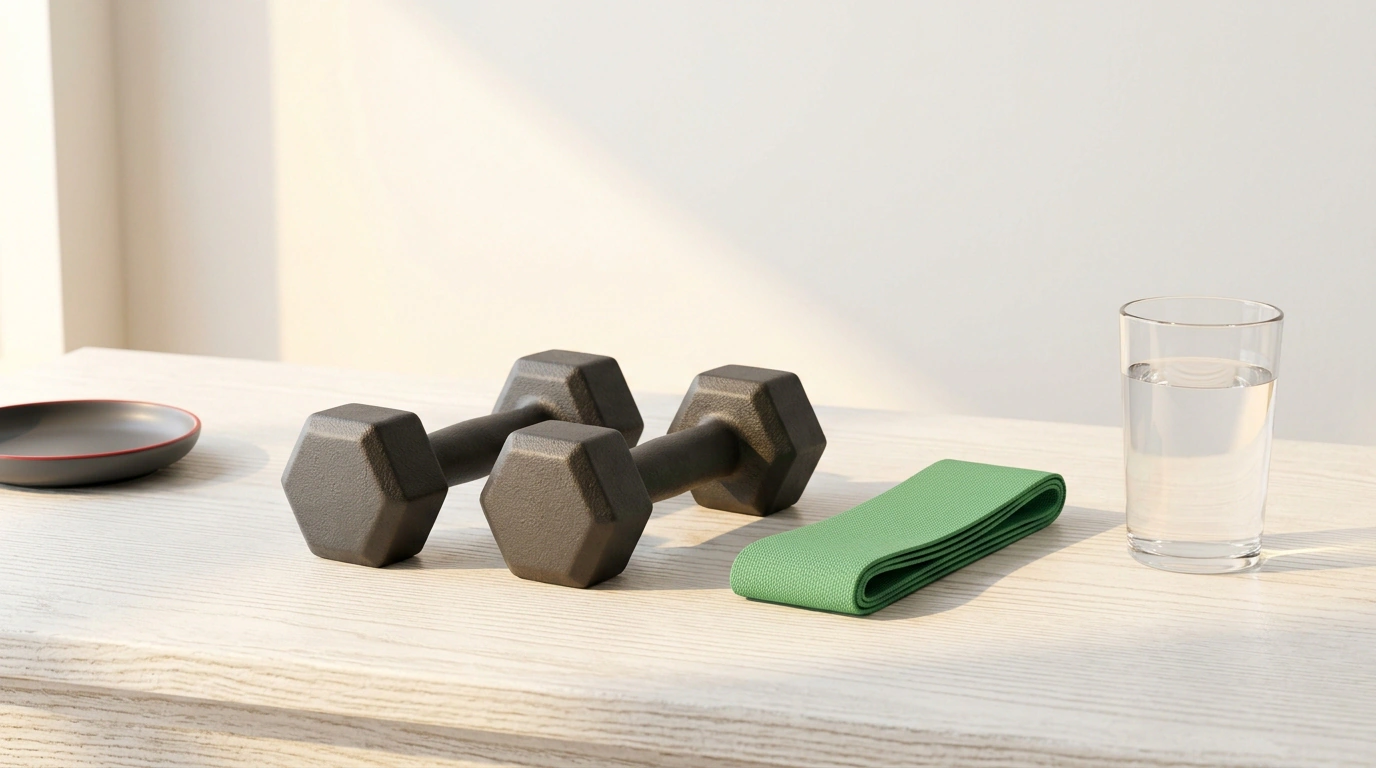
- Strength training: Two to three sessions a week for 30 to 45 minutes is enough. Squats, floor or desk push-ups, resistance bands, and light dumbbells provide plenty of stimulus. Work with challenging effort while leaving 2 or 3 clean reps in reserve before failure.
- Protein intake: As we age, anabolic resistance sets in, meaning muscles need more essential amino acids to trigger repair. Aim for 25 to 35 g of protein in each main meal.
- Daily protein target: Aim for 1.2 to 1.6 g of protein per kilogram of body weight per day (assuming healthy kidney function).
- Even distribution: Spread your protein across 3 meals (eggs or cottage cheese at breakfast, poultry or fish at lunch, and beef, tofu, or legumes at dinner).
- Baseline movement: Keep up 7,000 to 10,000 steps a day to support the capillary network feeding your muscle fibers.
Your skeletal muscles are the main retirement fund for your health. Start with a few simple squats today, and your blood vessels, liver, and joints will stay younger for decades.