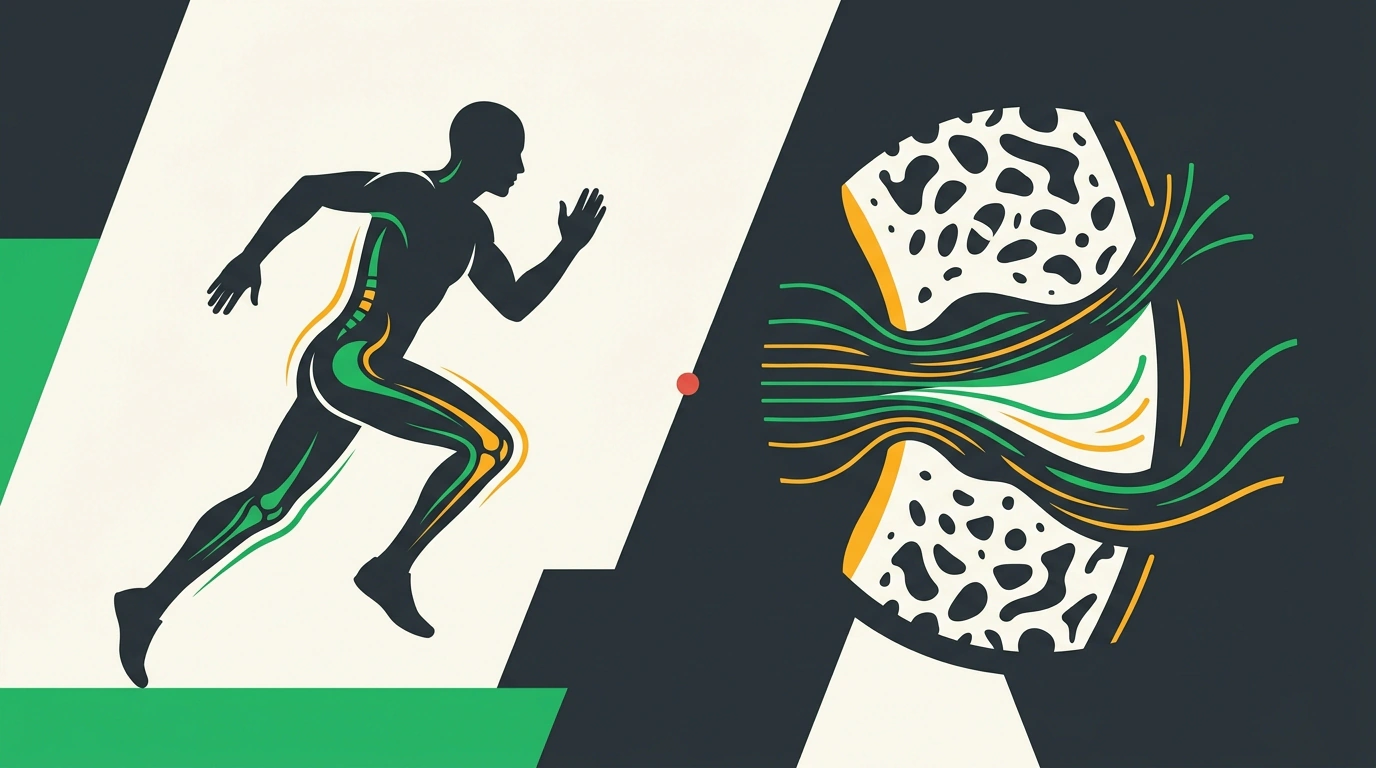
'I'm over forty, my knees click, and my lower back aches by evening. How could I possibly squat or run? My cartilage will wear away completely!'
I hear this line with alarming regularity. As soon as someone hits their forties or feels one sharp twinge in their back, a wall of rules goes up. Online advice warns you never to bend your knees past 90 degrees, never to round your back, and that the safest way to protect your joints is to lie on the sofa and move as little as possible.
Medicine has a name for this condition: kinesiophobia, an irrational fear of movement. The irony is that protective rest destroys joints faster than squats ever could. We already covered the hidden risks of inactivity in our article on the harms of prolonged sitting.
Let's see why joints suffer when you stop moving and how living tissue adapts to load.
You Are Not a Car: Why Tissue Gets Stronger Under Load
The biggest mistake behind kinesiophobia is treating the body like a machine. People picture joints as hinges or gears. The logic seems obvious: more mileage means more wear and tear, so you should move less.
A living body, however, is a self-renewing adaptive system governed by mechanotransduction. Living cells sense mechanical stress and respond by building stronger structures.
What happens without movement?
- Inactivity causes joint cartilage, ligaments, and tendons to atrophy (PMID: 32360761).
- Bones lose density because without compression, bone-building osteoblasts stop absorbing minerals.
- Under moderate load, tissues thicken and adapt as collagen synthesis and ligament strength increase (PMID: 26409630, PMID: 32503243).
Your body renews bone tissue every three to four years, but that renewal only happens when you give it regular mechanical loading.
The Sponge Inside Your Joint: How Cartilage and Discs Feed
Hyaline joint cartilage and the outer rings of spinal discs have no blood vessels. No capillaries deliver nutrients directly to them.
So how does cartilage survive?
Imagine a dense, springy sponge sitting in water:
- When you take a step or squat, the cartilage compresses and squeezes out stale fluid carrying metabolic waste.
- When the load lifts, the cartilage expands and pulls in fresh synovial fluid rich in nutrients.
This pumping cycle is the only way a joint gets fed. If you stay in a chair for weeks, the sponge dries out. Cartilage begins to starve, thin, and crack. Sitting still does not save a joint; it wears it down, as we explained in our look at whether running really ruins your knees.
MRI Scans vs. Myths: What Happens to Runners' Spines
For years, people assumed running inevitably wore down spinal discs. A study led by Daniel Belavý (Belavý et al., Scientific Reports, 2017, DOI: 10.1038/s41598-017-01956-2) overturned that assumption.
Quantitative lumbar MRI scans showed:
- Recreational runners had thicker, better-hydrated discs than peers with sedentary jobs.
- Runners' disc tissue held higher levels of glycosaminoglycans, the molecules responsible for shock absorption.
In rehabilitation medicine, clinicians measure fear of movement with the Tampa Scale of Kinesiophobia (TSK). Research (DOI: 10.1016/j.cpc.2014.07.001) shows that a high TSK score (above 37 to 40) predicts chronic pain more strongly than MRI findings like disc bulges. People get trapped in a cycle: fear leads to weak muscles, weak muscles destabilize joints, and that triggers fresh pain.
A Gentle Return to Movement: Your Smart Starting Checklist
Modern rehabilitation relies on graded exposure. Your body can grow stronger at any age as long as you give it time to adapt and recover.
Checklist for a Safe Return to Movement
- Red flags ruled out: no acute injury, groin numbness, or shooting pain down a leg
- Chair squats practiced: start with 10 to 12 bodyweight reps at a comfortable pace
- Daily walking added: 20 to 30 minutes of brisk walking to activate the joint fluid pump
- Comfort monitored: discomfort during exercise stays at or below 3 out of 10
- Consistency prioritized: 2 or 3 light workouts a week beat rare intense efforts
If a joint speaks up after a long break, reduce your squat depth or slow your pace, but don't stop moving altogether. Movement is medicine, and like any medicine, it works best at the right dose.
Don't let fear lock your body in place. Your joints are built for motion, and measured loading is what restores their strength and freedom.