A dangerous myth still floats around fitness circles: you can run anabolic steroids for a couple of years, build an impressive physique for the beach or stage, then 'cycle off properly,' clean up your system, and watch everything reset to factory settings. Cardiologist Alexey Utin broke down a landmark Norwegian study in the European Heart Journal that completely dismantles this illusion.
A team at Oslo University Hospital led by Rang Abdullah and Vibeke Almaas followed athletes for a full ten years. They compared heart structure and function in men who had used anabolic androgenic steroids (AAS) for years against athletes who trained strictly naturally.
The findings are sobering: the heart is not a bicep, and the price of artificially boosted muscle stays embedded in heart tissue long after the syringes are thrown away.
What happens to your heart muscle on a cycle
When supraphysiological doses of testosterone and its synthetic analogs enter the body, androgen receptors light up far beyond skeletal muscle. Heart tissue responds with aggressive growth, developing marked concentric hypertrophy of the left ventricle. The walls of your body's main pump thicken, yet the inner chamber doesn't expand to match.
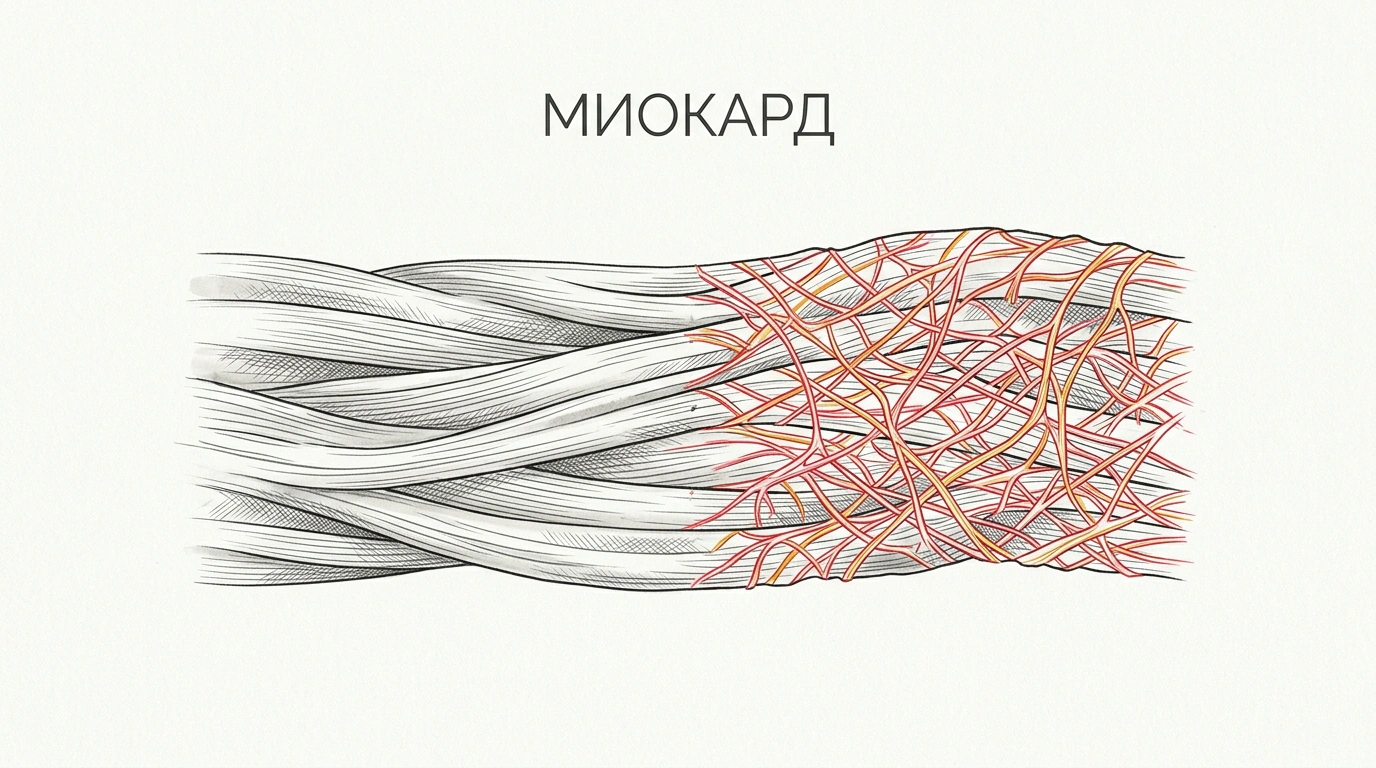
Worse still, anabolics directly stimulate the growth factor TGF-β and trigger diffuse fibrosis. Rigid connective tissue—type I and III collagen—grows right through the elastic muscle fibers. Unlike a localized scar after a heart attack, steroid-induced fibrosis weaves evenly throughout the entire heart wall.
As a result, the heart loses its ability to relax properly. Diastolic dysfunction sets in: the ventricle turns into a stiff rubber ball that struggles to draw blood in from the atria. Among 17% of participants who kept using steroids, pumping capacity crashed severely, with ejection fraction dropping below 40%—a clear sign of serious heart failure.
Many recreational lifters try to protect their hearts by dropping to low maintenance doses between cycles. The Norwegian study proved that these low-dose 'cruises' do not stop the damage. Ongoing exposure to external hormones keeps oxidative stress high and continues killing heart muscle cells.
What recovers—and what stays for good
Fifteen men in the study managed to stop taking anabolics completely, allowing researchers to see how much the heart can actually heal:
- Wall thickness shrinks: the myocardial mass index fell from 112 to 91 g/m², nearly matching the natural weightlifter control group. Once the hormonal push vanished, the muscle cells shrank back down.
- Ejection fraction partially rebounds: pumping contractility rose from 48% to 54% (though non-users typically stay steady around 60%).
- Fibrosis and stiffness never leave: collagen strands in the tissue matrix do not dissolve. Left ventricular stiffness and impaired relaxation persist for years.
This hidden diffuse fibrosis is dangerous in two ways: it steadily pushes the heart toward failure and creates patches of electrical instability. Those fibrotic islands are exactly where ventricular tachycardia and sudden cardiac death start in relatively young athletes.
If you've used steroids in the past, don't rely on how you feel day to day. Get regular screening: a specialized echocardiogram with tissue Doppler (to assess diastolic relaxation), 24-hour ambulatory blood pressure monitoring, a Holter ECG to catch arrhythmias, and a consultation with an evidence-based cardiologist.
Cardiovascular health is built over decades. We've already covered how uncontrolled anabolic use damages the heart—temporary muscle mass simply isn't worth irreversible remodeling of your myocardium.