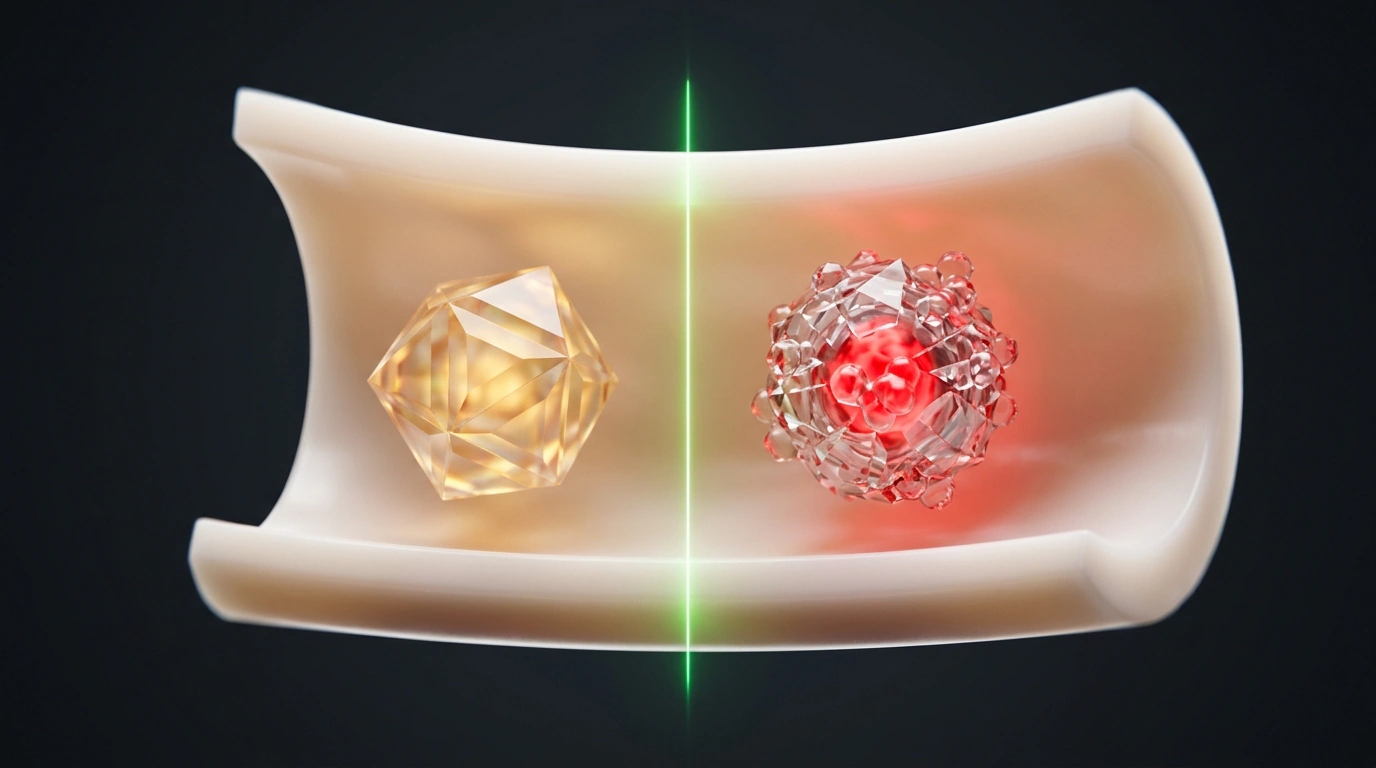
Imagine a drug that makes blood tests look nearly spotless. One injection a month cuts the main blood marker of chronic inflammation by two-thirds. On paper, it looks like a triumph. Yet when doctors counted actual heart attacks, strokes, and cardiovascular deaths across more than six thousand patients, the difference from a placebo was zero. Not a single extra heart saved.
That was the outcome of the major international ZEUS trial, published in NEJM. Social media has long pushed a tempting story: LDL cholesterol supposedly doesn't cause atherosclerosis, statins are pointless, and the real culprit is 'hidden inflammation' you just need to quiet down. ZEUS tested that hypothesis head-on in thousands of people, and the result was sobering.
Why Cardiologists Tried to Put Out Inflammation in the First Place
Let's quickly trace how an arterial plaque grows. Atherosclerosis is the gradual buildup of cholesterol 'bricks' and scar tissue right inside an artery wall. LDL (low-density lipoprotein) particles haul those building blocks in. When too many circulate in the blood, they slip under the vessel's inner lining and get trapped.
The immune system spots those deposits like a splinter and dispatches cleanup cells. A slow, stubborn smolder—local inflammation—begins. Over time, the plaque swells, narrows the artery, and its thin cap can crack. A blood clot forms instantly over the crack and blocks blood flow. That's a heart attack or stroke.
Stages of artery narrowing by atherosclerotic plaque (Source: Wikimedia Commons)
Lowering LDL with statins and other proven drugs slows this process down dramatically, yet even on medication, repeat events don't drop to zero. For years, cardiologists searched for a 'second pillar' of prevention: if inflammation smolders inside the plaque, why not switch it off directly?
The first major attempt came in 2017 with the CANTOS trial. Ten thousand heart-attack survivors received canakinumab, which blocks an early inflammatory signal without touching cholesterol. Repeat heart attacks dipped slightly, but overall deaths didn't fall. Worse, fatal infections and sepsis rose, and a year's supply cost around $200,000. In 2018, the FDA refused to approve it for heart protection.
Shortly before ZEUS, cardiology got another cold shower. In November 2026, results from the Lp(a)HORIZON trial of 8,322 patients showed that pelacarsen slashed blood levels of lipoprotein(a)—a hereditary type of cholesterol particle—by nearly four-fifths. Yet actual heart attacks and strokes stayed flat, and Novartis ended the program for patients with atherosclerosis (other drug classes targeting this molecule are still in testing). That put twice as much hope on ZEUS: could a sharper strike at inflammation finally deliver clear clinical benefit?
Pretty Lab Reports and Zero Saved Hearts: What Happened in ZEUS
ZEUS enrolled 6,376 high-risk patients: everyone had confirmed atherosclerosis, chronic kidney disease, and signs of systemic blood inflammation. Doctors spot this using high-sensitivity C-reactive protein (hsCRP), a test sensitive enough to catch quiet background inflammation. Participants entered with levels of 2 mg/L or higher.
On top of standard care, half received monthly injections of ziltivekimab and half got a placebo. Ziltivekimab binds interleukin-6 (IL-6). In simple terms, IL-6 acts like the immune system's megaphone: it broadcasts an alarm and tells the liver to pump out C-reactive protein. Mute the megaphone, and the lab sheets go quiet.
On lab printouts, silence really did arrive: IL-6 and hsCRP plunged. The heart and blood vessels, however, didn't notice. Heart attacks, strokes, and cardiovascular deaths happened at identical rates in both groups—statistically, a flat zero.
This is where the idea of a surrogate endpoint comes in: an intermediate blood test number that hints at benefit without guaranteeing it. Imagine an electrical fire starts in your apartment and the smoke alarm starts blaring. You can pull out the battery: the room goes quiet immediately, yet the wires keep burning. ZEUS brilliantly silenced the alarm in the bloodstream while the fire in the arteries kept burning on schedule.
The immune system noticed, though. Your body needs inflammation to fight bacteria and viruses. Turn that signal down systemically and your defenses weaken: serious infections hit 20.4% of patients on ziltivekimab versus 17.9% on placebo. One in five patients on the drug suffered a severe infection while getting zero heart-attack protection in return.
The JUPITER Trap and Four Landmark Trials Side by Side
Fans of the 'forget cholesterol, treat inflammation' theory usually pull out an old trump card: the 2008 JUPITER trial. In it, 17,802 seemingly healthy people with decent LDL (below 130 mg/dL, or roughly 3.4 mmol/L) but elevated hsCRP took 20 mg of rosuvastatin daily or a placebo. Major cardiovascular events dropped by nearly half, and overall deaths fell noticeably.
Sounds like a win for the inflammation camp, right? Only if you ignore the main detail: rosuvastatin in JUPITER knocked down both markers at once, cutting LDL cholesterol in half. The trial's design couldn't separate those two effects or tell how many lives were saved by lower cholesterol versus lower inflammation. Crediting JUPITER's entire success to fighting inflammation is a blatant logical sleight of hand.
Line up the four major trials side by side and the pattern turns crystal clear: drugs that only polished a blood marker offered no real heart protection, while steep LDL lowering changed outcomes.
| Trial | Drug and Primary Target | Blood Test Change | Real Heart Attacks, Strokes, and CV Deaths |
|---|---|---|---|
| ZEUS (2026, 6,376 patients) | Ziltivekimab (IL-6 blocker) | hsCRP −64%, free IL-6 −76% | No effect (17.6% vs. 17.7%; HR 0.99) |
| Lp(a)HORIZON (2026, 8,322 patients) | Pelacarsen (Lp(a) lowering) | Lp(a) −78.4% by month 12 | No effect (12.3% vs. 12.1%; HR 1.02) |
| CANTOS (2017, 10,061 patients) | Canakinumab (IL-1β blocker) | Lower hsCRP with no LDL change | −15% (HR 0.85), but higher fatal infections and FDA rejection |
| JUPITER (2008, 17,802 patients) | Rosuvastatin 20 mg (statin) | LDL −50% and hsCRP −37% together | −44% in events and −20% in all-cause mortality |
When a drug only lowers an inflammatory protein or a single genetic marker, the payoff is either zero or too modest against serious infection risks. When therapy thoroughly clears excess LDL—the actual raw material for plaques—catastrophes drop sharply and predictably.
What to Do With Your Labs and Cholesterol in Real Life
ZEUS's failure doesn't mean inflammation plays no part in atherosclerosis. Scientists will keep hunting for safer ways to target it. Today, however, the 'ignore cholesterol, fight inflammation' bet has flatly failed real-world testing. LDL cholesterol remains the number-one proven prevention target: lowering it with statins, ezetimibe, or PCSK9 inhibitors consistently protects the heart across dozens of large trials.
If your doctor prescribed statins or other cholesterol-lowering drugs, never stop taking them on your own after watching clips about 'cholesterol myths' or 'anti-inflammation protocols.' Discuss any doubts, side effects, or regimen changes in person with your primary care doctor or cardiologist.
To keep your blood vessels in good shape, you don't need 'anti-inflammatory' supplements or endless exotic lab panels. Bring a solid baseline to your appointment: a fresh lipid panel with LDL, a fasting glucose or HbA1c test, and a blood pressure log. It's also worth testing lipoprotein(a) once in your life—it barely changes over time and helps your doctor gauge your personal cardiovascular risk more accurately. From there, simple proven habits carry the load: quitting smoking, moving regularly, controlling blood pressure, and hitting your personal LDL target alongside your doctor.