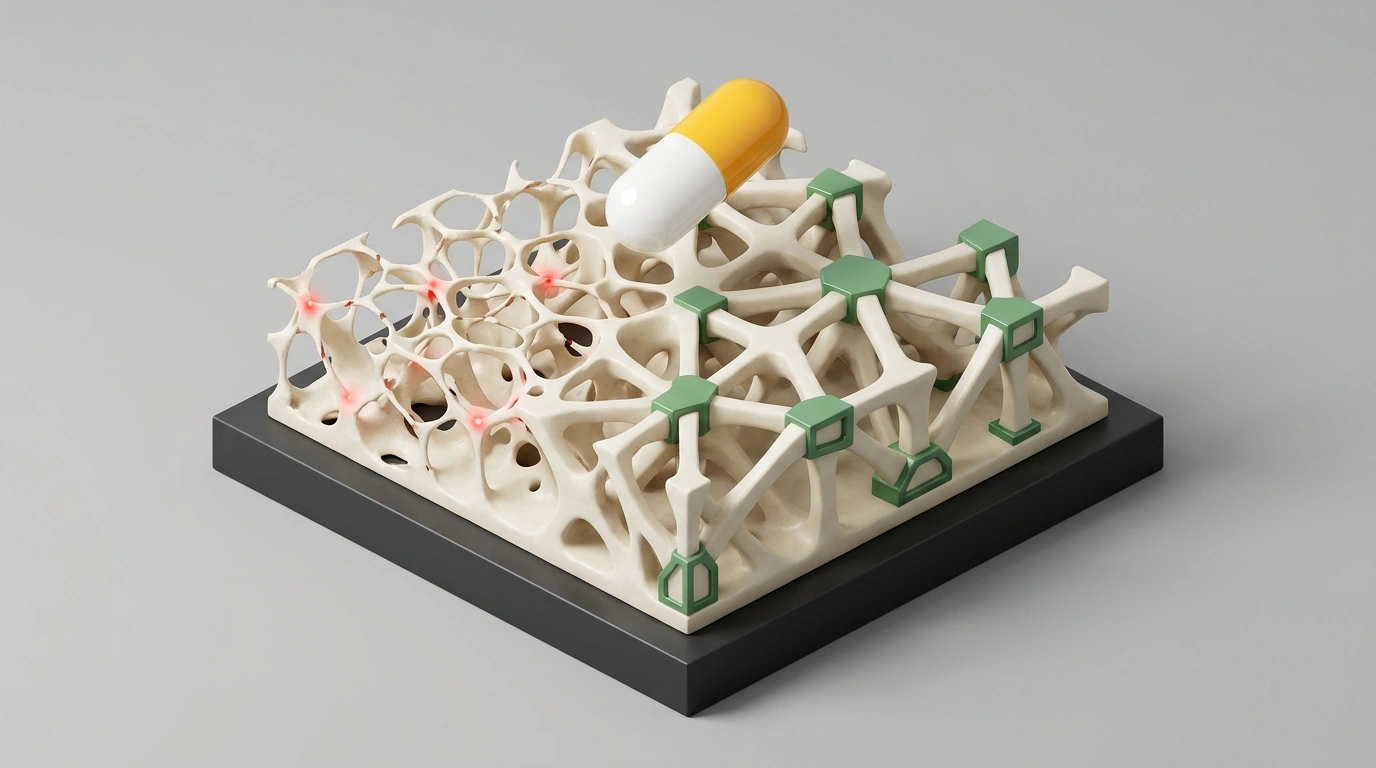
Hear the word 'osteoporosis' and your hand instinctively reaches for calcium and vitamin D3. The logic sounds airtight: bones turned brittle, so they must lack building blocks—let's top them up and patch the problem. Once the disease has set in, though, that math fails. Treating osteoporosis with supplements alone is like slapping a bandage on a fracture.
Why Calcium Alone Isn't Enough and How Doctors Diagnose It
Calcium and vitamin D3 still matter as a mandatory foundation. Before starting real treatment, a doctor checks blood calcium and 25(OH)D3 levels to fix any shortfall early—otherwise strong bone drugs can make blood calcium drop dangerously low. On their own, however, supplements don't stop bone loss.
Guessing from creaky knees or backaches gets you nowhere. An endocrinologist or rheumatologist diagnoses osteoporosis using two tools. First is the FRAX score: a calculator using your age, weight, past fractures, and habits to estimate your 10-year fracture risk. Endocrine Society guidelines treat 20% or higher for major fractures—or 3% or higher for the hip—as high risk.
Second is bone densitometry (DXA), a quick, painless X-ray of your lower spine and hip. The scanner compares your bone density to a healthy 25-year-old woman's benchmark and gives a T-score: values between −1.0 and −2.5 mean osteopenia, while −2.5 or lower confirm osteoporosis.
Halting Breakdown or Growing New Bone
Two crews of cells constantly remodel your skeleton: osteoclasts tear down old bone, while osteoblasts build new tissue. In osteoporosis, demolition outpaces construction. Antiresorptive drugs slow down the teardown, while anabolic drugs spark fresh bone growth.
Bisphosphonates usually come first, either as pills (alendronate, risedronate) or an annual zoledronic acid IV drip (Aclasta). They bind into bone, quiet the teardown cells, and keep working even after a course ends. Because kidneys clear them, zoledronic acid is off-limits if kidney filtration drops sharply due to acute kidney injury risk. Response can also fade over time, and doctors watch during long-term use for rare side effects like jaw osteonecrosis or atypical thigh fractures.
Denosumab (Prolia) is a targeted antibody against the RANKL protein that temporarily blocks the signal to break down bone. Your body doesn't build tolerance to it, bone density keeps climbing throughout treatment, and the kidneys don't clear it—so it works safely in chronic kidney disease and even dialysis under calcium and vitamin D monitoring. Its main catch: denosumab doesn't store itself in bone and stops working the moment your six-month window ends.
Teriparatide works from the opposite side: this parathyroid hormone fragment stimulates osteoblasts, grows fresh bone tissue, and restores internal architecture. Doctors prescribe it for severe osteoporosis, prior fractures, or when bisphosphonates fall short. Its drawbacks are high cost and a strict lifetime course limit, after which an antiresorptive drug locks in the gains.
| Drug Class | Dosing Schedule | How It Works | Main Advantage | Main Limitation |
|---|---|---|---|---|
| Bisphosphonates (Aclasta, alendronate) | 5 mg IV drip/year or pills | Slows bone breakdown | Keeps working after stopping; 'drug holidays' possible | Zoledronic acid banned if eGFR < 35 mL/min/1.73 m² |
| Denosumab (Prolia) | 60 mg subcutaneous shot every 6 months | Blocks breakdown signal | No tolerance buildup; safe in chronic kidney disease | Effect vanishes right after stopping; needs a 'bridge' |
| Teriparatide | Daily subcutaneous shots | Grows new bone tissue | Rebuilds structure in severe cases | High cost and 24-month lifetime limit |
Playing the Long Game and the Denosumab Rebound Trap
Bone renews slowly, so osteoporosis treatment runs for at least three years. Under Endocrine Society guidelines, doctors reassess fracture risk after 3–5 years on bisphosphonates: if bones have strengthened, they may approve a supervised 'drug holiday.'
Never try that with denosumab. Missing a shot past six months or quitting cold turkey triggers a 'rebound effect': osteoclasts wake up in a flood, bone density plunges, and the risk of multiple spontaneous spinal fractures shoots up within 6–18 months. Whenever stopping denosumab, your doctor must transition you onto a bisphosphonate—such as a zoledronic acid drip six months after your last shot or a one- to two-year course of pills.
Don't quit denosumab injections without a doctor's exit plan, and don't delay your next scheduled shot. Even if your DXA scan looks great, stopping requires a supervised switch to bisphosphonates guided by an endocrinologist or rheumatologist.