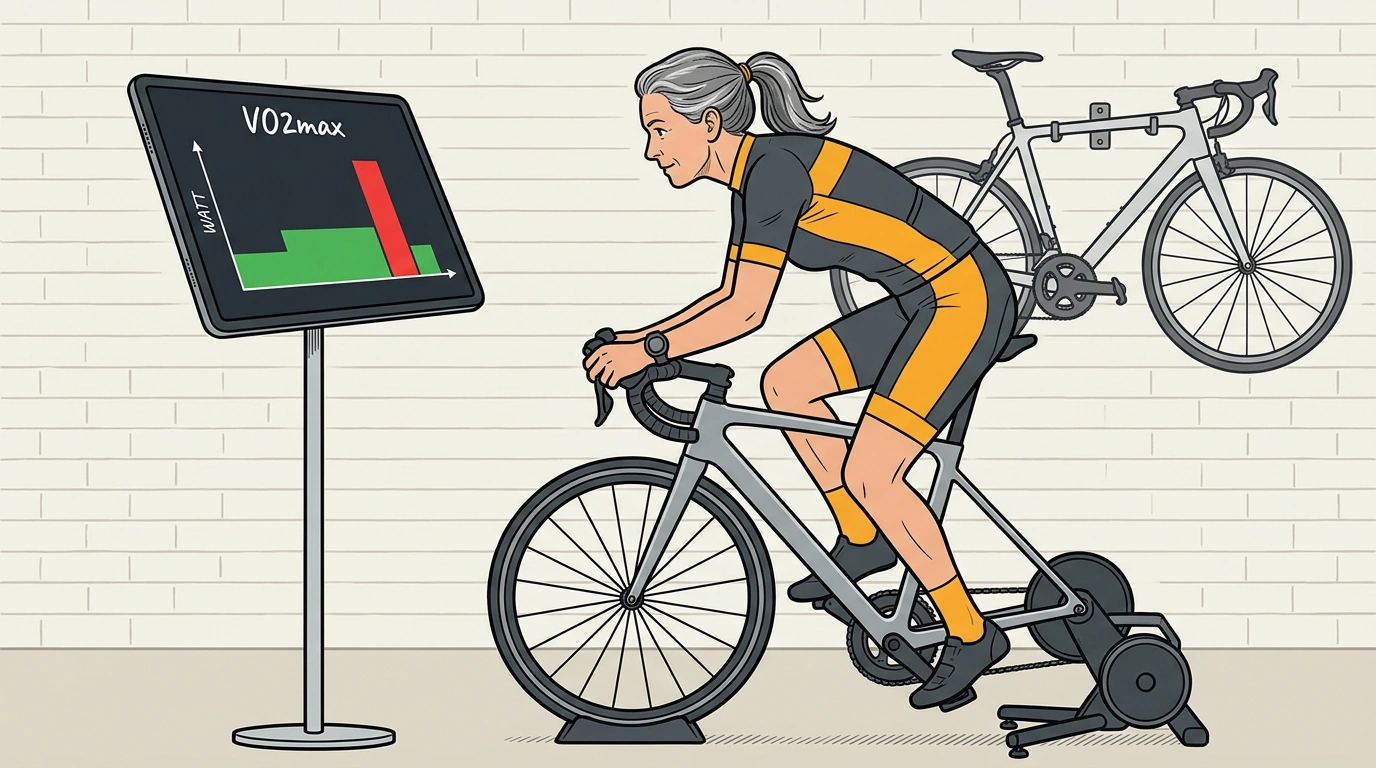
How fast does endurance really drop in women after forty if they run, swim, or cycle regularly? All it takes is a fitness watch nudging your VO₂max down by one point to make you feel like age is winning.
For a long time, there wasn't an honest answer: old sports physiology norms were built mostly on men or sedentary people. Female Masters athletes (veteran competitors, usually aged 35–40+ in endurance sports) stayed largely invisible. In November 2026, Shalaya Kipp, Jonathon Senefeld, and colleagues published a systematic review and meta-analysis in Sports Medicine covering 69 studies and 1,903 active women aged 40 and up. Every measurement came straight from lab gas-exchange testing—no smartwatch guesswork.
What VO₂max Is and Why People Compare It to an Engine
Without the lab jargon, VO₂max (maximal oxygen uptake) is the ceiling on how much oxygen your body can pull from the air and deliver to working muscles per minute at peak effort. Think of it like a car's engine size: the stronger your heart, lungs, and blood vessels work together, the faster you can cruise without gasping.
It's written in two ways. Absolute VO₂max counts liters of oxygen per minute—pure system power, like horsepower under the hood. On the road, though, vehicle weight matters too. That's why runners usually track relative VO₂max: liters divided by body weight, giving milliliters per kilogram per minute (mL/kg/min) so people of different sizes can compare fairly.
How Endurance Shifts Decade by Decade
When researchers lined up all 1,903 lab tests by age, the pattern looked remarkably steady. Each decade, average relative VO₂max in female Masters athletes stepped down smoothly by roughly five units. Meta-regression put the yearly change at minus 0.57 mL/kg/min, or about 11.7% per decade. That pace of decline held steady across runners, cyclists, swimmers, and rowers.
Average Relative VO₂max in Female Masters Athletes by Age
At first glance, it's tempting to blame age-related weight gain: body mass rises, the denominator grows, and relative VO₂max slides down. Yet if extra kilos were the whole story, absolute oxygen uptake in liters per minute would stay flat. It dropped in these athletes too. That points straight to changing heart mechanics: maximum heart rate and the blood pumped per beat both ease down gradually with age.
The review comes with two fair caveats. The dataset is cross-sectional—researchers compared different women across age brackets rather than following the exact same athletes for thirty years. Also, the 70+ bracket included only 64 women, making its spread wider. Still, the core takeaway is encouraging: even though the percentage dip resembles the general population, active women start and finish on a completely different floor. A trained woman in her sixties often holds an endurance reserve out of reach for sedentary folks half her age.
Why Averages Are a Guide, Not a Ceiling
A group curve maps the average trend across hundreds of people; it doesn't set your personal limit. Pick up regular running or swimming at 45 or 50, fix your sleep, and stop racing every easy jog, and your own VO₂max can climb for years right past the statistics.
Meanwhile, take smartwatch estimates with a grain of salt. Kipp's team measured oxygen through a lab mask at full exhaustion, whereas watches just guess from heart rate and pace. Hot weather, poor sleep, a mild cold, or headwinds easily shave a couple of points off your watch score while your true fitness hasn't budged. Trust real-world feedback more: how pace holds at a steady heart rate, how quickly your pulse drops after intervals, and how time trials go.
Basic habits slow the slide best: consistent aerobic volume without long layoffs, manageable tempo or interval efforts to tap top engine gears, and strength work twice a week for muscle support and running economy. If you're coming back after a long break—or notice palpitations, shortness of breath, or blood pressure spikes—check in with a doctor before pushing hard.