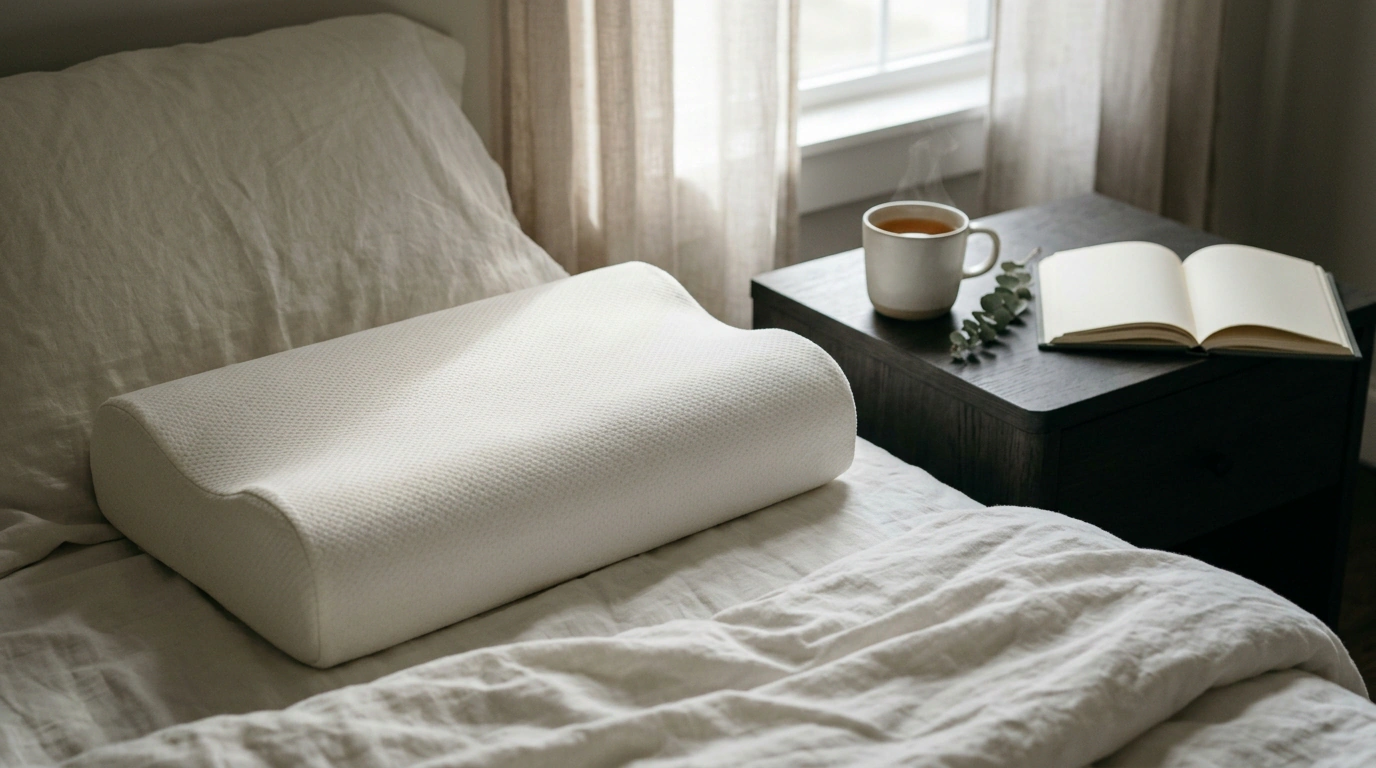
You wake up, turn your head toward the alarm, and your neck aches as if you spent all night unloading freight cars. It's easy to swing to one of two extremes. Either you shrug and keep sleeping on an old flat pillow with your hand tucked underneath, or you browse gift guides and order a pricey 'orthopedic' contour model hoping it fixes everything overnight.
Both paths miss the mark. A lumpy, flattened pillow really does keep muscles tense until morning, yet an 'orthopedic' stamp on the box guarantees nothing by itself. A plain, comfortable medium-firm pillow works just as well when it nails the single most important spec.
Height Matters More Than a Fancy Label
In sleep ergonomics—setting up your bed so neck and shoulder muscles actually rest at night—pillow height (loft) comes first. Its job is to keep your cervical spine neutral: your neck should continue the straight line of your backbone without tilting up or drooping down.
A classic store mistake is squeezing a pillow with your hands and forgetting your shoulder width. When you sleep on your side, there's a gap under your head equal to one shoulder's width. Too thin, and your head sags down; too tall, and your neck bends toward the ceiling all night.
You can check the right height at home in one minute. Measure the distance from the side of your head to the outer edge of your shoulder—compressed under your head's weight, your pillow should fill that exact gap. Back sleepers need a lower loft: there's no shoulder gap underneath, so a tall pillow shoves your chin toward your chest.
Five Pillow Fills Without the Marketing Hype
The second reason people overpay is hunting for one 'magic' material. Science hasn't crowned a single best fill. A 2021 systematic review and meta-analysis in Clinical Biomechanics (Pang et al.) compared different designs: supportive, shape-holding pillows like latex, spring, and contoured models moderately reduced morning stiffness and chronic neck pain compared with flat-crushing feather pillows. Simply put, they hold their height until morning.
| Fill | Pros | Cons |
|---|---|---|
| Memory foam | Molds to head contours, distributes pressure softly | Can feel dense and trap heat |
| Latex | Bouncy, snaps back fast, performed well in reviews | Springy feel isn't for everyone |
| Down and feathers | Soft, easy to scrunch and shape | Flattens overnight; needs constant fluffing |
| Synthetic fiber | Budget-friendly, easy to machine-wash | Compresses faster than latex or dense foam |
| Shredded foam (adjustable) | Let's you tune height and firmness at home | Takes a couple of nights to dial in the fill |
If you toss and turn or worry about ordering the wrong size online, adjustable shredded foam cuts half the guesswork. Unzip it and pull out two handfuls for back sleeping—or stuff them back in to support your shoulder on your side.
Two Honest Limits Ads Won't Tell You
Ads promise deep sleep and a brand-new spine, yet two firm realities stand in the way.
First, morning neck pain isn't always your pillow's fault. That same Pang et al. meta-analysis found supportive pillows eased morning neck discomfort and improved bed comfort, yet didn't significantly improve overall sleep quality. If you crane your head toward a monitor for eight hours a day and scroll your phone in bed, those muscles are already overloaded and simply can't recover overnight.
Second, a pillow doesn't cure degenerative disc disease or herniated discs. It's a household comfort tool, not medical treatment. Pillow trials routinely exclude people with acute cervical disc herniation and arm numbness—if you have those symptoms, you need a doctor's exam and targeted physical therapy.