'Every neighborhood has a running coach these days—someone runs for a year or two and feels ready to coach, but it doesn't work like that.' Running coach Alexander Lapkin said that about amateur running. Copying a training plan off the internet is easy. Guiding a busy adult to a personal best without injury or burnout is much harder.
What Separates a Coach From a Fast Amateur
Why bother hiring a coach when hundreds of free 16-week plans sit online? A spreadsheet on your phone knows nothing about your sleep, a brutal week at work, or a sore shin.
An amateur with one or two years under their belt usually copies whatever worked for them onto every athlete. A real coach brings a deeper base: years of personal mileage, lessons from past injuries, and formal education. Lapkin himself moved into road running after 11 years of competitive ballroom dancing, has run for over a decade, worked through his own injuries, and trained at Yury Strofilov's S10 school.
What to Look for When Choosing a Running Coach
- Formal education in running physiology and coaching methods alongside personal experience.
- Multi-year practice and a clear grasp of how to prevent overuse injuries.
- A flexible plan built around your work schedule, sleep, and daily recovery.
- Hands-on help with race strategy, fueling, and kilometer-by-kilometer pacing.
Shaving 52 Minutes in Three Years Without Breaking Down
With steady, structured work, fitness grows calmly without shortcuts. Look at runner Karina's progression. In 2023 in Yekaterinburg, she finished her second marathon in 3:54—back then, the only goal was breaking four hours.
Three years of consistent training lifted her to a new level. In April 2026, she ran a tune-up half marathon in 1:28, and in August she clocked a 39:49 10K. Tune-up races act like an honest thermometer: they proved she was ready to run faster than 3:05, and by fall she set her sights on breaking three hours.
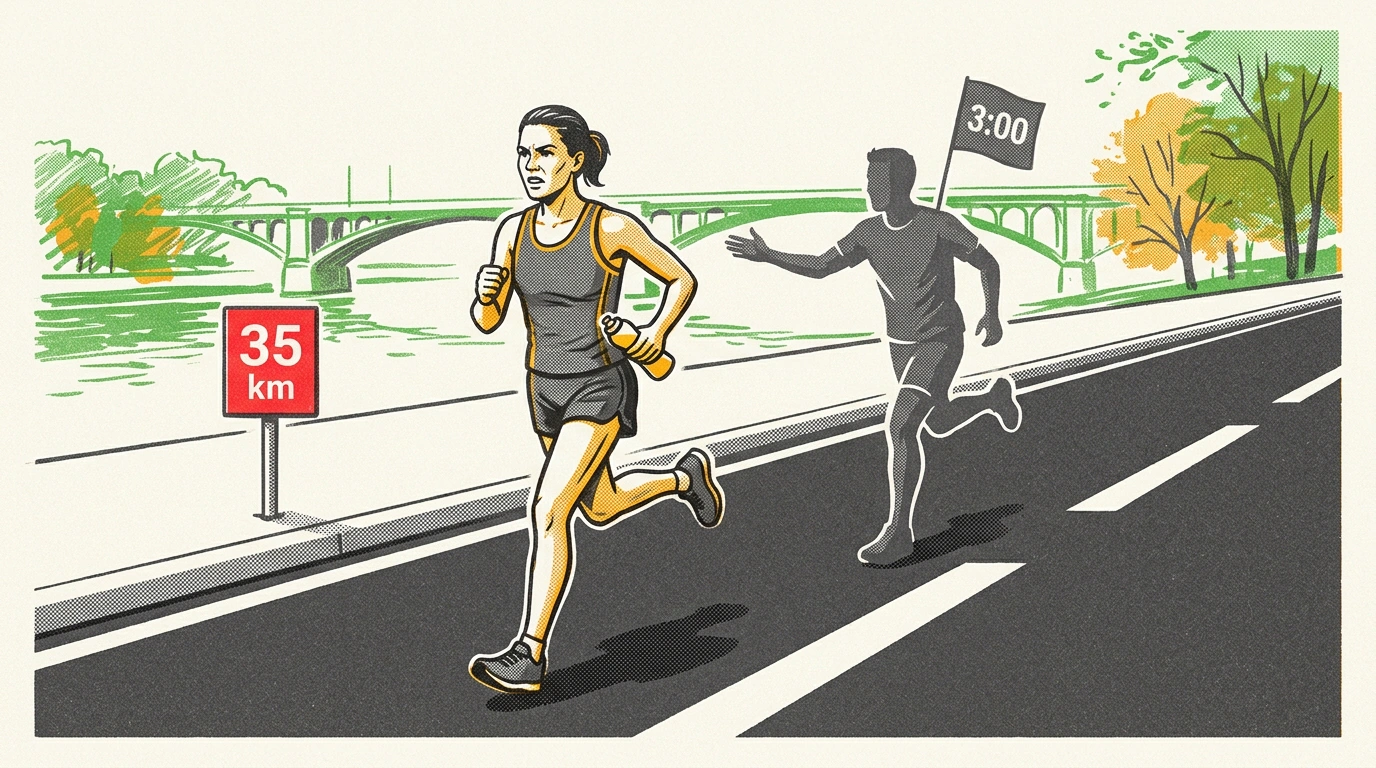
At the 2026 Moscow Marathon, Karina targeted a 4:15/km pace. The first 25 kilometers rolled by with room to spare: the 2:59:00 pacers (experienced flag-bearing runners holding steady group pace) sat roughly a minute behind her, the tough climbs were over, and her legs felt responsive.
Then at kilometer 35, the lights went out. Kilometers 35 through 40 passed in a fog; 41 and 42 were pure agony, with just one thought looping in her head—don't stop. She crossed in 3:02:16 (nearly 52 minutes faster over three years) and took second place in the 30–34 age group. At the same race, two more of Lapkin's athletes set personal bests of 2:52 and 3:03.
Why 'The Wall' Hits at 35K and How to Survive It
Why do the first 25 kilometers feel smooth before your legs suddenly fill with lead? Runners call it 'hitting the wall,' and simple physiology explains it.
At marathon speed, muscles burn muscle glycogen—fast-access carbohydrate stored right inside muscle fibers. According to physiologist Benjamin Rapoport's calculations, muscles and the liver hold around 1,500–2,000 kcal of this fuel. At hard marathon effort, that tank lasts 90–120 minutes, yet covering 42.2 kilometers demands 2,500 kcal or more. Around kilometers 30–35, the tank runs dry, forcing your body onto fat. Fat holds plenty of energy, yet releases it slower—so your pace drops.
Add neuromuscular fatigue from over 30,000 pounding steps: micro-damage piles up in muscle fibers, running economy fades, and your brain turns up the volume on perceived effort.
Three habits help tame the wall. First is even pacing—starting too hot burns glycogen early. Second is fueling on the move. Under ACSM guidelines, races lasting 1–2.5 hours call for 30–60 g of carbs per hour, while efforts beyond 2.5–3 hours need 60–90 g per hour from a glucose-fructose mix, starting in the first 30–45 minutes. Always test those amounts on long training runs first so your stomach adapts.
Third is live course support. At the Moscow Marathon, Lapkin met Karina along the route with water and gels, checked her form, and cheered her on. When you spot a familiar face holding a water bottle through the late-race haze, your brain finds it easier to keep pushing—and your legs carry you to the finish.