In France, teaching cranial osteopathy is officially banned. Yet in other countries, surveys cited in a major 2016 review show that anywhere from 3.4% to 94.8% of osteopath patients receive these head manipulations. Videos about "breathing skull bones" rack up hundreds of thousands of views, and some people genuinely walk out of a session feeling rested and clear-headed.
How do those two facts sit side by side? Why does the method fail blinded tests while keeping appointment books full for weeks? Let's look at how an adult skull is built, what happened in experiments with a privacy screen, and where the relief after a session actually comes from.
Where the 'breathing skull' came from and why plastic models fool the eye
In viral clips, it all looks convincing. A practitioner takes a detachable plastic skull model, removes a few pieces, holds the parietal bones, and demonstrates a smooth "inhalation phase" and "exhalation phase." Then comes the promise: in bronchial asthma, one of the skull sutures supposedly gets "locked." In one such video, osteopath Yuri Lukashev puts it bluntly: "As soon as we start spreading this little suture..."—implying that breathing will improve.
Your eyes want to believe it, because the plastic parts really do move in his hands. A living adult head works differently.
The idea goes back more than a century. Osteopathy founder Andrew Taylor Still launched the field in the US in 1874, and in the early 20th century his student William Garner Sutherland invented the "primary respiratory mechanism" hypothesis. He proposed that the brain pulses rhythmically, cerebrospinal fluid passes that wave to membranes, skull bones, and the sacrum, and sensitive fingers can detect and fix that pulse. Practitioners call this the craniosacral rhythm.
Adult human anatomy doesn't match a snap-together plastic model. The bones of the skull vault are joined by dense, jagged sutures made of tough connective tissue that lock the cranium together. Supporters often point to the base of the skull—the spheno-occipital synchondrosis, a cartilage joint between the sphenoid and occipital bones—claiming mobility remains there. But a 2021 CT study by Dalili Kajan and colleagues (Orthodontics & Craniofacial Research, scans of 763 people aged 9 to 22) showed a clear picture: that joint starts fusing at age 9 and turns completely into bone around age 17. In an adult, there is physically nothing left to "breathe."
Diagram of the sutures and bones of the human skull (Source: OpenStax / Wikimedia Commons, CC BY 3.0)
The screen test: what fingers actually feel when blinded
When told about the anatomy, supporters usually reply that the movements are tiny—too small for machines to catch, yet trained hands can still feel them. Testing that claim is straightforward.
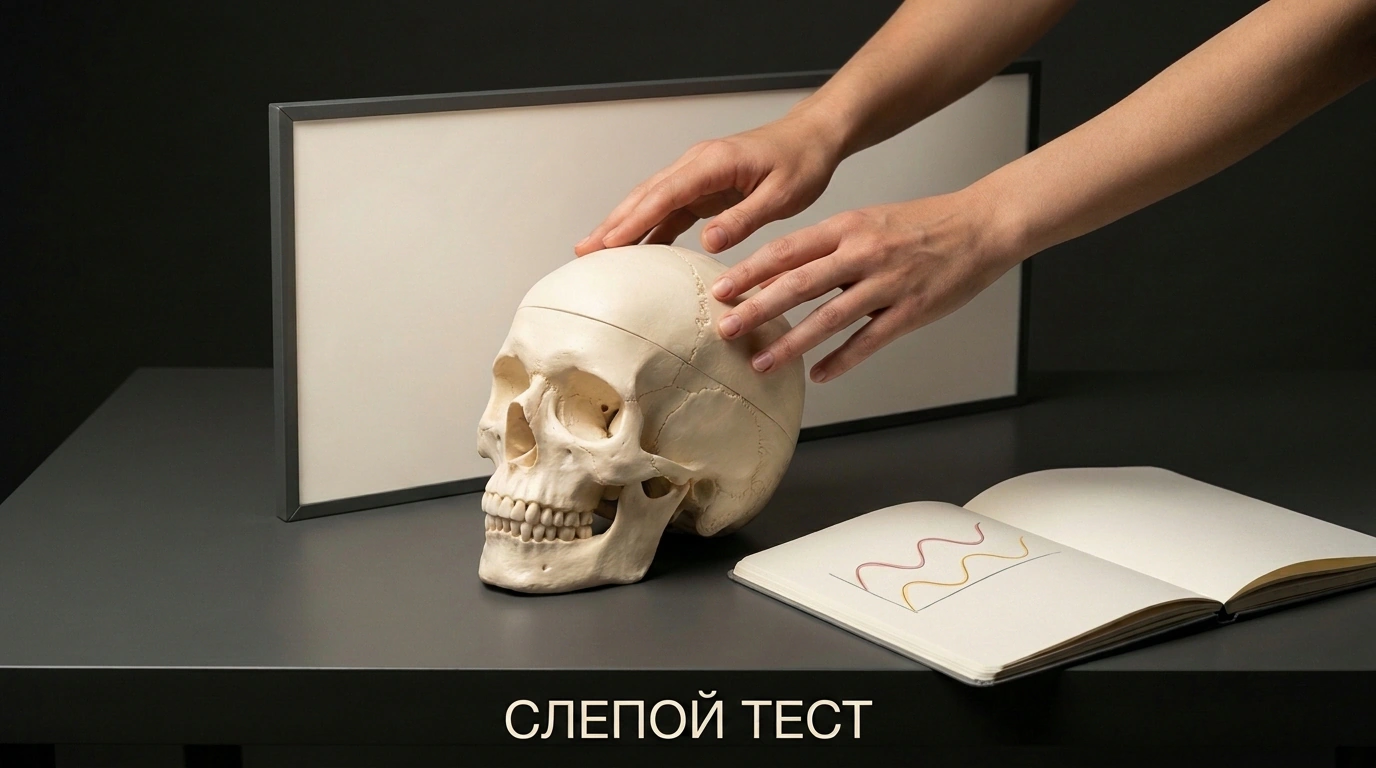
In medicine, researchers check inter-rater reliability: do two specialists reach the same conclusion when they examine the same person independently? To keep practitioners from picking up accidental cues from a colleague's eyes, nods, or breathing, they use blinding—often just placing a screen between them.
That's exactly what Rogers, Witt, Gross, Hacke, and Genova did in 1998 (Physical Therapy). Two certified craniosacral therapists simultaneously listened to the "rhythm" in 28 adult volunteers. One held the head, the other held the feet, and a screen kept them from peeking.
Agreement collapsed. Researchers measured it using the intraclass correlation coefficient (ICC), where reliable agreement is above 0.75 and zero means pure guessing. At the head, ICC was 0.08; at the feet, 0.19. Even the same therapist re-examining the same person barely matched their own earlier readings (ICC 0.18 to 0.30). And rhythms measured simultaneously at one person's head and feet didn't match either. Each practitioner was feeling something different.
In 2016, Albin Guillaud's team published a large systematic review in PLoS ONE searching MEDLINE, PEDro, the Cochrane Library, and specialist journals. Out of 1,280 publications and 4 extra papers, 9 studies reached the diagnostic analysis. Eight had a high risk of bias (mostly from poor blinding), one (Halma et al.) raised serious concerns, and two papers (by Upledger and Sommerfeld with co-authors) were deemed statistically unusable due to calculation errors. Not a single study confirmed that a "craniosacral rhythm" can be reliably felt by hand.
Asthma, chronic pain, and testing whether treatment works
Suppose diagnosis by sutures doesn't hold up—could the gentle techniques still treat illness anyway, like easing bronchial asthma?
Scientific databases contain zero clinical trials on "spreading skull sutures" for asthma. There is, however, a Cochrane review by Hondras, Linde, and Jones (2005) on manual therapies for asthma: 3 randomized trials, 156 patients. Manual techniques failed to beat a sham procedure on either symptoms or lung function.
In the second part of the 2016 PLoS ONE review, the authors tested cranial osteopathy's effectiveness for any medical condition. From 556 publications and 14 extra papers, they selected only randomized and crossover trials in real patients, excluding healthy volunteers. The quality breakdown of those trials is telling.
Quality assessment of cranial osteopathy clinical trials (PLoS ONE, 2016)
The vast majority of trials fell short due to weak design: no clear primary endpoint, no correction for dozens of repeated comparisons, and no check on whether patients believed the sham treatment. And in the small handful of better-run studies (Elden 2013 for pelvic pain in pregnancy, Haller 2015 for chronic neck pain, and Castro-Sánchez 2016 for low back pain), uneven conditions skewed the results.
In Elden's trial, the control group had almost no live contact with a specialist, and the gap in morning pain came mostly from pain worsening in the control group. In Haller's study, three therapists delivered craniosacral therapy while only one gave the sham treatment. In Castro-Sánchez's trial, there was no difference at all on the primary scale (the Roland-Morris questionnaire), even though a craniosacral session lasted 50 minutes versus 30 minutes of standard massage.
Over the next eight years, the scientific consensus didn't budge. In 2024, a systematic review and meta-analysis by Ceballos-Laita and colleagues in Healthcare found once again that for pain syndromes, craniosacral therapy showed no clinically meaningful long-term edge over adequate controls, with GRADE evidence quality rated low to very low.
There's an interesting regulatory contrast noted in the PLoS ONE review: in 2010, the WHO mentioned cranial osteopathy in a benchmark training document for osteopathy, even though teaching it is banned in France. The review authors (backed by the French National Council of Physiotherapists) pointed out that the WHO's own criteria require proven effectiveness and reproducibility—neither of which this method has.
Why you might feel better afterward and where the safety line lies
One everyday question remains. If bones don't move and blinded trials find no specific effect, why do friends walk out of a session feeling clear-headed and relieved?
That's the contextual effect—a very real response of your nervous system to the setting, not to shifting skull bones. Picture a normal day: rushing around, staring at screens, clenched jaw, tight neck. Then you lie down for 50 minutes in a quiet room with no phone, next to a calm person who listens closely to your complaints and holds your neck and head gently without causing pain. Anxiety drops, overworked muscles let go, and your brain switches from stress mode to rest. On top of that, pain naturally comes in waves: people tend to book appointments at the peak of a flare-up, right before symptoms would ease on their own anyway. The relief is real; it just comes from quiet, attention, and gentle touch, not "breathing bones."
Gentle head touch in adults rarely causes physical harm. If you treat a visit like a pricey way to unwind—similar to a spa massage—and it fits your budget, there's no harm done. The safety line is crossed when a pleasant ritual is sold as a cure for medical conditions.
- Bronchial asthma is a chronic inflammation of the airways. It is controlled with maintenance inhalers and an action plan from a pulmonologist or primary care doctor; stopping medications to 'spread sutures' risks a severe flare-up.
- Chronic neck, back, or pelvic pain needs proven basics: graded exercise, physical therapy, and doctor-prescribed medications when needed.
- A promise to 'fix a diagnosis by hand' or advice to stop prescribed treatment for a course of osteopathy is a clear sign to walk away and see a qualified specialist.
If you just want to melt away tension after a hard week, a regular relaxing massage or a quiet walk gives you the same rest without fairy tales about moving skull seams. And for asthma, frequent headaches, or lingering back pain, it's much safer to see a medical specialist and stick to methods that actually pass blinded tests.