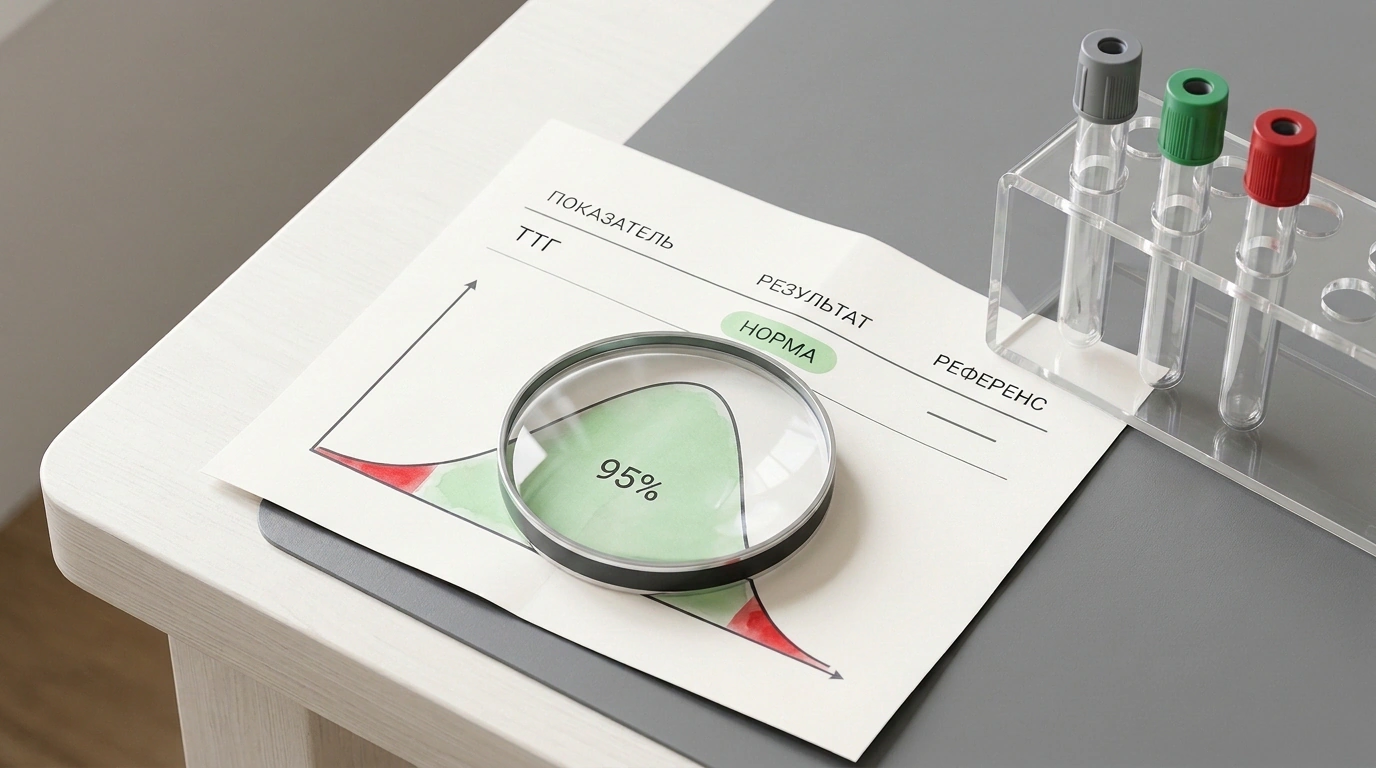
When a red arrow lights up next to a line on your lab report, your stomach drops. It feels like you've finally found the culprit behind your fatigue, morning puffiness, or a couple of extra kilos. Yet there's a statistical trap hiding behind that red arrow that checkup ads never mention.
A lab's reference interval covers roughly 95% of supposedly healthy people. The other 5% are completely healthy too—their personal normal just sits slightly above or below the box. Take one targeted test for a clear reason, and your odds of a false alarm are low. Buy a trendy 20-hormone panel all at once, and the math kicks in: at least one number will almost certainly fall outside the column.
Why a 'full hormone profile' turns a healthy person into a patient
Hormones are a dream product for commercial checkups. There are lots of them, their names sound impressive, and their levels shift constantly—jumping after poor sleep, a traffic jam, a hard workout, or an argument. You buy a big "fatigue and metabolism" package, and suddenly your table glows with a couple of "abnormalities"—the perfect excuse to sell you a long course of IV drips, supplements, and repeat labs.
If all 20 lines happen to come back spotless, plan B kicks in. At the consultation, you're told that standard lab ranges are "too wide." They cross out the reference interval and draw narrower "optimal" or "integrative" ranges over the top. There is no clinical evidence behind those tight corridors, yet with one stroke of a pen a healthy person walks out with a diagnosis and a long shopping list.
Evidence-based medicine works the other way around: a doctor moves from your symptoms and physical exam to targeted tests, rather than firing 20 blood tubes hoping to hit something. Let's look at which tests genuinely give answers and which ones only drain your wallet and nerves.
What actually works: thyroid, blood sugar, and cholesterol
If you're worried about sluggishness, weight gain, or just want a sensible check of your basic metabolism, three areas with clear medical thresholds are enough.
The first checkpoint is your thyroid. For initial screening, you need one test: thyroid-stimulating hormone, or TSH (typical reference 0.4–4.0 mIU/L). The body's control loop shows why TSH alone is plenty.
Negative feedback mechanism of the pituitary-thyroid axis (TSH and thyroid hormones) (Source: OpenStax / Wikimedia Commons, CC BY 3.0)
Your pituitary gland acts like a sensitive thermostat. The moment your thyroid slows down and makes less of its hormones (T4 and T3), the pituitary pushes TSH up to nudge it along. If there's too much thyroid hormone, TSH drops. That's why, when TSH is normal, testing free T4—let alone hunting for "low T3"—isn't necessary. Free T4 only comes in when TSH is out of range.
Even a mildly elevated TSH isn't an automatic ticket to the pharmacy. A level above 10 mIU/L almost always calls for treatment. But the 4–10 mIU/L range with normal free T4 is called subclinical hypothyroidism: the gland is keeping up, just with a bit more push from the pituitary. A 2019 BMJ clinical guideline (Bekkering et al.) gave a strong recommendation against routinely prescribing levothyroxine to non-pregnant adults in this zone, because large trials showed no improvement in fatigue, weight, or well-being. Usually, watchful waiting is enough.
There are clear exceptions. During pregnancy or when planning one, the American and European Thyroid Associations (ATA and ETA) apply stricter rules: especially if TPO antibodies are positive, doctors keep TSH below 2.5 mIU/L. Strict targets also apply after thyroid removal for cancer.
The second checkpoint is carbohydrate metabolism. Here, fasting blood glucose and glycated hemoglobin (HbA1c)—which reflects your average blood sugar over two to three months regardless of last night's dinner—do the heavy lifting. Under American Diabetes Association (ADA) criteria:
- fasting glucose below 5.6 mmol/L is normal, 5.6–6.9 mmol/L points to prediabetes, and 7.0 mmol/L or higher raises suspicion for diabetes (the WHO prediabetes cutoff is slightly higher, starting at 6.1 mmol/L, with the same diabetes threshold);
- HbA1c below 5.7% is normal, 5.7–6.4% corresponds to prediabetes, and 6.5% or higher indicates diabetes.
The third checkpoint is a lipid panel (cholesterol and its fractions). Here, relying on the lab's printed reference range can actually be risky: your target LDL depends on your personal cardiovascular risk. An LDL of 2.5 mmol/L is great for a healthy person with no risk factors, but far too high if you have high blood pressure, diabetes, kidney disease, or arterial plaques. Delaying statins or cutting your dose because of a "normal lab sheet" is a dangerous mistake.
The panic magnets: prolactin, menstrual cycle, and testosterone
Three topics account for most overdiagnosis—cases where a healthy person gets a scary label and strong medication for no good reason.
The first trap is prolactin (typically 100–500 mIU/L). It spikes easily from poor sleep, exercise, sex the night before, a stressful commute, or walking briskly to the clinic. Oversleep, sprint to the lab, draw blood—and you get a number above the reference range.
One strict rule applies here: a single test never equals a diagnosis. One high prolactin result is not a reason to rush into a pituitary MRI and start cabergoline. According to Endocrine Society guidelines, if you have no clear symptoms, you first repeat the test with proper preparation, review your medications and TSH, and ask the lab to check for macroprolactin. Macroprolactin is a large, mostly inactive form of the hormone bound to antibodies. It inflates the number on paper without causing pituitary trouble.
The second common scenario is testing "all female sex hormones just in case." If your menstrual cycle is regular and you have no symptoms, routine sex-hormone screening isn't needed. Even if a slightly high testosterone number pops up by chance, evidence-based medicine doesn't treat a number without symptoms.
The third topic is male testosterone and the myth that "everyone in the US and Europe gets shots after 30." Morning total testosterone is typically above 12 nmol/L, and 11.8 vs. 12.1 nmol/L are equally normal. Under Endocrine Society standards, male hypogonadism is diagnosed only when clear symptoms are paired with two confirmed low morning fasting total testosterone readings on separate days.
Popular tests that rarely change anything in routine care
Now for the checkup bestsellers that sound scientific but usually change nothing at an evidence-based endocrinologist's office.
Fasting insulin (often listed as 2–25 mcU/mL) is marketed as the ultimate test for "insulin resistance." It has no unified clinical diagnostic cutoffs: in someone with excess weight, doctors still rely on glucose and HbA1c. Leptin (2–20 ng/mL) is almost always high in obesity anyway, isn't treated separately, and doesn't change the plan. DHEA-S varies wildly by age and sex; it helps when doctors suspect an adrenal tumor or excess androgens (as in PCOS), but it doesn't explain everyday fatigue.
Blood tests for serotonin, dopamine, and melatonin miss the mark in routine care as well. Serotonin and dopamine in vein blood don't reflect brain levels, and melatonin swings dramatically over 24 hours—you can't diagnose sleep or mood disorders from those lab sheets.
| Test | When it's actually needed | The main catch |
|---|---|---|
| TSH | First-line thyroid check | Borderline values in non-pregnant adults usually call for monitoring, not pills |
| Free T4 | Only if TSH is out of range | Ordering it 'as a bundle' when TSH is normal wastes money |
| Fasting glucose and HbA1c | Screening for prediabetes and diabetes | Reliable baseline that trendy insulin tests don't replace |
| Lipid panel (LDL) | Assessing cardiovascular risk | The lab sheet doesn't know your risk profile; your doctor sets the target |
| Prolactin | Cycle disruption, galactorrhea, low libido | Spikes easily from stress and commuting; needs a repeat test and macroprolactin check |
| Total testosterone (men) | Persistent deficiency symptoms | One morning test proves nothing; two separate confirmations are required |
| Fasting insulin and leptin | Almost never in routine screening | Don't change the diagnosis or treatment plan in excess weight |
| DHEA-S | Suspected adrenal tumor or PCOS | Doesn't explain general fatigue and varies widely by age |
| Blood serotonin, dopamine, melatonin | Not used to assess mood or sleep | Venous levels don't reflect brain activity or daily sleep rhythms |
Buying an "insulin + leptin + cortisol" bundle without an exam or clear symptoms is commerce, not endocrinology. The longer the list of unindicated blood tubes, the higher the chance of treating a healthy person.
A quick filter before heading to the lab
- Ask yourself and your doctor what specific decision will change if a number falls outside the range.
- Skip 'full hormone panels' before talking to a primary care doctor or endocrinologist; start with symptoms, not a price list.
- If prolactin spikes or testosterone dips on a single test, don't panic or buy meds before a properly prepared repeat test.
- Never stop or adjust prescribed medications—especially statins or thyroid hormones—on your own.