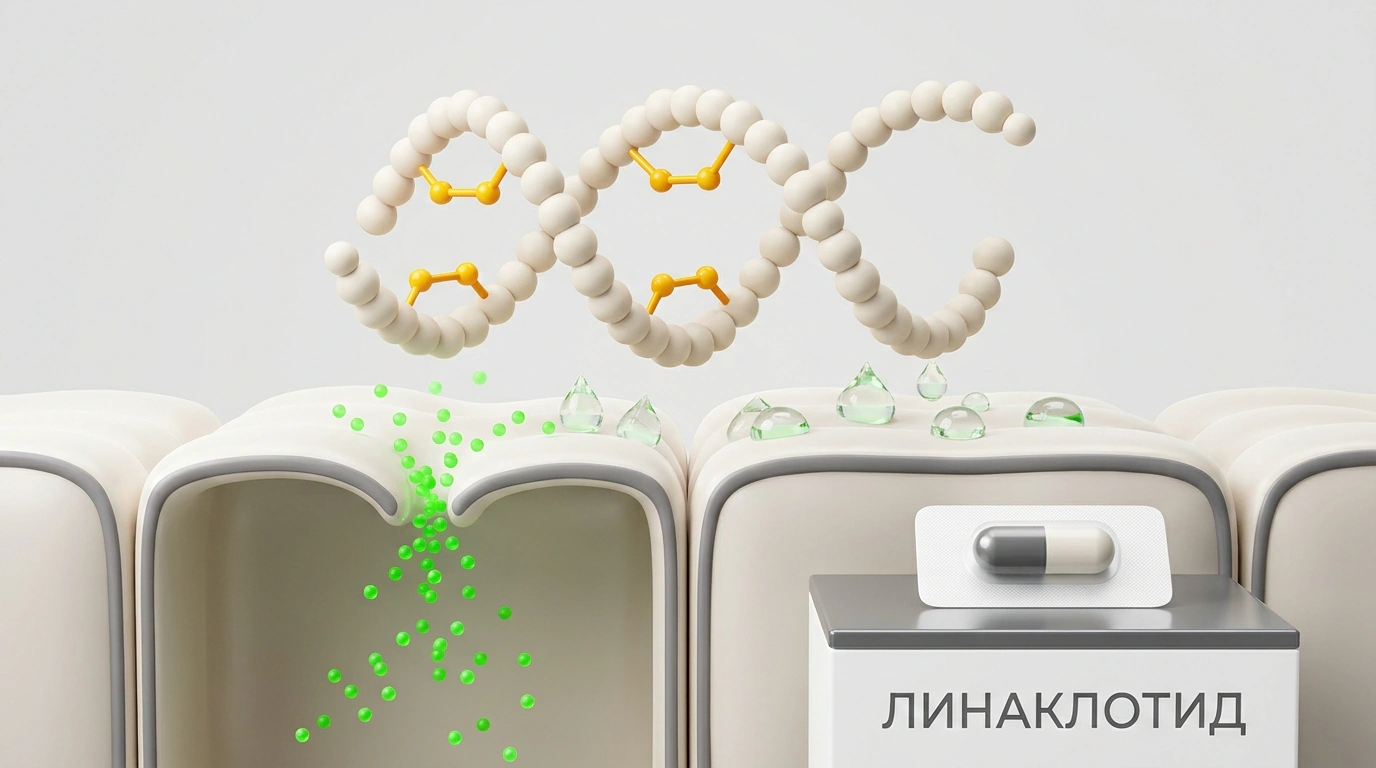
The first medication containing the active ingredient linaclotide has appeared in Russia's official drug register: prescription-only capsules called Linzelax-Pro in three dosages. The entry in the State Register of Medicines (GRLS) is dated June 30, 2026, bringing welcome news for people with stubborn chronic constipation or irritable bowel syndrome. Until now, this entire class of drugs wasn't available in Russian pharmacies.
In constipation-predominant irritable bowel syndrome (IBS-C), the gut looks healthy on scans and endoscopies, yet the belly regularly aches, bloats, and bathroom trips turn into an ordeal. Standard laxatives often fall short here: they may move stool along, but the pain and cramping remain.
Abroad, linaclotide has long been a standard tool. In the 2022 American Gastroenterological Association (AGA) guidelines for IBS-C, it earned the highest certainty-of-evidence rating—the only drug for this condition to do so. A joint 2023 AGA/ACG guideline also endorsed it for chronic idiopathic constipation when fiber and macrogol aren't enough. It is also included in specialist guidelines in the UK (NICE, BSG) and South Korea.
How it works in plain terms: a double effect
Linaclotide belongs to a class called secretagogues—drugs that signal the gut lining to release more water and salts into the intestinal lumen. Very little of the drug enters the bloodstream; it acts locally by turning on guanylate cyclase-C receptors on the gut surface, triggering two effects at once. First, an inflow of chloride, bicarbonate, and water softens stool and gently speeds transit without harshly stimulating the bowel wall.
The second effect explains why gastroenterologists value this molecule for IBS-C. People with IBS often develop visceral hypersensitivity: nerve endings in the gut wall act like an overly sensitive alarm, turning normal stretching from food or gas into sharp pain and bloating. Linaclotide dials down that excess pain-receptor sensitivity, easing both constipation and abdominal pain together.
Doses, how to take it, and the main side effect
Placebo-controlled trials tested courses lasting 12 to 26 weeks, and open-label follow-ups tracked patients for up to 18 months, showing it's built for long-term use. Under FDA labeling, the dose depends on the diagnosis, and the capsule is taken strictly on an empty stomach at least 30 minutes before the first meal. It must be swallowed whole—never chewed or opened.
| Indication | Studied dose | Guideline status (AGA / ACG) | Diarrhea rate in trials |
|---|---|---|---|
| IBS with constipation (IBS-C) | 290 mcg daily | Strong recommendation, high certainty | About 20% (vs. ~3% on placebo) |
| Chronic idiopathic constipation | 72 or 145 mcg daily | Strong recommendation, moderate certainty | About 16–19% |
The flip side of pulling water into the gut is diarrhea: if slightly too much fluid enters, stool becomes too loose. That's the most common side effect and the main reason some patients stop treatment. Usually it's manageable, though roughly 2 in 100 people experience severe diarrhea, in which case the drug is stopped and fluids are replaced. Serious systemic side effects are unlikely because the compound stays inside the gut.
Linaclotide is a second-line prescription medication started by a doctor only after dangerous causes of constipation are ruled out and basic steps have been tried. Under international safety rules, it is strictly contraindicated in children under two years old (animal studies in young subjects showed a risk of severe dehydration) and in anyone with known or suspected mechanical bowel obstruction.
Registration in the GRLS doesn't mean capsules will hit pharmacy shelves tomorrow—retail launch dates, the final Russian package insert, and pricing haven't been announced yet. If you've been struggling with stubborn constipation or IBS-C, keep this option in mind and bring it up with your gastroenterologist at your next visit.