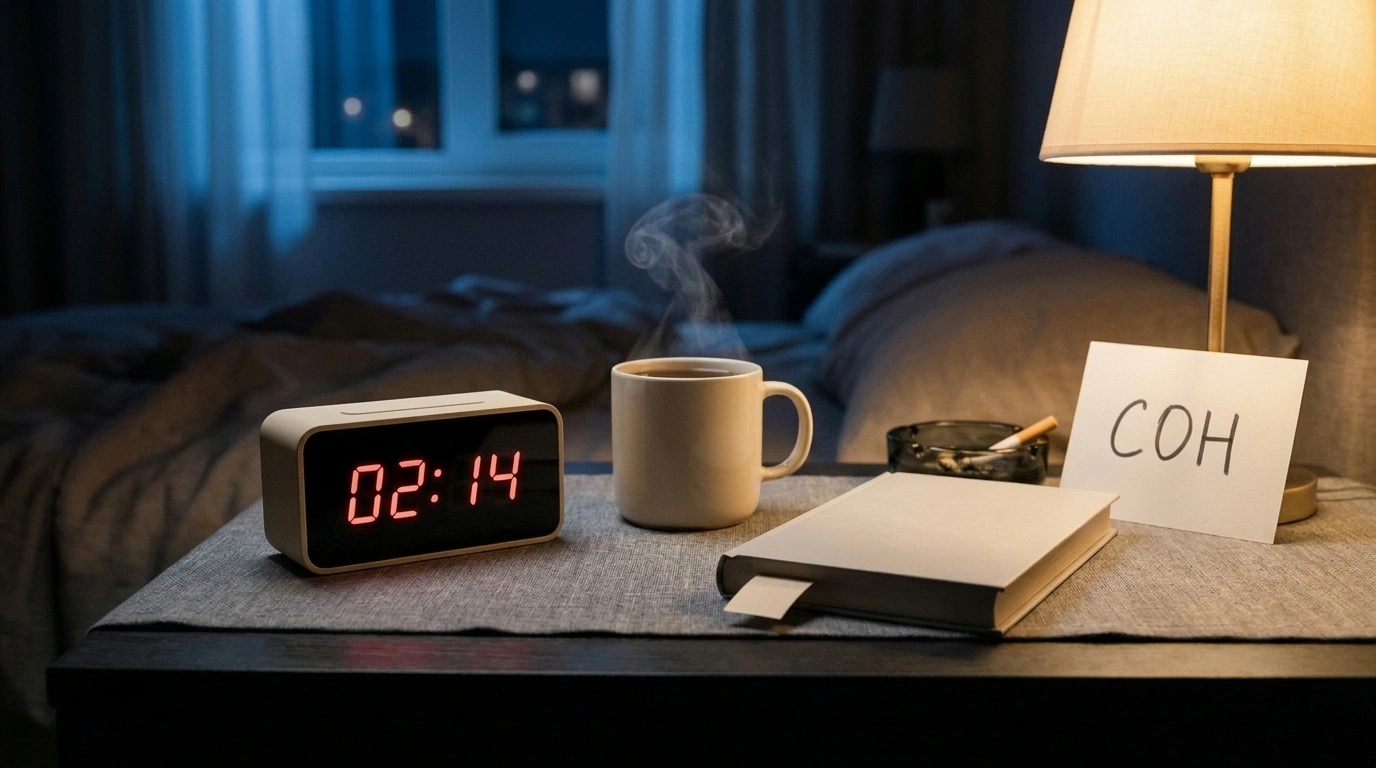
Why do two people smoke the same number of cigarettes a day, yet one tosses and turns until 2 a.m. while the other practically shuts down at their desk mid-afternoon? For years, people blamed habits, stress, or weak willpower at bedtime. Genetics now points to a sharper explanation: how fast your body processes nicotine.
How scientists separated nicotine from lifestyle
Untangling this with standard surveys is almost impossible. Smokers often drink more coffee, go to bed later, or work shift schedules, tangling all those factors together. So a team from the Universities of Bristol and Bath (M. Page, M. Gibson, M. Munafò, J. Khouja, and R. Richmond) took a different route, publishing a study in Addiction using UK Biobank and large genetic datasets. Depending on the specific sleep trait, the analysis covered between 5,185 and 487,153 people.
The researchers used multivariable Mendelian randomization. That sounds dense, but the idea is straightforward. At birth, each of us randomly inherits a set of gene variants—a natural lottery untouched by your job or evening coffee. Some of those genes set your nicotine metabolite ratio (NMR), meaning how quickly your liver breaks down nicotine and clears it from your blood. The scientists separated that clearance speed from daily cigarette count and checked current, former, and never-smokers separately.
Why include people who never smoked? As a built-in safety check. If "fast" or "slow" genes altered sleep on their own, the effect would show up in non-smokers too. Instead, the pattern appeared specifically in people regularly taking in nicotine.
Two scenarios: why some stay wired at night and others crash by day
Picture your liver as a sink drain, and every cigarette as a mug of water poured in. With a wide drain, water disappears almost immediately and the level drops fast. With a narrow drain, that same pour sits high in the basin for much longer.
Blood nicotine behaves the same way, and your sleep disruption depends on the "width of your drain" regardless of how many cigarettes you smoke:
If you metabolize nicotine slowly, it lingers in your bloodstream. Because nicotine is a stimulant, your nervous system stays keyed up late into the evening and struggles to shift into rest mode. That pushes your chronotype—your natural preference for early or late sleep—toward being a "night owl": falling asleep before midnight gets hard, and the morning alarm feels brutal.
If you metabolize nicotine fast, your liver clears it briskly, keeping blood levels lower after each cigarette. Fast metabolizers are less likely to drift into late-night schedules and usually wake up more easily. At first glance, that sounds lucky. Yet there's a catch: during the day, they're noticeably more likely to be hit by heavy daytime sleepiness and the urge to nap just to make it to evening.
What if someone switched to vaping or uses nicotine patches? The authors address that directly. The entire mechanism runs on regular nicotine intake itself, so e-cigarettes and nicotine replacement therapy play by the same rules. Fast metabolism doesn't protect your sleep either—it simply trades nighttime insomnia for daytime grogginess.
A two-way loop and the smallest step that works
The most intriguing twist came when researchers checked the reverse direction. They found that a genetic tendency toward longer sleep in current smokers is itself linked to slower nicotine breakdown. Science hasn't mapped the exact biological pathway behind that reverse signal yet, but one thing is clear: sleep and nicotine influence each other in both directions.
Of course, genetic studies show broad population patterns and don't replace an individual checkup. If you've struggled with insomnia or severe daytime sleepiness for a long time, see a doctor to rule out other causes. The surest way to restore normal sleep is to quit nicotine completely. If you aren't ready for that step today, start with one simple rule: cut out cigarettes and all other nicotine sources at least three hours before bed. That window usually gives blood stimulation levels enough time to drop so your nervous system has a fair shot at powering down for the night.