"After eating, I walk outside for ten minutes to tell my body where to send the calories." A video like this recently made the rounds on social media: a lean, fit guy claims he skips cardio and stays in shape with four short walks after meals. The pitch sounds clever—your leg muscles start asking for glycogen (stored carbs in muscle and liver), so your body supposedly routes your fresh lunch straight to your legs instead of your waist.
It sounds like a metabolism cheat code, except your body doesn't work like that. If you eat dinner and lie down on the couch, no secret switch automatically turns that meal into body fat.
Why walk timing doesn't drive fat loss, though it helps blood sugar
Body fat builds up and comes off slowly. Your weight responds to energy balance—the gap between the calories you eat and the energy you burn over weeks. Those 40 minutes of daily walking truly help with fat loss if you barely moved before. What matters is adding the activity itself, not how many minutes passed since you finished your soup. At the same pace and distance, a walk right after lunch, an evening loop in the park, housecleaning, or taking the stairs burns the same energy.
That said, post-meal walking does have one real perk. A 2022 meta-analysis in Sports Medicine found that short 2–5 minute light walking breaks after eating blunt blood sugar spikes by roughly 17% compared with continuous sitting (simply standing gave about 9.5%). A 2013 Diabetes Care experiment also showed that three 15-minute post-meal walks noticeably smoothed 24-hour blood sugar in older adults at risk for diabetes, especially after dinner. Working leg muscles pull some glucose straight from the blood for fuel. Plus, tying a walk to mealtime makes it easier to remember. Still, without an overall calorie deficit, fat won't melt away.
Who does fine with an easy stroll and who needs to step it up
When you weigh time spent against payoff, casual walking has clear limits. If you carry significant excess weight, even a relaxed stroll on flat pavement is real work. Moving extra mass raises your heart rate while sparing your joints the impact of running. Starting out, that pace is more than enough.
If you don't have much extra weight, the picture shifts. Exercise intensity—how hard your body works per minute—stays low during a slow stroll: an hour wandering around the block burns modest calories and barely challenges your heart. In an analysis of over 50,000 British adults (British Journal of Sports Medicine, 2019), average and brisk walking paces were linked to a 20–24% lower risk of all-cause death compared with slow walking. A newer 2026 study from the same group confirmed that higher peak stepping cadence alongside solid daily step counts gives your heart extra protection.
Three ways to upgrade a walk without running
If you head outside or step onto a treadmill for health and calorie burn, it's easy to level up a regular walk.
First, pick up the pace. A brisk stride (5.5–6.5 km/h, or at least 100 steps per minute) turns a stroll into true aerobic exercise: your breathing deepens and every minute pays off better.
Second, add incline. Walking uphill outdoors or raising the treadmill deck forces you to work against gravity, firing up glutes, hamstrings, and calves while boosting heart rate without running's joint impact. On a treadmill, starting at a 5–8% incline is a sensible target.
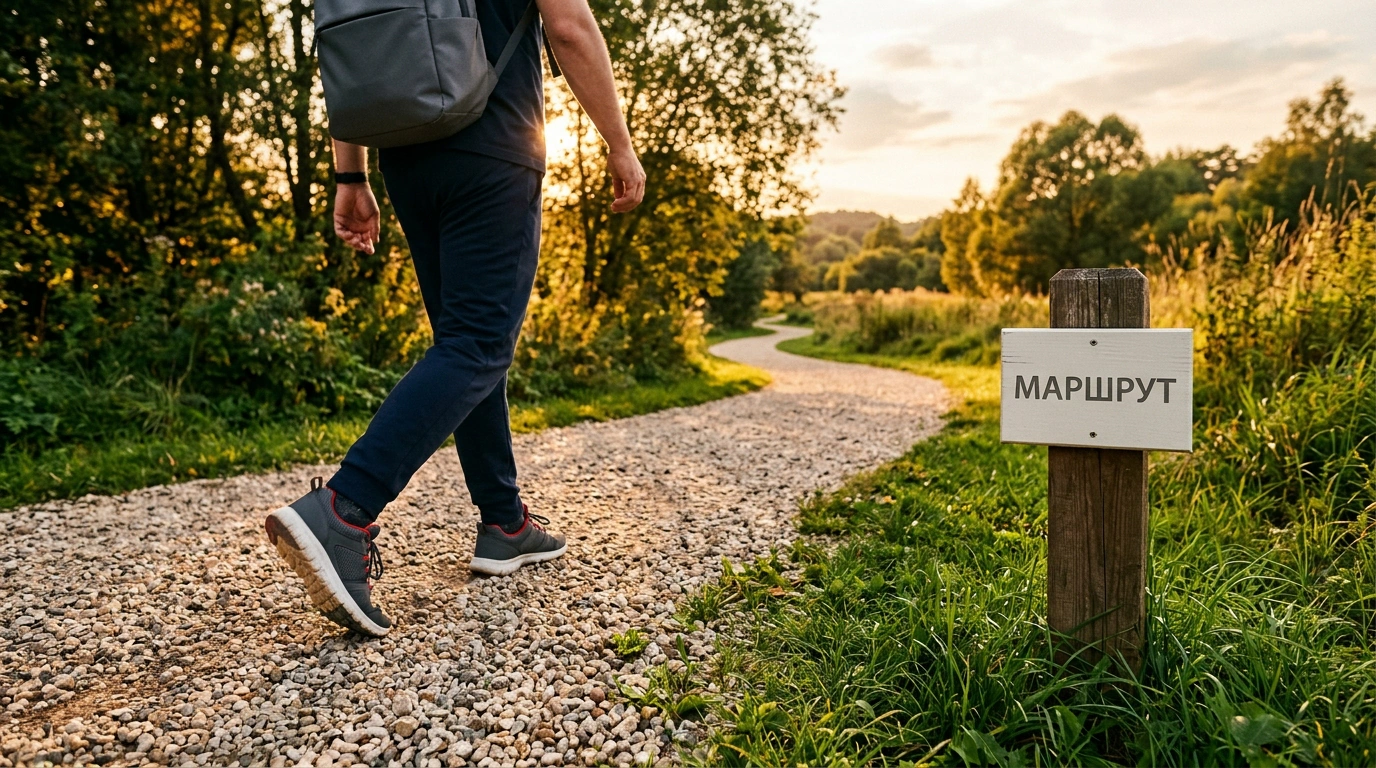
Third, carry moderate weight using a backpack or weighted vest—a practice called rucking. Sports physiology calculations show that carrying 10–20% of your body weight raises energy burn by roughly 10–15% at the same walking speed. A vest distributes weight evenly around your torso, while a backpack recruits your back and core more. Start gently with 5–10% of your body weight.
If you carry significant excess weight or have knee, foot, or lower-back pain, stick to flat ground and a comfortable pace without a loaded pack. If pain persists, check with a doctor before changing your routine.
Pick whichever of the three upgrades fits your routes—and don't beat yourself up if you feel like having tea on the couch after dinner and saving your walk for tomorrow afternoon.