When your lower back aches by evening or your knees cave inward during gym squats, most people take one of two routes. Option one: stretch your back frantically and hold planks until you shake. Option two: buy sneakers with thicker soles and softer insoles.
Both reactions make sense, yet both share a blind spot: almost nobody looks all the way down at their own bare feet.
Why your back and knees depend on how your feet work
Your body operates as a kinetic chain—a linked stack of joints from the ground up: foot, ankle, knee, hip, and spine. If the bottom link is stiff or collapses inward, higher levels have to compensate for the tilt. There's no magic button where rubbing your heel cures back pain, yet a stable base takes strain off your knees and hips with every step.
Thousands of pressure and stretch sensors live in the skin of your sole and ligaments. They constantly tell your brain where your center of gravity sits, a sense called proprioception. Imagine trying to text on your phone wearing thick winter mittens: your fingers stay warm, but hitting the right letter is nearly impossible. Thick-soled cushioned sneakers do something similar—that plush layer muffles feedback from the floor.
As a result, your brain controls your base half-blind.
Most gyms ban bare feet for safety reasons, and that's fine. Spending five to ten minutes barefoot at home—no socks, toes spread wide—sharpens the neuromuscular connection, helping your brain feel your foot clearly and fire its small, deep stabilizing muscles on time. That skill carries straight into the gym: even back in sneakers, you'll feel a steadier base on squats and lunges.
Systematic reviews indexed on PubMed back this up: training intrinsic foot muscles (including the "short foot" exercise, gently lifting the arch without curling the toes) three times a week for 4–8 weeks improves single-leg balance, ankle stability, and reduces arch collapse in flexible flat feet.
A 5–10 minute home warm-up: foot, ankle, and balance on a book
Start without any gear. Shoes squeeze or bend your toes upward for hours, so stretch them back first: tuck one foot behind you with the tops of your toes on the floor and gently stretch the top of the foot (do this standing if kneeling hurts your knees). Next, sit tall, point your toes forward and pull them back hard (both together and alternating), then add ankle circles. To wake up deep arch muscles, scrunch just your toes as if picking up a small object, send a "wave" through your foot, and inchworm forward using your toes and arch.
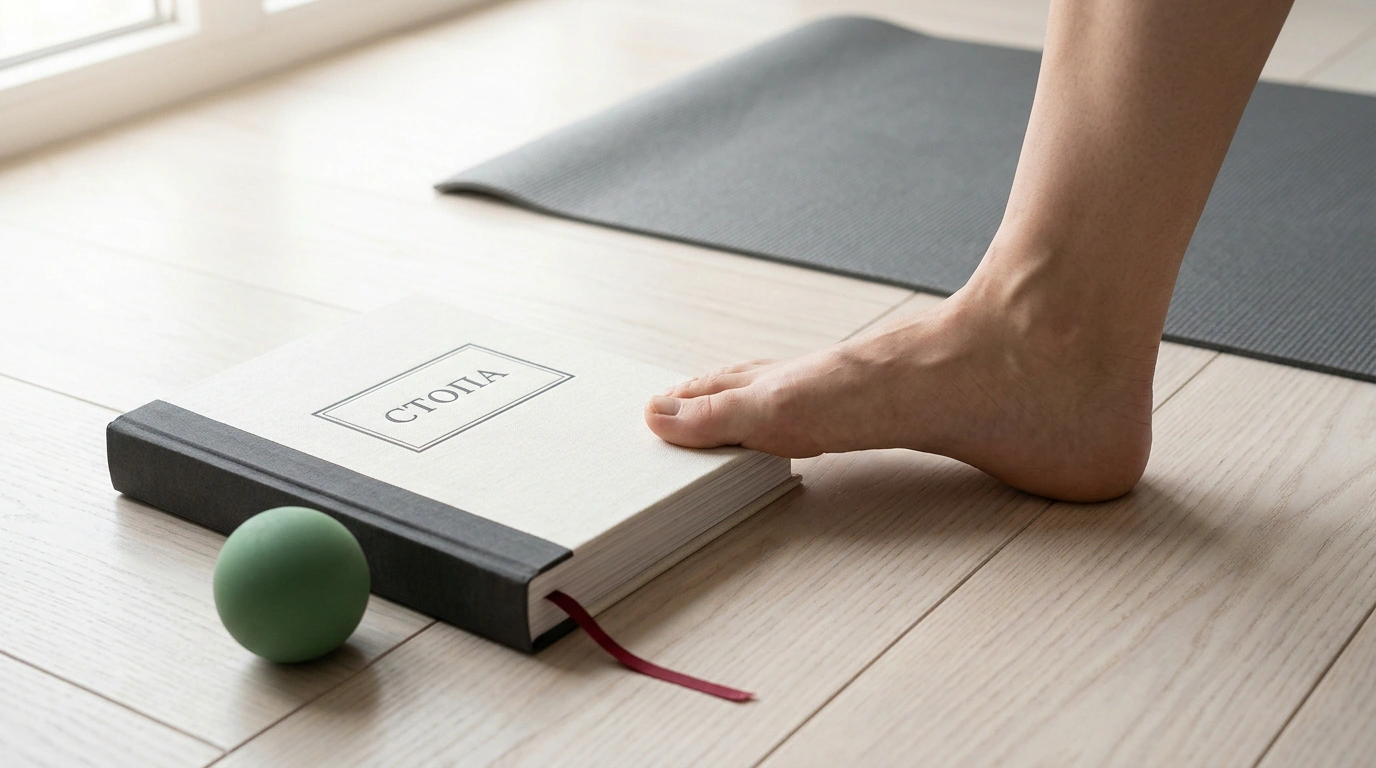
Now move to balance using a 7-cm yoga block or a couple of heavy, non-slip books. Place the support crosswise, step onto it with the ball of one foot so your heel hangs off, and bend your standing knee slightly. Step your free leg forward and back without straightening your standing knee—your calf, thigh, and stabilizers will light up immediately. Then hold your free leg behind you and gently lower your heel toward the floor like pressing a gas pedal, keeping that knee bend steady.
Finish with three quick moves on the same block. First, gentle hip rotations on a slightly bent standing leg: keep your knee aligned over your second toe so your glutes and deep hip muscles do the work. Second, calf raises with a yoga block or soft pillow pinched between your feet (a pillow works better than a book): press through your big and second toes while keeping your pinky toes on the floor. Third, calm step-overs across the block landing toe-to-heel (skip jumping if impact is off-limits), followed by a smooth forward lean with your heel on the book into a single-leg balance.
Ten minutes without breaking a heavy sweat, and your body already holds its ground differently.
Where warm-up benefits end and medical care begins
Strengthening your feet genuinely improves balance and knee-hip control, though claims about "curing flat feet and slipped discs in a week" don't hold up. How foot work affects lower-back pain varies by person: with herniated discs, radiculopathy, spondylolisthesis, or rigid flat feet, a barefoot warm-up doesn't replace a medical exam, treatment, or core and hip training.
Anyone with diabetic peripheral neuropathy (reduced protective sensation in the feet), active foot ulcers, Charcot foot, or severe peripheral artery disease must strictly avoid barefoot exercise due to the risk of unnoticed, slow-healing injuries.
If you have painful flat feet, jumping straight into long barefoot sessions can overload your plantar fascia and calf tendons, so start with just a couple of pain-free minutes. And if you have sharp foot, knee, or back pain, a recent injury, or noticeable foot deformity, see a doctor or physical therapist first.