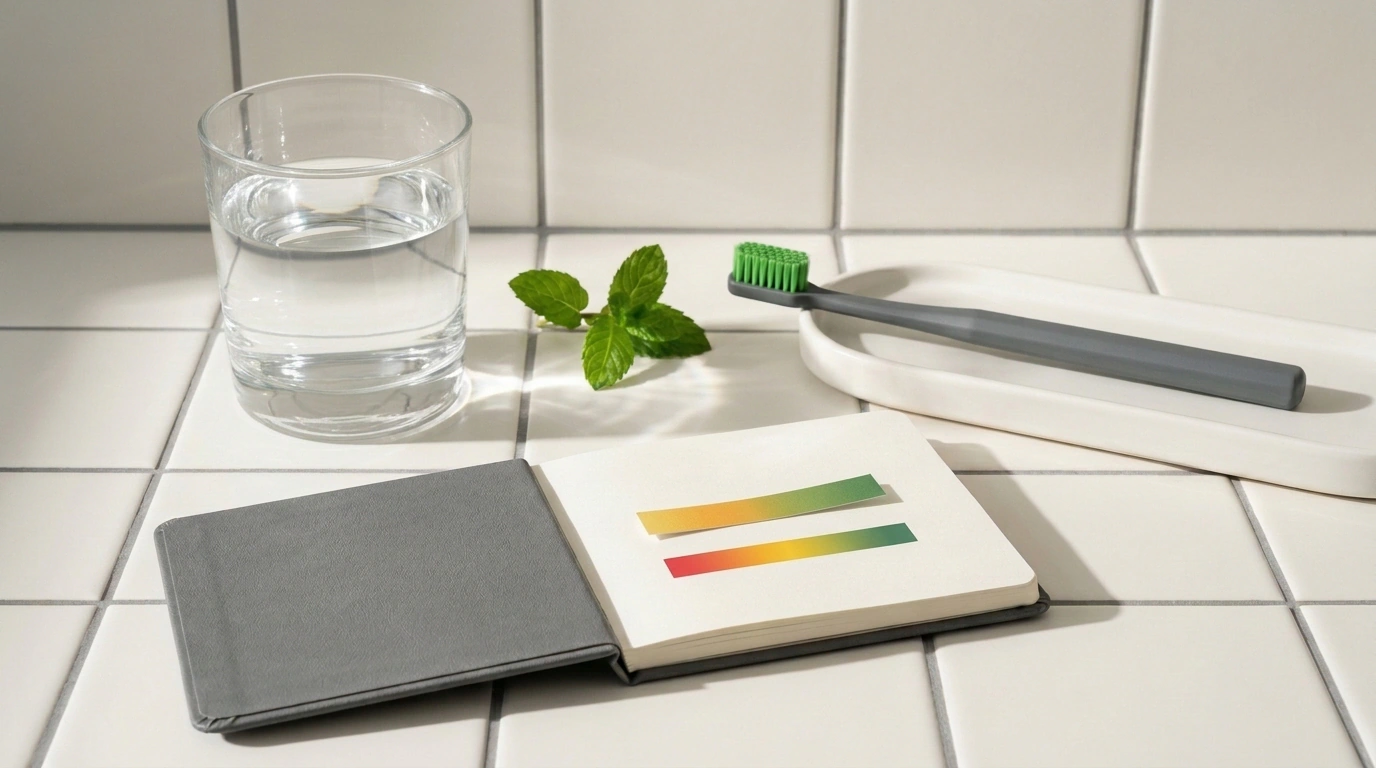
'We have an entrance to the gut—our mouth. That's why I love pH strips to check oral pH, which should be 7.' That line kicks off a viral video making the rounds on social media again. The rest of the recipe sounds simple: if the strip doesn't read 7, drink hydrogen water. Still no luck? Brush your teeth before eating—supposedly that's what people do in Korea, Japan, and China, and why obesity is rare there.
It sounds neat: a home test, trendy water, and an East Asian slimming secret. Yet when you check it against scientific studies and everyday Korean habits, every link falls apart. Let's look at all three steps in order.
Why your mouth is never 'exactly 7.0'
The pH scale measures acidity from 0 to 14. Seven is neutral, like pure water; lower numbers are acidic, and higher numbers are alkaline. Your body doesn't run on a single 'correct' number. Your stomach needs strong acid, while your mouth stays milder and shifts constantly.
Your saliva's buffer system acts like a 24/7 stabilizer. Drink coffee with lemon or eat an apple, and acidity dips for a bit. Saliva quickly brings it back up and returns minerals to your enamel. It's a living process, not a frozen gauge.
That's the hidden trap with test strips: chasing a 'perfect 7' makes it easy to invent a problem you don't have. Researchers measured saliva and mucosal pH in healthy people years ago, and the normal range turned out to be quite wide.
Normal oral pH in healthy people according to 2006 and 2013 studies
A 2013 study in the European Review for Medical and Pharmacological Sciences examined 81 healthy young adults. Average unstimulated saliva sat near neutral, yet individual healthy readings spanned nearly two full pH units. Numbers also shifted across the day and by season.
In a 2006 study in Oral Diseases, researchers measured mucosal acidity at different spots inside the mouths of 50 healthy people. The roof of the mouth was noticeably more alkaline than the inner cheek, with a full one-unit gap inside the same mouth at the same minute. Place a strip two centimeters to the left, and you get a different 'diagnosis.' Chasing an exact 7 makes about as much sense as trying to keep your heart rate locked at 70 beats per minute all day.
What hydrogen water actually does
Suppose the strip doesn't show 7. Step two of the viral recipe tells you to drink hydrogen water, which ads often group with alkaline water and pitch as a way to balance pH, heal the gut, and drop weight.
In 2023, the Journal of Water and Health published a randomized trial on 24 students. One group drank Kangen alkaline water, while the other drank regular reverse-osmosis water—the kind from a standard home fine-filtration system. Researchers checked dental plaque, Streptococcus mutans bacteria, and saliva pH. They found no meaningful difference in saliva pH between the groups. A regular filter worked just as well.
The story is similar for weight loss and gut health. Hydrogen water does not burn fat and is not a weight-loss tool. Some small, short 4–8 week trials have tested its effects on lipid markers and microbiota, but sample sizes are tiny and dissolved hydrogen levels vary. There is no solid reason to spend money on a hydrogen generator—plain clean water does the job without the markup.
Where Korea's toothbrushing habit really came from
The third claim grabs attention most: if water fails, brush before meals, because supposedly everyone in Korea, Japan, and China does that and stays thin. In reality, a real Korean habit has been flipped upside down.
In the late 1980s, the Korean Dental Association launched a national campaign around the '3-3-3' rule: brush three times a day, within three minutes after eating, for three minutes each time. After meals, not before.
The habit starts in kindergarten. Canadian English teacher Claire Mitchell told The Korea Herald that even after two years at a Seoul elementary school, she still marveled at how calmly kids lined up after lunch at long school sinks to brush together. In 2016, more than a hundred schools in Seoul installed dedicated multi-faucet sinks just for this routine.
Adulthood looks much the same. Ten to fifteen minutes before lunch ends, office coworkers gather at restroom sinks with toothbrushes in clear cases, chatting while they brush. Highway rest stops stock toothbrush vending machines, study cafes set up brushing corners, and department stores mount mouthwash dispensers on walls.
Seoul National University dentistry professor Cho Hyun-jae credits etiquette and local cuisine: Korean dishes use plenty of garlic and red chili pepper, which leave strong odors and visible specks on teeth. Seventy-year-old Gyeongju taxi driver Park Sang-jin even looks for sinks along his route out of respect for passengers, despite wearing a mask. This culture has nothing to do with weight loss or chasing an 'oral pH of 7.'
Preventive dental checkup and evidence-based oral care (Source: CDC)
Dentists do add one important update to the 'three minutes after eating' rule today. The American Dental Association (ADA) warns that after acidic foods and drinks—citrus, juices, soda, wine, or vinegar dressings—acid temporarily softens tooth enamel. Brushing right away wears enamel down faster. It's better to wait 30–60 minutes for saliva to neutralize the acid, and rinse with plain water or chew sugar-free gum right after eating. Brushing before an acidic breakfast like orange juice actually makes sense, though to protect enamel—not to lose weight.
How viral wellness recipes get built
This clip is a textbook example of how loud social media tips are put together from four familiar pieces.
First comes an everyday truth: digestion starts in the mouth, and people in Korea really do brush often. Your brain recognizes a real fact and lowers its guard for the rest.
Next comes a 'magic' number like strict pH 7.0. Real physiology works across wide ranges, while a crisp number creates an illusion of scientific control and a reason to test yourself at home.
Then they add an 'Eastern halo'—pointing to slim populations in Korea and Japan, turning a fresh-breath campaign into a secret anti-obesity hack, even by mixing up 'after meals' with 'before meals.'
And at the end, there's almost always something to buy: pH strips, specialty water, or a home hydrogen generator.
Quick check before buying the next wellness gadget
- Does it promise 'one exact right number' where healthy people naturally vary widely?
- Was the trendy product tested against a plain everyday alternative in a human trial?
- Was a foreign cultural habit twisted to fit a neat weight-loss story?
- Does the tip end with a product that claims to replace basic habits and medical care?
If you answer 'yes' to even a couple of these, keep your wallet closed. Healthy teeth only need a soft brush, regular toothpaste, a pause after acidic drinks, and routine dental checkups—no strips or extra worry required.