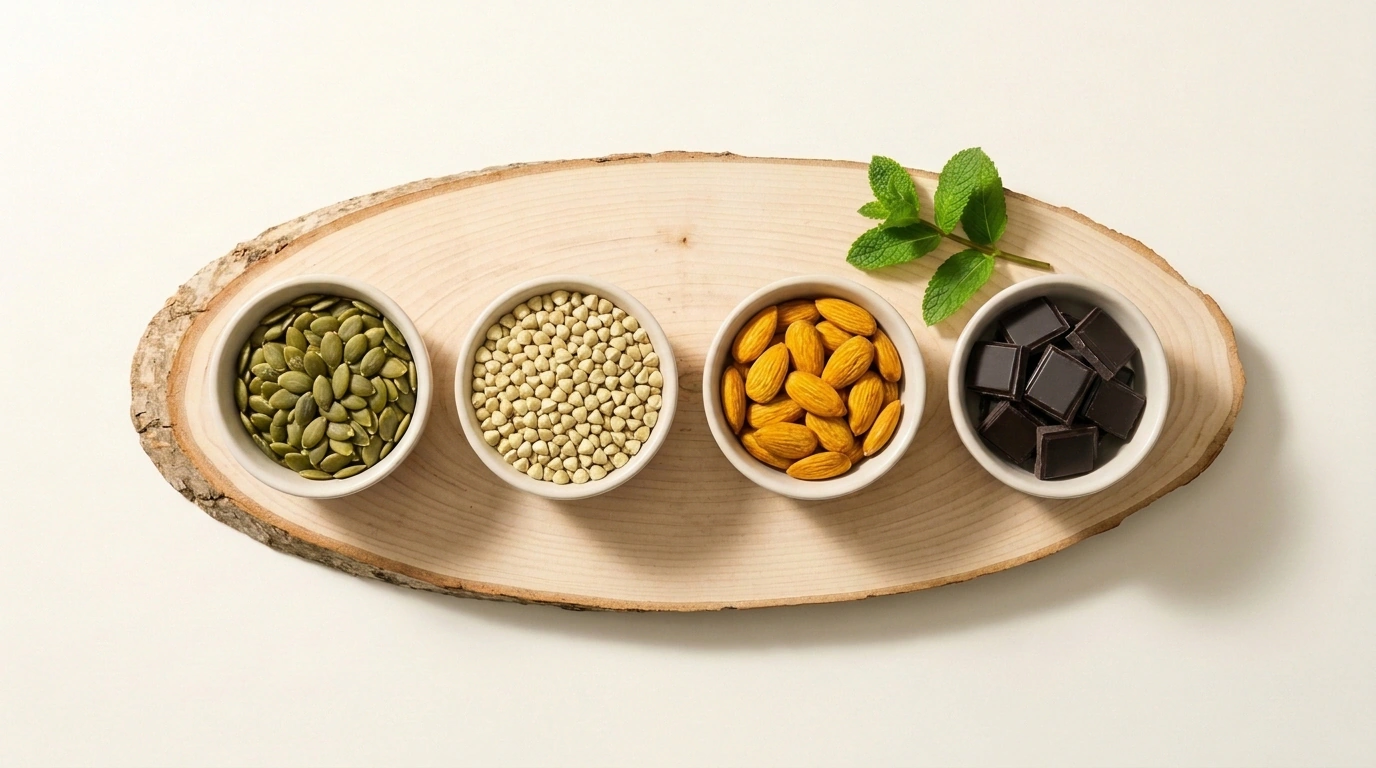
How do you hit your daily magnesium target from regular groceries without blowing your calorie budget or chewing through buckets of greens? According to NIH Office of Dietary Supplements guidelines, an adult woman needs 310–320 mg of magnesium a day (350–360 mg during pregnancy), and a man needs 400–420 mg. On paper it looks effortless: open any chart, spot nuts and spinach at the top, and head to the store. In the kitchen, you quickly realize 'per 100 grams' numbers rarely match a real plate.
Why 'per 100 grams' charts mislead you
It makes far more sense to judge foods by nutrient density—how much of a mineral you get in a normal serving without overloading calories or sheer volume. A hundred grams of nuts or dark chocolate runs 550–600 kcal, nearly a full lunch. Meanwhile, a hundred grams of fresh spinach looks like a mountain of leaves only a very hungry rabbit could finish in one sitting.
When you convert popular magnesium sources from NIH ODS and USDA FoodData Central into normal everyday portions, the picture clicks into place:
| Food | Real serving | Magnesium per serving | Main catch |
|---|---|---|---|
| Pumpkin seeds | Handful (28–30 g) | ~156 mg | Top density; easy to toss on salad or oatmeal |
| Buckwheat (cooked) | Bowl (150–200 g) | ~85–130 mg | Wins on comfortable volume and moderate calories |
| Almonds | Handful (28–30 g) | ~80 mg | High in fat and calories; portion control matters |
| Spinach (cooked) | Half cup | ~78 mg | Shrinks dramatically when cooked; bulky raw |
| Peanuts | Quarter cup (~35 g) | ~63 mg | Handy snack, yet just as calorie-dense as nuts |
| Dark chocolate (70–85%) | Two or three squares (25–30 g) | ~60–65 mg | Nice treat with tea, easy to overdo sugar and fat |
Seeds, nuts, and chocolate versus plain buckwheat
Pumpkin seeds are the easiest magnesium concentrate on a regular grocery shelf. One handful tossed into a salad or morning porridge covers roughly a third of a man's daily need and nearly half of a woman's. Still, one handful won't cover the whole day, and people often mix up their selenium content too. USDA data shows pumpkin seeds hold very little selenium—only 3–6 mcg per handful against a 55 mcg daily target, so stick to Brazil nuts for selenium. For zinc, though, pumpkin seeds truly shine (6.3–7.6 mg per 100 g), making them a great everyday partner to magnesium.
Almonds, peanuts, and dark chocolate (70% cocoa or higher) follow a simple 'cost versus benefit' rule: mineral density is high, and you pay for it in calories. Nuts and peanuts are packed with fat—oil is literally pressed from them—so munching half a bag during a show quickly wrecks your daily energy balance. Dark chocolate pairs nicely with afternoon coffee, yet eating an entire bar for magnesium is a poor trade.
Next to them, ordinary buckwheat looks surprisingly strong. Gram for gram, buckwheat loses to nuts. Yet you can comfortably eat a full bowl at lunch or dinner without overshooting fat. Thanks to its natural portion size, it lays down a steady base that a handful of seeds or two squares of chocolate easily top off.
What to skip—and how to build a daily target
Four popular items get far too much credit when people hunt for magnesium. Raw spinach contains the mineral, yet hitting your target with fresh leaves would take a giant tub of greens. Steaming or boiling shrinks spinach way down, turning it into a solid side for eggs or dinner, though it shouldn't carry your whole day.
Polished white rice loses its outer bran—and most of its minerals—during processing, leaving it nearly empty of magnesium. Apples bring great fiber (especially with the skin on), yet offer almost no magnesium. As for pharmacy hematogen bars, that is pure childhood nostalgia: sold by the register next to vitamins, they feel healthy. In reality, they are candy bars made of sugar and condensed milk, with negligible magnesium that varies wildly by brand.
Putting together a working daily combo is simpler than it sounds. A bowl of buckwheat as a side, a handful of pumpkin seeds in your salad, and a handful of almonds or a couple squares of dark chocolate with tea already deliver around 320–340 mg of magnesium. That meets a woman's daily target and roughly four-fifths of a man's before you even count bread, vegetables, and beans. If you suspect a real deficiency or are eyeing pill bottles, talk over your symptoms and diet with a doctor instead of guessing doses.