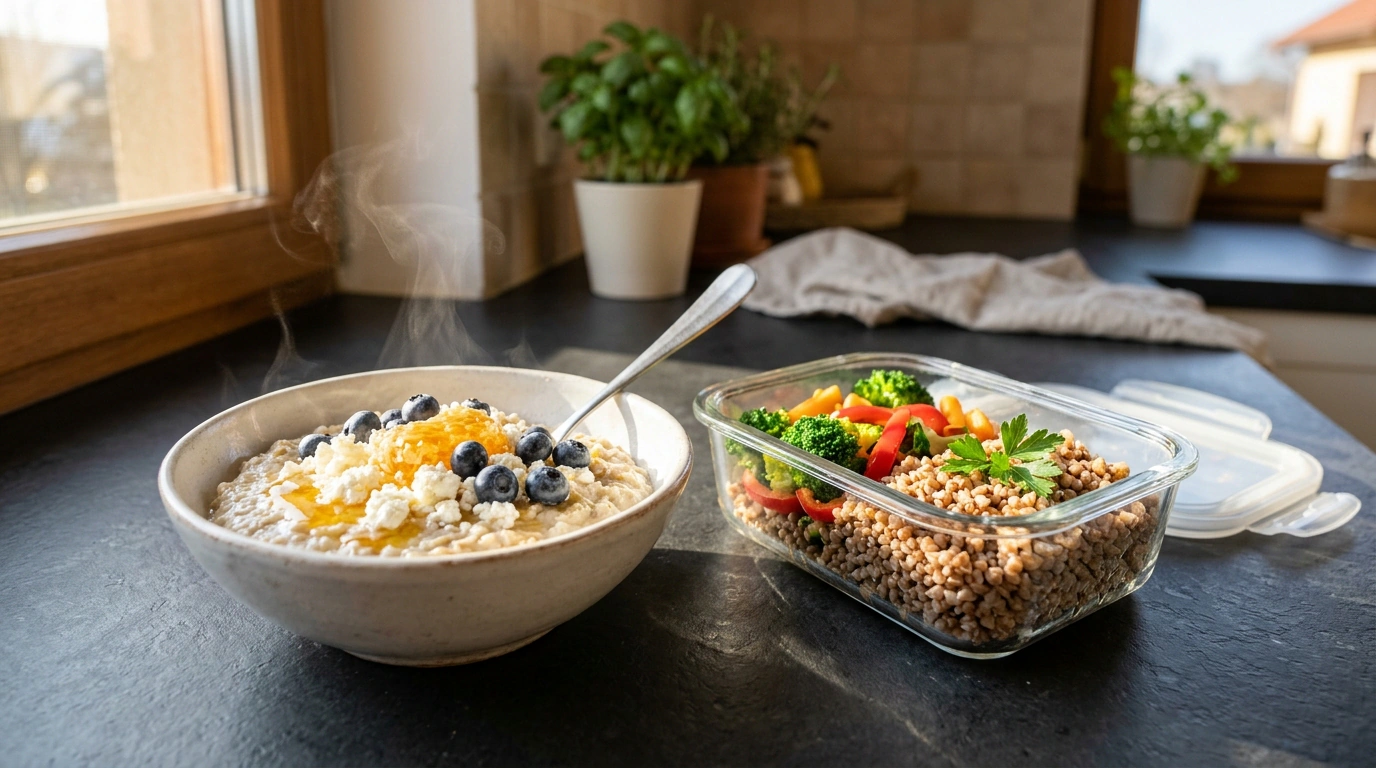
Up eight kilograms—from 52 to 60 kg at 175 cm tall. That was the result for Anton, a guy with a small appetite and a packed workday, eating plain grains, soup, cottage cheese, and modest portions of meat. No tubs of mass gainer, no shakes by an alarm clock, and no forcing down dry chicken breast. Two simple pieces did the work: regular strength training and a steady calorie surplus, consistently eating just a bit more energy than he burned.
Why everyday grains beat mass gainers at the start
The backbone of his diet was three daily servings of 100 g dry grains. Around them sat normal home cooking: soup at least once a day, a bit of meat, cottage cheese, bread, and vegetables—whatever went down easily.
This case highlights the basic rule of gaining weight. Supplement ads make it sound like muscles refuse to grow without powders. Physiology is simpler: resistance training and a steady calorie surplus drive growth. Extra scoops of protein beyond your daily need do not speed things up. Your body takes what it needs for repair and sends the rest into general energy use—and if total calories run too high, the extra simply turns into body fat.
There is a practical downside too. When shakes crowd out real food and fiber, your stomach often pushes back with heaviness and discomfort. A warm bowl of buckwheat, rice, or oats with vegetables digests more predictably, gives steady fuel for training, and costs less. In cold weather, hot porridge goes down easily, making it simple to stick with the plan for months.
The 'mountain of meat' trap: appetite, protein targets, and purines
A classic mistake when you have a low appetite is trying to 'load up on protein' all at once. You pile a double steak or giant chicken breast onto your plate, struggle through it, and can't stand the sight of food for half the day. Protein-heavy meals sit heavy and kill hunger. Your stomach feels stuffed, appetite shuts off, and the grains holding the calories you actually needed stay sitting in the pot. Protein is high, calorie surplus is zero, and the scale refuses to move.
In this real-world plan, 100–150 g of meat a day—plus cottage cheese and grains—got the job done. That sounds modest until you check the research. A major meta-analysis by Morton and colleagues in the British Journal of Sports Medicine (2018) showed muscle growth plateaus around 1.62 g of protein per kilogram of body weight per day (with the upper confidence bound at 2.2 g/kg). Above that mark, extra protein on average stops adding muscle.
A 60-kg person needs just under 100 grams of protein a day. Look how easily regular food hits that mark:
| Food in daily menu | Daily portion | Approx. protein |
|---|---|---|
| Meat | 100–150 g | 25–35 g |
| Cottage cheese | 2 servings | 35–40 g |
| Grains (dry weight) | 300 g | 30–36 g |
Everyday home meals cover the science-backed target completely, without leaning on one food or buying supplement tubs.
There is also a medical reason to keep meat portions reasonable: purines. These natural compounds from cell nuclei are abundant in meat (especially red meat and organ meats like liver), some fish, and seafood. Breaking them down produces uric acid. Normally, it stays dissolved in blood and leaves through your kidneys. If levels stay high for long—or your kidneys fall behind—urate crystals can form, irritating joints (causing gout) and raising kidney stone risk.
Healthy people don't need to fear a modest serving of meat: your body makes 70–80% of its uric acid on its own, while only 20–30% comes from food (with alcohol, especially beer, and fructose-sweetened drinks playing a notable role). Cottage cheese and dairy hold almost no purines and help kidneys clear uric acid, while eggs are neutral. If blood tests already show high uric acid, or you have joint pain or kidney disease, check with a doctor before starting a weight-gain diet.
A steady pace and the cold-porridge rule
At 175 cm, 60 kg is just a waypoint. A practical target for steady progress is 700–1,000 g per month. That tracks close to a beginner's natural rate of muscle growth—weight climbs smoothly without stomach heaviness or rapid fat gain.
Doubling your portions on Monday makes no sense; by Wednesday you'll be sick of eating. Increase serving sizes little by little. Cottage cheese splits neatly into two servings, say midday and closer to bedtime, if your stomach handles it well.
On packed days running from six in the morning until midnight, consistency without perfection saves the day. Warm porridge tastes better. Yet if there's no microwave around and your choice is eating it cold from a container or skipping lunch altogether—eat it cold. Small, unglamorous habits like that are what keep the scale moving upward during weeks when an ideal routine is out of reach.