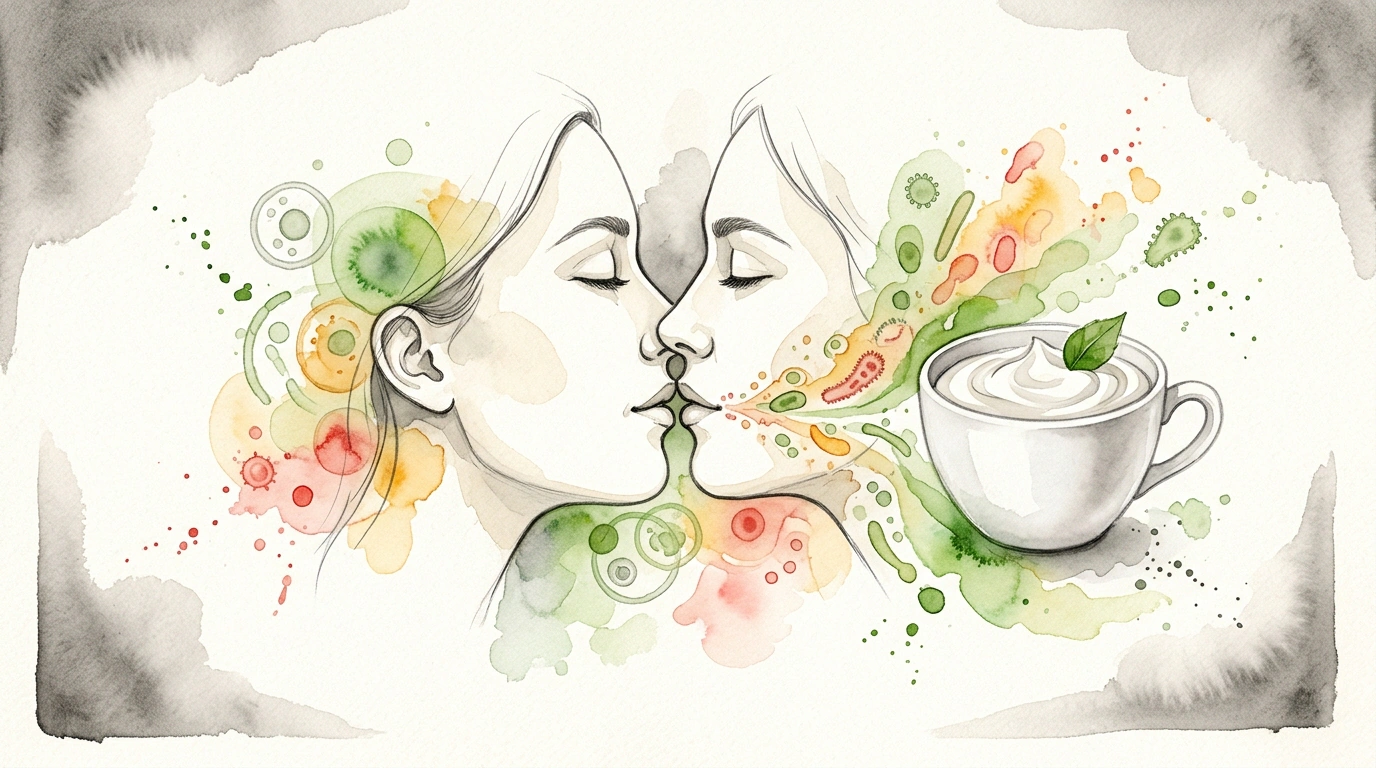
During a ten-second deep kiss, two people pass around 80 million bacteria between them. It sounds like a scare line from a high school biology class, yet Dutch microbiologists measured it in a real study. To track the transfer, they asked couples to drink a sip of regular yogurt right inside the Amsterdam zoo.
Kissing gets plenty of bold health claims online. People say it lowers cholesterol, melts away stress, and boosts immunity better than vitamins. Let's look calmly at which claims actually rest on human studies, where scientists themselves warn against jumping to conclusions, and why psychologists suggest kissing for a full six seconds.
The Arizona Experiment: Why Stress Dropped and What Cholesterol Had to Do With It
The claim about 'kissing away cholesterol' comes from one specific study. In 2009, researchers at Arizona State University led by Kory Floyd recruited 52 healthy adults—26 married or cohabiting couples. They split the couples randomly into two groups. The first group got a six-week assignment: kiss your partner more often and for longer than usual. The second group got no special instructions.
Six weeks later, volunteers filled out questionnaires again and gave blood samples. Compared to the control group, the kissing group reported noticeably lower stress, higher relationship satisfaction, and lower total blood cholesterol. It sounds like the ideal prescription you don't have to buy at a pharmacy.
Look closer at the study design, though, and the picture becomes more modest. First, 52 people is a very small, fairly uniform sample—hardly enough to generalize to everyone. Second, the trial lasted only six weeks, with no check on whether the changes held up six months later. Third, participants knew their assignment: when you're asked to kiss more for science, you naturally expect to feel better and rate your mood higher.
There's a fourth catch that matters most medically. The lab only measured total cholesterol, without separating 'bad' LDL from 'good' HDL, and didn't strictly control diet or exercise. You definitely can't treat kissing as a replacement for statins, a healthy diet, or medical care. Lower tension in a relationship does help your nervous system relax, which gently supports metabolic health. It's a great addition to daily life, not a standalone treatment for blood vessels.
80 Million Bacteria and a Cup of Yogurt at the Amsterdam Zoo
The microbe study was even more creative. In 2014, microbiologist Remco Kort and colleagues from the Dutch institute TNO and the Micropia microbe museum wanted to see how much kissing mixes oral bacteria. Instead of locking volunteers in hospital rooms, they invited 21 couples visiting Amsterdam's Artis Zoo, aged 17 to 45.
Researchers took saliva samples and swabs from the front of the tongue before and after a 10-second kiss. To measure the exact transfer, they used a clever marker. One partner drank 50 milliliters of probiotic yogurt containing Lactobacillus and Bifidobacterium. Around 700 bacterial species live in a normal human mouth, yet those yogurt strains are barely present—just fractions of a percent. After the sip, marker levels spiked in the 'donor,' the couple kissed for ten seconds, and researchers counted how many marker bacteria crossed over.
The ARTIS-Micropia microbe museum in Amsterdam, where Kort and colleagues conducted their kissing study (Source: ARTIS-Micropia official website)
The math averaged out to 80 million bacteria per 10-second kiss. That sounds dramatic until you learn one key detail: the mouth isn't one uniform habitat, but at least two very different ecosystems.
How Similar Oral Bacteria Are in Couples vs. Strangers
The chart shows a clear split. Couples who live together share a much more similar mix of bacteria on their tongues than random strangers do. Even more interesting, that similarity barely depends on whether they kissed an hour ago or yesterday morning. The tongue acts like permanent real estate: microbes settle there long-term, shaped mainly by shared daily life, food from the same fridge, and similar hygiene habits.
Saliva works the exact opposite way. On average, partners' saliva was almost as different as two strangers' saliva. Even a full 10-second kiss didn't change the average picture. The reason is simple mechanics: your mouth holds less than a milliliter of saliva at a time and flushes it continuously, washing temporary visitors away fast.
Nine Kisses a Day, Male Math, and the 'Ironclad Immunity' Myth
To make partners' saliva actually look similar, one kiss isn't enough. When the Dutch team matched lab swabs against couple surveys, a clear threshold stood out: noticeable saliva similarity appeared only when couples shared at least nine intimate kisses a day—or had kissed within the past hour and forty-five minutes. After that, fresh saliva sweeps the temporary guests away.
The surveys also uncovered a funny everyday detail. Nearly three-quarters of the men (74%) estimated their kissing frequency higher than their female partners did. On average, men reported ten deep kisses a day, while women reported five. One enthusiastic man even wrote down 50 kisses a day for the past year, while his girlfriend listed eight and said their last kiss was 18 hours earlier. The researchers had to exclude that couple so it wouldn't skew the math.
What about the popular claim that kissing 'trains your immune system'? Here, romance outruns the evidence. Kort's study measured bacterial transfer and microbiome similarity, not whether participants caught fewer colds. The idea that kissing evolved to help women encounter cytomegalovirus before pregnancy remains an interesting hypothesis, not a proven fact. There is still no solid proof that swapping saliva makes your immune system stronger.
The flip side of sharing saliva, however, is thoroughly documented. Along with harmless mouth residents, real infections travel the exact same route.
Saliva and direct lip contact can spread Epstein-Barr virus (which causes infectious mononucleosis and can linger in saliva for months after recovery), herpes simplex virus type 1 (which can spread even without visible cold sores), common respiratory viruses like flu and colds, and cytomegalovirus, which poses risks during a first infection in pregnancy or in people with weakened immunity. If you have a cold sore, a sore throat, or a fever, it's wiser to hold off until you recover.
The Six-Second Rule: Why Put a Timer on a Kiss
Once you strip away the hype about cholesterol and miracle immunity, what remains is very real: how kissing affects your nervous system and sense of closeness. For most busy couples, the main problem is simple—kisses shrink into a quick peck on the run. At the front door with keys in hand, beside a boiling pot, or in the dark before sleep while your brain is still spinning through work tasks.
Psychologist John Gottman, who has studied couples in his lab for decades, suggested a practical way to break that autopilot: the six-second kiss. Try setting a phone timer once and counting out six full seconds. Compared to a one-second peck, the pause feels surprisingly long.
That brief stop is the whole trick. In six seconds, your brain steps out of daily noise and focuses on the person in front of you. You don't need the right words, deep talks, or problem-solving. Your body gets a calm safety signal: cortisol (your internal stress alarm) eases slightly, while oxytocin—linked to trust and bonding—reinforces a sense of support.
In the Gottman method, this tiny ritual is one of the easiest ways to care for a relationship regularly. Two six-second kisses a day—say, before leaving in the morning and when reuniting in the evening—take just 84 seconds a week. Less than a minute and a half out of seven days. Small, repeated moments of attention like this help build the buffer that keeps warm interactions outnumbering daily friction.