When your lower back aches or your shoulder blades feel tight by evening, your first instinct is to touch your toes or hang from a pull-up bar. Yet with desk work, the real culprit often hides in front: tight chest muscles and a stiff mid-back.
Why Your Back Tires at the Top and Aches at the Bottom
Keep your hands on a keyboard for eight hours a day, and your chest muscles (pectoralis major and minor) adapt to staying short, pulling your shoulders forward. Your thoracic spine—the middle section of your back attached to your ribs—locks into a rounded curve and barely extends. Its neighbors pick up the slack: your neck cranes toward the screen while your lower back absorbs extra strain.
That raises a fair question: 'Isn't a good stretch enough?' It will feel better for half an hour. As soon as you sit back down, though, your posture folds forward again if nothing at the back holds it upright. Your spinal extensors and shoulder-blade muscles act as a natural support corset; without their endurance, passive stretching wears off quickly. That is why rehab reviews and the UK's NICE NG59 guideline recommend combining joint mobility, stretching tight areas, and back strengthening for everyday back discomfort. Taking 2–3 minute movement breaks every hour or two during the day also stops tension from piling up.
Four Steps of a Top-Down 12-Minute Routine
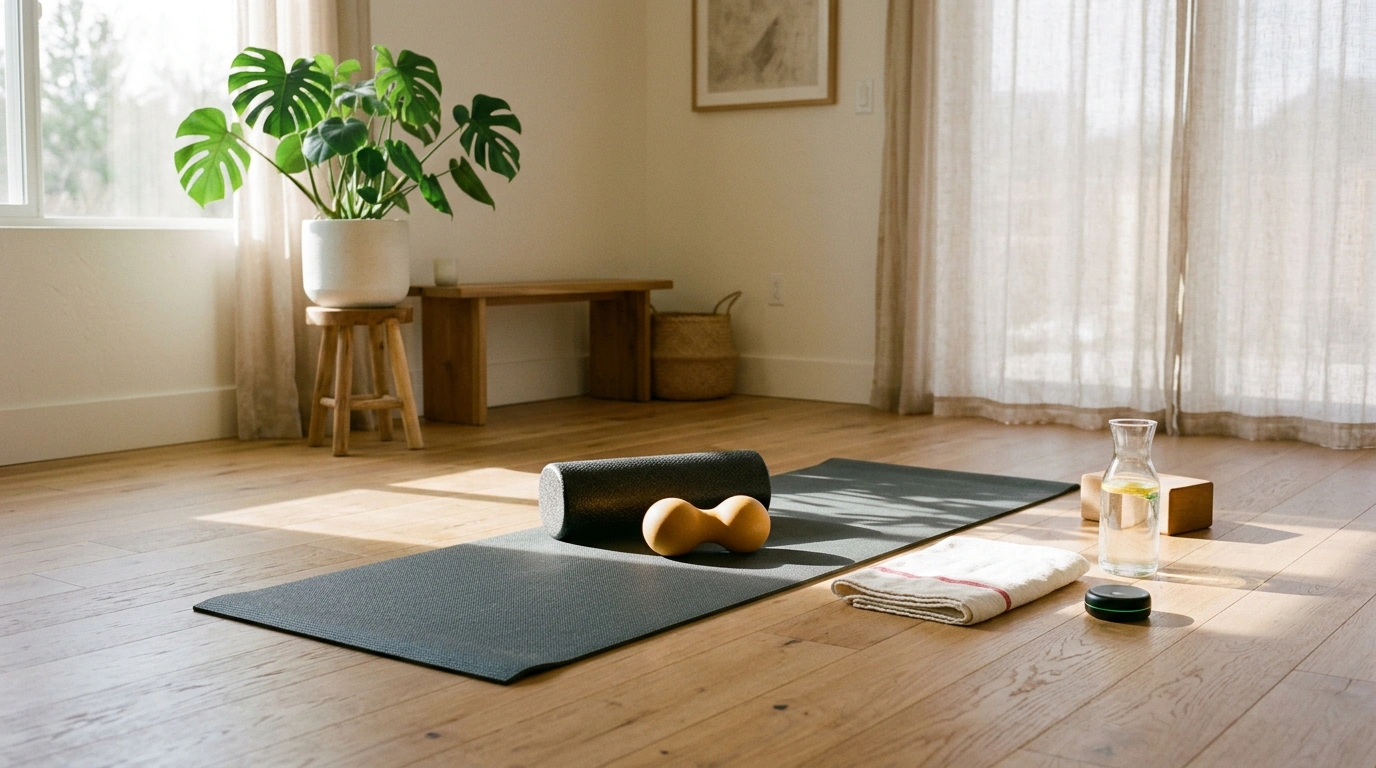
This top-down logic shapes a 12-minute no-equipment home routine where all you need is a mat.
You start with gentle neck mobility—smooth, controlled movements without jerks. First, tilt your ear toward your right and left shoulders, then tuck your chin to your chest and look up gently without snapping your head back. Add a light hand-assisted side-neck stretch, followed by slow up-and-down and side-to-side motions.
Next, you wake up the thoracic spine and open the chest. Do side bends reaching one arm overhead, then controlled torso twists pulling your shoulder back. Follow that with a move you can do right in your desk chair: lace your fingers behind your head, pull your elbows wide, and gently pulse backward whenever the spot between your shoulder blades starts to ache.
The third block moves to the mat. On hands and knees, do cat-cow arches and rounds, then sit back on your heels with fingers laced behind you, press your upper back forward, and sweep your arms in wide waves. After a deep chest-to-floor stretch, slide into the 'under-the-fence' move: imagine ducking under a low fence chest-first without moving your hands or dropping your elbows, letting your mid-back extend instead of folding your lower back. Always follow torso circles with a rounded-back counter-stretch, then lie on your back in a figure-four stretch to release your glutes and ease lower-back tension.
Finish face-down by strengthening your back and glutes. Do basic 'superman' lifts: smooth raises of outstretched arms and legs, brief holds, and alternating leg lifts while squeezing your glutes. One key form cue: keep your head down and look at the floor so your neck doesn't take over. Aim for this strength finisher at least three times a week, then round out gently in child's pose.
Where Home Stretching Stops and Medical Care Begins
This routine eases everyday stiffness well, but it isn't a cure-all for every kind of back pain. Keep all movements free of sharp pain; if your lower back is sensitive, keep 'under-the-fence' dips and back extensions shallow or place a small pillow under your hips.
According to NICE NG59 and NHS guidelines, skip home exercise routines and seek medical care if you notice warning signs:
- Cauda equina syndrome (call emergency services immediately): numbness around your groin or buttocks, sudden trouble urinating or controlling your bowels, or worsening weakness in both legs.
- Nerve deficit (see a doctor promptly): shooting pain with numbness in an arm or leg, or muscle weakness such as foot drop.
- Other warning signs: back pain with fever or chills, recent trauma, unexplained weight loss, a history of cancer, or constant worsening pain that doesn't ease when lying down and wakes you at night.
If you have no warning signs and your back is simply tired from sitting, 12 minutes on a mat plus a couple of desk breaks quickly brings back easy movement.