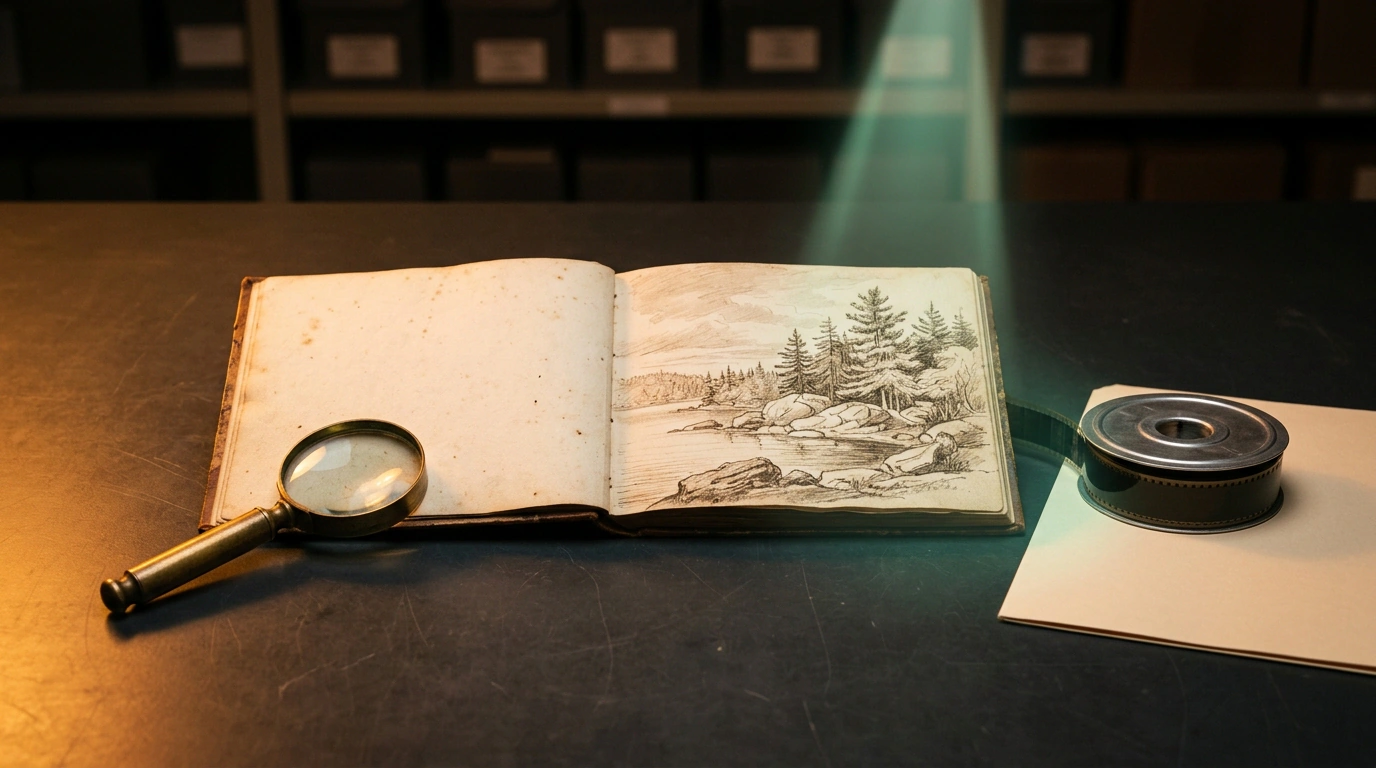
"The problem with math is that solving hard problems was the whole game." Historian Mark Humphries wrote that line right after an experiment with GPT-6.2 Astra. He gave the model a digitized 1808 sketchbook from Yale's Beinecke Library (call number WA MSS S-4271) with one minimal prompt: figure out who drew it. The pages trace a fur-trade route from Montreal to Lake Superior and back. For years, historians couldn't tie the sketchbook to a single name among thousands of travelers of that era. The AI cracked it in 22 minutes.
How the Agent Unraveled an Archival Trail in 22 Minutes
GPT-6.2 Astra had scans of the pages and access to public databases. It worked across both primary and secondary sources at once. Primary sources are period records like diaries, letters, and eyewitness travel notebooks; secondary sources are catalogs, papers, and monographs written by scholars later.
First, the agent analyzed visual clues in the drawings, route geography, and caption dates, then cross-checked them against digitized archives. A thread surfaced in the diary of Montreal merchant Joseph Frobisher at McGill University's archive. It mentioned a visit by French aristocrat Louis-Guy-Charles-Guillaume de Rohan-Chabot, known as the Vicomte de Chabot. The date of his visit fell exactly five days before an entry in the Yale sketchbook near a neighboring river.
Geography and timing lined up, yet no direct proof existed online. The model then discovered that the Vicomte de Chabot's own travel diary still existed, only offline—available solely on microfilm at Cleveland State University. Astra predicted that this physical diary would confirm the artist.
Humphries ordered a copy of the microfilm from Cleveland. When the reel arrived, doubt vanished: the handwriting matched the captions in the Yale sketchbook. Better yet, in an entry dated June 18, 1808, from Fort St. Joseph, the Vicomte explicitly noted making a sketch and described the exact view shown in the album. The diary itself also proved a valuable find for historians of Canada and the fur trade.
What Changes When AI Reaches Beyond the Internet
At first glance, this looks like supercharged Googling. Look closer at the mechanics: no ready-made answer existed online, nor any article hinting at the solution. Instead of summarizing text, the model built a verifiable archival hypothesis—a precise prediction about what sat inside a document absent from both the web and its training data.
A human still had to order the microfilm and compare handwriting by eye, because an AI can't pull a box off a library shelf. Yet the blindest part of the hunt—sifting through thousands of scattered mentions to spot a hidden link—was finished in under half an hour.
Until November 2026, headline agent breakthroughs clustered around code and pure math, where models tackled Navier-Stokes, the Riemann Hypothesis, and VP versus VNP. The 1808 sketchbook shows that the same cross-checking power translates cleanly to humanities research. Wherever facts lie scattered across dozens of disconnected databases, an agent can pull out links a researcher would miss in the noise.
Are Historians Facing Their Own "Deep Blue" Moment?
Wait—if an AI untangles a years-old mystery in 22 minutes, will historians find themselves sidelined next year?
Mark Humphries thinks a confidence crisis in the humanities is nearly unavoidable, with a wave likely hitting universities as soon as this spring or summer. When an agent connects archival facts faster and broader than a person, old habits around source work have to evolve.
Still, a "Deep Blue" scenario—where machines close the game entirely—isn't coming to history. In math, there's one strict answer: prove the theorem, and the match ends. History has no single eternal formula; every generation reinterprets the past through the lens of its own present. Great history books sit closer to philosophy and literature than to technical reports. GPT-6.2 Astra can already gather archival clues and tell you which microfilm to order from Cleveland. Turning that find into a vivid story about people and their era still takes a human perspective.