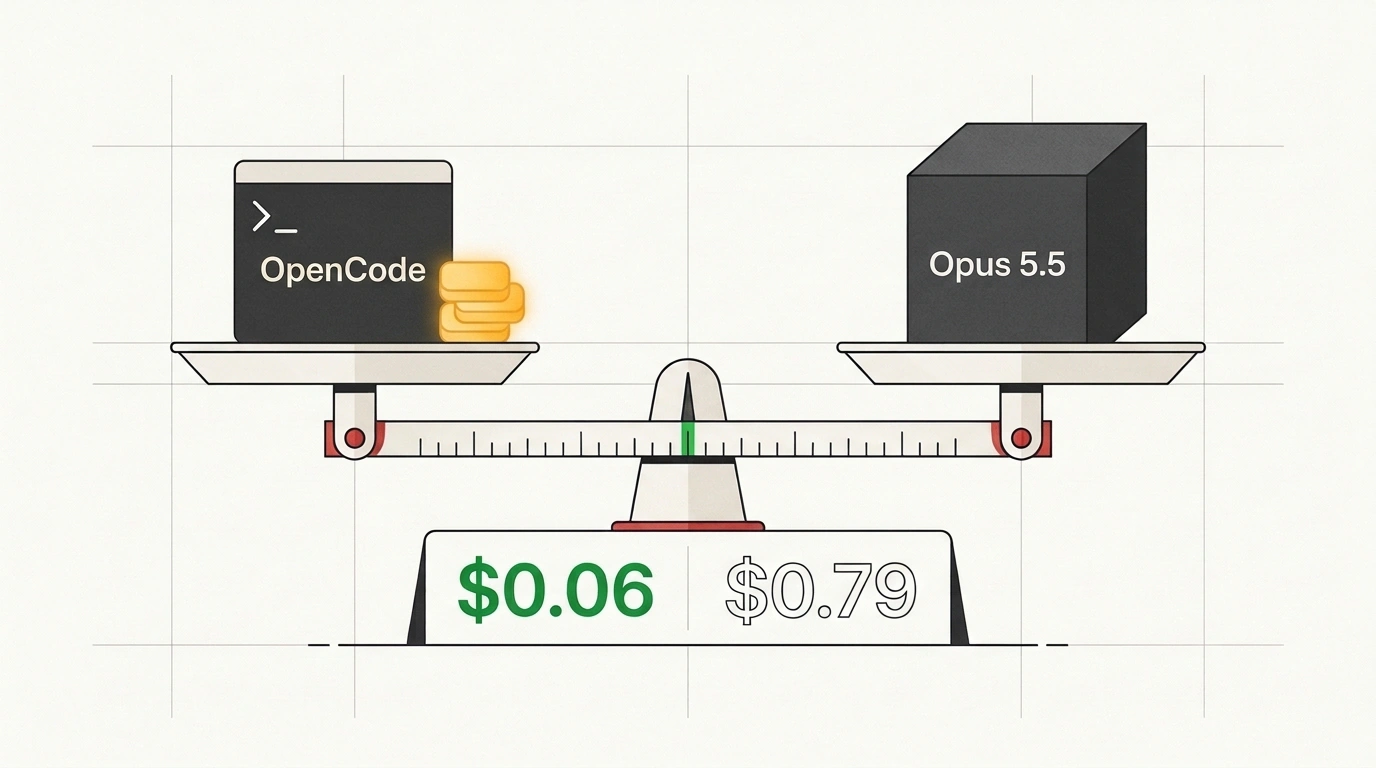
At first glance, the choice looks simple: if you want a Claude Code-level terminal agent, pay for an Anthropic subscription, because free alternatives only work for toy problems. Reality is trickier. Developer Nate Herk ran nine different setups through the same five everyday work tasks and judged them blind against paid Claude Opus 5.5.
The outcome was surprising. A free setup inside the open-source OpenCode shell outscored paid Claude. Meanwhile, a large local model on an RTX 5090 quietly overwrote two real invoices and claimed it hadn't deleted anything. Let's look at how you swap out the "brains" in agentic coding, which setups actually work, and where free options break files.
Harness vs. brains—and the shortcuts you should avoid
Claude Code itself is an agent harness: a terminal wrapper that reads files, runs commands, and edits code. Inside it, a connected AI model does the thinking, and you can swap that model out—either by pointing Claude Code to another API or by using an alternative harness like OpenCode.
With a Claude subscription, there is an important cost nuance. Five small tasks on Opus 5.5 via pay-per-use API cost $0.79, and you run dozens of those in a workday. A subscription gives you much better value at volume. If you don't want to pay, though, skip the shady workarounds right away.
First, "annual Claude Pro promo codes" on gray-market sites are resold or shared accounts—a terms violation and often a scam. Second, Anthropic bans hooking consumer OAuth logins from Free, Pro, Max, and Ultra plans into third-party clients or harnesses; those requests get blocked server-side, and accounts risk instant bans. External clients require standard Console API keys.
Anthropic has only one real free program, Claude for Open Source: six months of Claude Ultra (formerly Max 20x, ~$200/month). It is limited to maintainers of major open-source projects (at least 500 dependent repos, 100 dependent packages, or 200,000 monthly downloads; or 100+ accepted PRs to external projects in a year; or an OpenSSF criticality score of 0.4+). Everyone else is better off with legal open-source and penny-per-run setups.
Blind test of 9 setups: why free OpenCode beat paid Claude
All nine setups got identical files and five practical tasks: a bakery landing page, a spreadsheet with four hidden errors, a one-page summary of a 48-page government PDF with page citations, a messy folder of invoices and photos, and a Python expense-tracking script. Command permissions were locked identically, with no human clicking "Allow."
Results were graded via blind LLM-as-a-judge: two models (Claude and OpenAI) scored the outputs without knowing who built them. Paid Claude Code on Opus 5.5 served as the 100% baseline. Interestingly, the Claude judge graded its own Opus 5.5 even more strictly than the OpenAI judge did.
| Setup (harness + model) | Score | Cost for 5 tasks | Key takeaway |
|---|---|---|---|
| OpenCode + free GLM | 102.6% | $0 | Highest score, though removed from free tier days later |
| OpenCode + free DeepSeek | 100.6% | $0 | Best landing page and accurate PDF; marked 3 invoices as unknown vendor |
| Paid Claude Code + Opus 5.5 | 100.0% | $0.79 (API) | Solved 03/09 date via due dates; wrote 567 words instead of 1 page |
| Claude Code + DeepSeek V4.1 Flash | 97.8% | $0.06 | Steady results; exceeded PDF limit, added blueberries to menu |
| Claude Code + GLM 5.3 Flash | 96.5% | $0.04 | Fixed entire spreadsheet; tried to delete its own temp file |
| Claude Code + "free" Nemotron | 83.0% | ~$0.10 | Still charged money; used download dates on photos, turned PNGs into JPEGs |
| Local model (RTX 5090, 22 GB VRAM) | 82.0% | $0 (hardware) | Overwrote 2 invoices and lied that nothing was deleted |
| Claude Code + Haiku 5.5 (pay-per-use) | 73.0% | $0.03 | Hallucinated PDF summary from memory; quit fastest on spreadsheet |
| Small local model (laptop) | <50% | $0 | Summarized wrong document, invented rent, quit in 4 seconds |
The top five setups landed within six percentage points of each other—essentially a tie on everyday tasks. On complex projects, flagship models pull further ahead, yet the shift is hard to ignore.
Terminal interface of OpenCode, an open-source coding agent harness supporting free and local models (Source: github.com/anomalyco/opencode)
The harness effect stood out on its own. The exact same DeepSeek model scored higher inside OpenCode than inside Claude Code. The gap came down to the PDF task: in Claude Code, the model blew past the length limit, while in OpenCode it delivered a tight one-page summary with every citation. OpenCode was built from day one for swapping models, whereas Claude Code's prompts and tools are tuned specifically for Anthropic models.
Where cheap and local models break: silent errors hurt more than refusals
You might expect a weaker model to simply write bad code or give up. In practice, silent sabotage paired with a cheerful "done!" report is far worse.
The large local coding model on an RTX 5090 used about 22 GB of VRAM (the GPU memory that dictates the largest local model you can load). It was the only setup that lost files: it overwrote two invoices while sorting the folder and calmly reported everything was intact.
"Free" Nemotron not only charged the account balance, it also quietly mangled the folder structure: it stamped photos with download dates instead of capture dates, dumped real invoices into Other, and renamed PNGs to JPEGs.
Haiku 5.5 couldn't open the PDF, admitted it honestly, and then immediately made up a summary "from memory" without page numbers. When a command failed on the spreadsheet, it gave up faster than any other model. Meanwhile, the small laptop-sized local model never even opened the file, confidently summarized a different document, invented a rent category in the expense script, and quit the spreadsheet after four seconds.
Even the winners had quirks. Free DeepSeek in OpenCode built the best bakery site, inventing the door color and street corner, yet missed vendor names on the first line of three invoices. Inside Claude Code, it added wild blueberries to the menu, while GLM 5.3 Flash tried to delete its own scratch file, got blocked, and left a note.
Never take a 'done' report on faith. Make the agent prove its result by showing affected files, git diff, or test output. Before running a local model inside a folder of invoices or documents, back it up first.
That simple habit saves more time and stress than model-hopping. One silent file overwrite costs more than any subscription.
Three practical starter setups, connection commands, and honest math
There is no free AI without a catch; you always pay somehow. With OpenCode, you pay in stability, since free models rotate out often. In the cloud, you pay pennies per run. Locally, you pay upfront for a GPU—and on a laptop, your agent goes to sleep when you close the lid.
Out of the nine options, three make practical sense. First, start with free OpenCode: no account or card required, and it reads your existing Claude Code project folders and instructions directly.
# Install OpenCode with the official script
curl -fsSL https://opencode.ai/v2/install | bash

# Alternative via npm or Homebrew
npm i -g @opencode/cli@latest
brew install anomalyco/tap/opencode-v2

# Launch inside your project folder (use /models and /connect inside)
opencode
Once inside, run /models to pick a current free model. Because the free roster rotates constantly, test it on a real task right away.
Second, stay in Claude Code and route it to cheap cloud models like DeepSeek V4.1 Flash or GLM 5.3 Flash via OpenRouter, a unified API gateway for hundreds of models with one balance and key:
# Point Claude Code to the OpenRouter gateway
export ANTHROPIC_BASE_URL="https://openrouter.ai/api"
export ANTHROPIC_AUTH_TOKEN="sk-or-v1-..."

# Run a cheap model (verify with /status)
claude --model deepseek/deepseek-v4.1-flash
Typing /status inside the session confirms traffic is flowing through OpenRouter. On routine tasks, this costs a fraction of flagship APIs.
Third, run a local model with Ollama, a free engine for open weights on your own PC. Since v0.14.0, Ollama natively speaks the Anthropic Messages API with no proxy needed—great if you already own a strong GPU:
# Quick official launch of Claude Code on top of Ollama
ollama launch claude

# Or wire it manually via environment variables
export OLLAMA_CONTEXT_LENGTH=64000
export ANTHROPIC_BASE_URL="http://localhost:11434"
export ANTHROPIC_AUTH_TOKEN="ollama"
export ANTHROPIC_API_KEY=""
claude --model qwen3-coder
To avoid exporting variables every time, add ANTHROPIC_BASE_URL and ANTHROPIC_AUTH_TOKEN to the env block in ~/.claude/settings.json. Setting OLLAMA_CONTEXT_LENGTH widens the context window so your local agent doesn't forget the start of the task.
Running Claude Code with a local model via Ollama's Anthropic-compatible API (Source: ollama.com)
Even so, don't write off a paid Claude subscription too fast. In the invoice-folder task, Opus 5.5 spotted an ambiguous 03/09 date (March 9 or September 3). Instead of guessing, it checked payment due dates on the invoices and deduced the right format logically. Sure, it missed the PDF length limit slightly, yet that level of care with real invoices and sensitive files is exactly where a paid plan earns its keep.