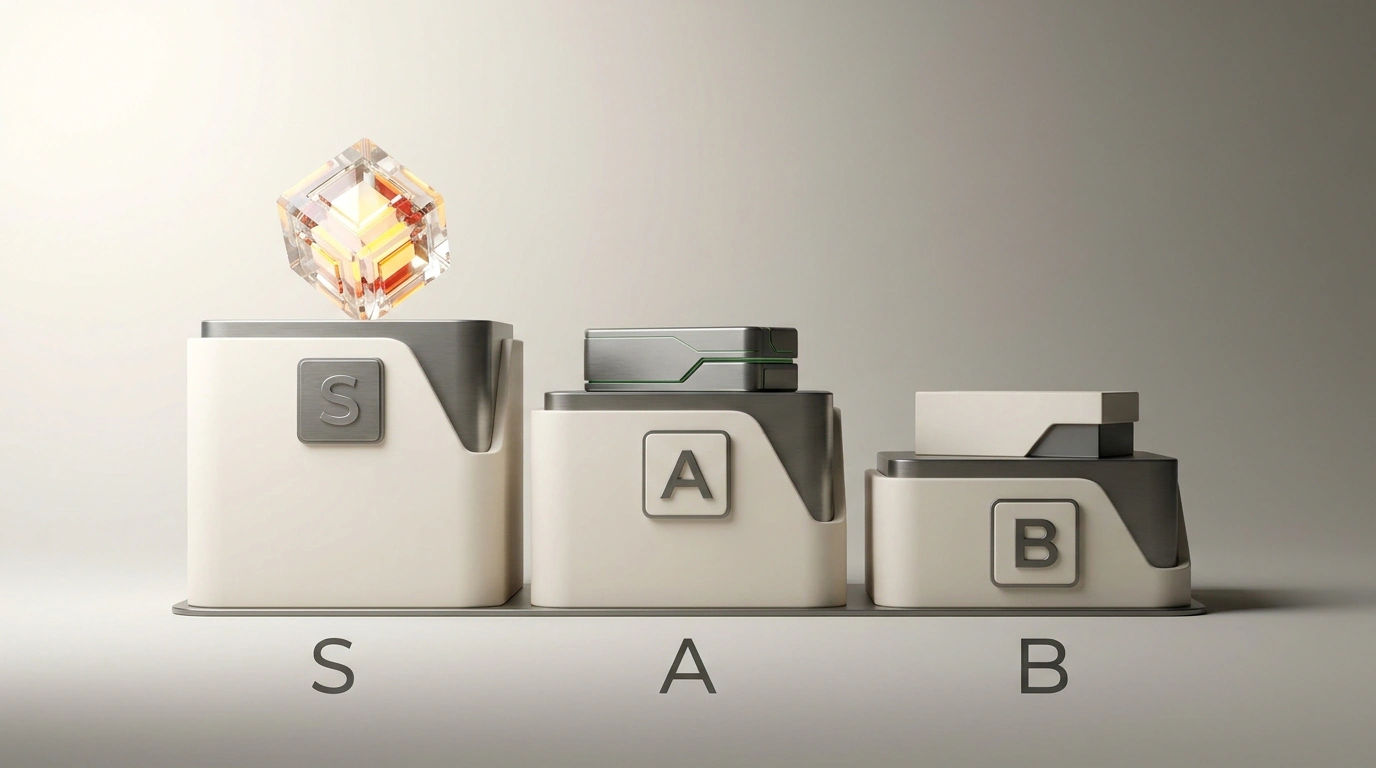
The smartest AI model on the planet is losing first place to its own younger sibling. That sounds wild until you open a real project on a Friday night: your subscription quota melts in two hours while a heavy flagship wastes extra turns on a trivial edit. By late 2026, picking a coding AI is no longer about dry benchmark scores. What matters is quota burn, speed, and how easily a model cooperates without ten follow-up prompts.
The cleanest way to sort this crowded field is a practical tier list from S (everyday favorite) to F (no clear use case), where order inside each tier counts too. Below are 17 current models from Anthropic, Google, OpenAI, Meta, xAI, Mistral AI, and Chinese labs, plus two fresh Meta releases awaiting field tests. One honest caveat: this comes from real paid subscriptions, daily coding, browser automation, and video editing—not a sterile lab benchmark.
Why peak intelligence no longer guarantees first place
On paper, the crown belongs to Claude Fable 5.2. In deep reasoning and hard engineering, it genuinely edges out Claude Opus 5.5. Switch the lens to money and subscription quotas (the built-in message caps inside fixed plans like Claude Pro or Max), and that picture falls apart.
Fable 5.2 costs twice as much as Opus 5.5 over the API and drains subscription limits noticeably faster. Leaving it on by default gets expensive when a simpler model solves the task in one shot. Nobody drives a mining dump truck to pick up bread, even if it has the biggest engine in the garage.
The second deciding factor is conversation style. Some models head straight for the answer: you give a task, get working code, and move on. Others have to be coaxed and nudged. Over an eight-hour coding day, that friction hurts far more than a two-point benchmark edge.
The top tiers: Opus 5.5, the Gemini 4 Neon surprise, and Fable 5.2's niche
Claude Opus 5.5 sits alone at the top in S-tier. It strikes the best balance of code quality, generous quotas, and predictability. It takes the shortest path, follows instructions cleanly, and reads your intent even from a messy prompt. A million-token context window (enough "working memory" to hold an entire codebase) has become table stakes at this level.
Anthropic's Claude model ecosystem, leading the late 2026 coding tier list (Source: claude.com)
The biggest surprise of the season sits at the top of A-tier: Gemini 4 Neon. Just weeks before its release, few developers took Gemini seriously for coding. Then Neon landed so well that even Google engineers admitted on social media they hadn't expected such a reaction.
At peak complexity, Neon trails Fable 5.2 and sits slightly behind Opus 5.5. In day-to-day work, though, it actually feels smoother than Opus—fast, responsive, and noticeably cheaper. Everything from quick fixes to upper-mid tasks goes straight to Neon, leaving heavy architecture and tangled refactors to Opus 5.5. If Google keeps this pace, Neon could eventually challenge Anthropic's lead.
Claude Fable 5.2 takes second in A-tier. Its role is narrow yet clear: brutal bugs, critical architecture, and reviewing someone else's code. As a last resort, it never misses.
Official API price per 1M output tokens (late 2026)
The chart shows right away how API pricing reshapes the ranking. Top flagships from Anthropic and OpenAI cost several times more than everyday workhorses, and dozens of times more than open Chinese models. Still, a high price tag doesn't guarantee a smooth experience.
B-tier specialists and the lightweight battle in C-tier
OpenAI's November release, GPT-6.2 Sol, leads B-tier. Few people pick it for pure coding, yet in computer use it leaves everyone else behind. That means looking at a screen, clicking buttons, and filling browser forms without an API. Factoring in speed and cost, Sol is the top choice for browser automation and surprisingly capable at video editing; it only misses A-tier because it isn't an all-rounder.
Next is another fall surprise: Meta Muse Wonder Full, packing a million-token context and active memory. Its conversational flow feels a lot like Gemini 4 Neon—zero arguing over minor details and quick to grasp the point, though slightly weaker than Neon overall.
Third in B-tier is GPT-6.2 Astra, OpenAI's big flagship that drew heavy criticism at launch. It isn't useless: push hard enough and you can pull an answer slightly stronger than Neon's. The problem is having to pry that result out of it. At Fable 5.2 prices, arguing with your tool isn't worth the hassle.
Rounding out B-tier is DeepSeek V4.1 Flash, the first open-weights model on the list (weights you can host on your own hardware or run via third-party clouds for pennies). It writes solid code, builds projects well, and handles motion graphics. It only sits here because if you already pay for Claude, Gemini, and ChatGPT subscriptions, you rarely reach for a separate API.
C-tier pairs two lightweight workhorses: Gemini 4 Hydrogen and Claude Sonnet 5.5. Hydrogen ranks higher because it's cheaper, offers a free tier, and matches Sonnet on simple tasks. Sonnet 5.5 fell into a trap inside Anthropic's lineup: it writes great prose, yet burns subscription quota almost as fast as Opus 5.5 while coding noticeably worse.
Underdogs, open weights, and a daily cheat sheet
D-tier holds capable Chinese models: Moonshot AI's Kimi K3.1 Pro (the strongest of the group outside fast DeepSeek), DeepSeek V4 Pro, Alibaba's Qwen 4 Max, and Z.ai's GLM 5.3. None of them are broken, yet with active Western subscriptions there is little reason to swap out Opus 5.5 or Neon.
Two different stories share D-tier alongside them. xAI's Grok 4.7 excels at lively chat, research, X search, and Grokbot workflows, but struggles with writing and editing code. Claude Haiku 5.5 repeats Sonnet's problem: the quality drop from Opus 5.5 is too steep for the tiny quota savings, leaving it only for trivial prompts.
At the bottom in F-tier sit two models. Gemini 4 Carbon was pitched as having a "big-model feel," yet it lags and stumbles on long tasks—and Google is doubling its price on December 1, 2026. Beside it is Europe's open-weights Mistral Large 4, codenamed Le Chonk. A trillion-plus parameter architecture commands respect, though its coding quality is merely "fine" with no clear niche. Left unranked for now are Meta's compact newcomers—open Muse Spark Open and lightweight executor Muse Ember—which still need full testing.
| Tier | Model | Developer | Weights / context | Practical role |
|---|---|---|---|---|
| S | Claude Opus 5.5 | Anthropic | Closed, 1M | Default daily coding model |
| A | Gemini 4 Neon | Closed, 1M | Simple to mid-level tasks, maximum comfort | |
| A | Claude Fable 5.2 | Anthropic | Closed, 1M | Hard bugs, architecture, and code review |
| B | GPT-6.2 Sol | OpenAI | Closed, >272K | Leader in computer use and video editing |
| B | Meta Muse Wonder Full | Meta | Closed, 1M | Smooth chat like Neon, slightly weaker |
| B | GPT-6.2 Astra | OpenAI | Closed, >272K | Strong if pushed, frustrating to work with |
| B | DeepSeek V4.1 Flash | DeepSeek | Open, 1M | Fast, ultra-cheap API coding |
| C | Gemini 4 Hydrogen | Closed, 1M | Cost-effective light model with free tier | |
| C | Claude Sonnet 5.5 | Anthropic | Closed, 1M | Good for prose, poor value on quotas |
| D | Kimi K3.1 Pro | Moonshot AI | Open, 1M | Best Chinese model outside DeepSeek Flash |
| D | DeepSeek V4 Pro | DeepSeek | Open, 1M | Solid, no standout edge beyond price |
| D | Qwen 4 Max | Alibaba | Closed | Workable, no reason to switch stacks |
| D | GLM 5.3 | Z.ai | Open / API | Reliable, doesn't stand out in the flow |
| D | Grok 4.7 | xAI | Closed, 500K | X search and research, weak at coding |
| D | Claude Haiku 5.5 | Anthropic | Closed, 1M | Only for the simplest prompts |
| F | Gemini 4 Carbon | Closed, 1M | Slow, unstable, price doubles in December | |
| F | Mistral Large 4 (Le Chonk) | Mistral AI | Open, 1M | Open weights, still lacks a clear niche |
| Unranked | Meta Muse Spark Open | Meta | Open, 1M | Compact open model, awaiting tests |
| Unranked | Meta Muse Ember | Meta | Closed, ~1M | Light execution model, awaiting tests |
Open-weights release of Mistral Large 4 (Le Chonk), one of 17 models evaluated in the late 2026 ranking (Source: mistral.ai)
DeepSeek V4 Pro, Kimi K3.1 Pro, GLM 5.3, and Mistral Large 4 only stay near the bottom while you rely on paid Western subscriptions. The moment you switch to pay-per-token APIs, cut budgets, or must keep data on your own servers, the table flips: DeepSeek V4.1 Flash, Kimi K3.1 Pro, and open Muse Spark Open jump straight into the top league.
- Simple to mid-level code edits: Gemini 4 Neon—fast, pleasant to work with, and easy on the budget.
- Default daily development: Claude Opus 5.5—fewest iterations and best balance of quality and quotas.
- Heavy debugging and review: Claude Fable 5.2—turn it on selectively when a mistake costs more than tokens.
- Browser automation (computer use) and video editing: GPT-6.2 Sol.
- X search and research: Grok 4.7.
- API savings or open weights: DeepSeek V4.1 Flash for code, Kimi K3.1 Pro or Meta Muse Spark Open for self-hosting.